



Question: Please asap i have only 1 hour. answer in your own terms SUBJECT: Legal Environment of Business Read the Brown vs. Board of Education case
Please asap i have only 1 hour. answer in your own terms SUBJECT: Legal Environment of Business
Read the Brown vs. Board of Education case on page 5. Then fully answer the Critical Legal Thinking Questions. In doing so, explain what narrow and literally Constitutional interpretation means.
Questions: It has been said that the U.S. Constitution is a living documentthat is, one that can adapt to changing times. Do you think this is a good policy? Or should the U.S. Constitution be interpreted narrowly and literally, as originally written?
CASE:
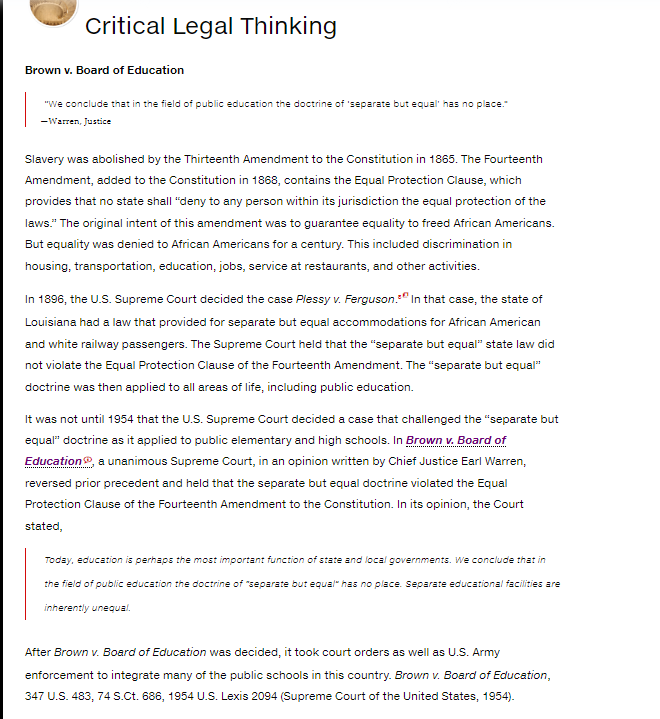
Critical Legal Thinking Brown v. Board of Education "We conclude that in the field of public education the doctrine of 'separate but equal' has no place." -Warren, Justice Slavery was abolished by the Thirteenth Amendment to the Constitution in 1865. The Fourteenth Amendment, added to the Constitution in 1868, contains the Equal Protection Clause, which provides that no state shall "deny to any person within its jurisdiction the equal protection of the laws." The original intent of this amendment was to guarantee equality to freed African Americans. But equality was denied to African Americans for a century. This included discrimination in housing, transportation, education, jobs, service at restaurants, and other activities. In 1896, the U.S. Supreme Court decided the case Plessy v. Ferguson. In that case, the state of Louisiana had a law that provided for separate but equal accommodations for African American and white railway passengers. The Supreme Court held that the "separate but equal" state law did not violate the Equal Protection Clause of the Fourteenth Amendment. The "separate but equal" doctrine was then applied to all areas of life, including public education. It was not until 1954 that the U.S. Supreme Court decided a case that challenged the "separate but equal" doctrine as it applied to public elementary and high schools. In Brown v. Board of Education, a unanimous Supreme Court, in an opinion written by Chief Justice Earl Warren, reversed prior precedent and held that the separate but equal doctrine violated the Equal Protection Clause of the Fourteenth Amendment to the Constitution. In its opinion, the Court stated, Today, education is perhaps the most important function of state and local governments. We conclude that in the field of public education the doctrine of "separate but equal" has no place. Separate educational facilities are inherently unequal. After Brown v. Board of Education was decided, it took court orders as well as U.S. Army enforcement to integrate many of the public schools in this country. Brown v. Board of Education, 347 U.S. 483, 74 S.Ct. 686, 1954 U.S. Lexis 2094 (Supreme Court of the United States, 1954)
Step by Step Solution
There are 3 Steps involved in it
1 Expert Approved Answer
Step: 1 Unlock

Question Has Been Solved by an Expert!
Get step-by-step solutions from verified subject matter experts
Step: 2 Unlock
Step: 3 Unlock