







Question: Please ASAP step by step In wireless communications, it is not uncommon to find that PR may change by many orders of magnitude over a
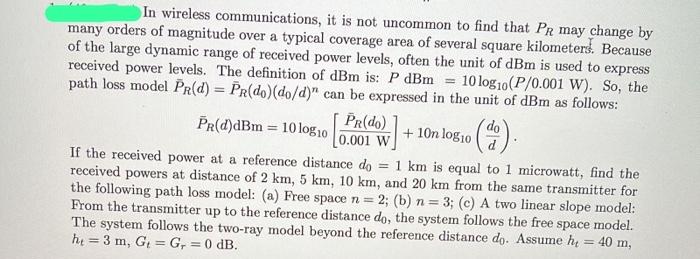

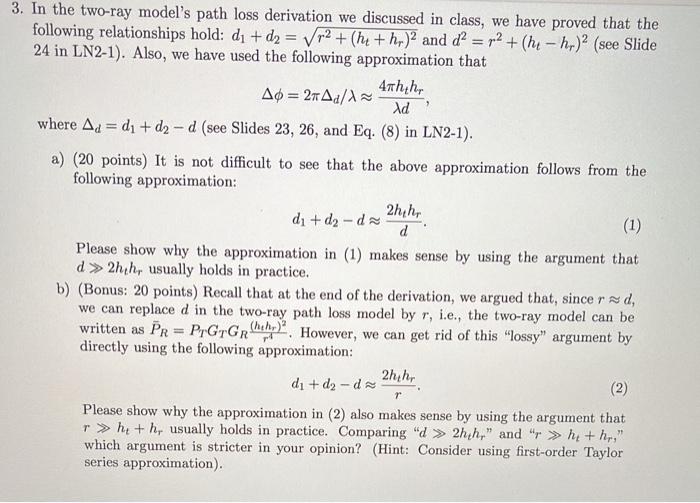
In wireless communications, it is not uncommon to find that PR may change by many orders of magnitude over a typical coverage area of several square kilometers. Because of the large dynamic range of received power levels, often the unit of dBm is used to express received power levels. The definition of dBm is: PdBm=10log10(P/0.001W). So, the path loss model PR(d)=PR(d0)(d0/d)n can be expressed in the unit of dBm as follows: PR(d)dBm=10log10[0.001WPR(d0)]+10nlog10(dd0). If the received power at a reference distance d0=1km is equal to 1microwatt, find the received powers at distance of 2km,5km,10km, and 20km from the same transmitter for the following path loss model: (a) Free space n=2; (b) n=3; (c) A two linear slope model: From the transmitter up to the reference distance d0, the system follows the free space model. The system follows the two-ray model beyond the reference distance d0. Assume ht=40m, ht=3m,Gt=Gr=0dB. 2. (40 points) Problem 2.4 part (b) in Schwartz, p58 (Note: "dB" here should be underste "dBm"). In the two-ray model's path loss derivation we discussed in class, we have proved that the following relationships hold: d1+d2=r2+(ht+hr)2 and d2=r2+(hthr)2 (see Slide 24 in LN2-1). Also, we have used the following approximation that =2d/d4hthr where d=d1+d2d (see Slides 23, 26, and Eq. (8) in LN2-1). a) (20 points) It is not difficult to see that the above approximation follows from the following approximation: d1+d2dd2hthr. Please show why the approximation in (1) makes sense by using the argument that d2hthr usually holds in practice. b) (Bonus: 20 points) Recall that at the end of the derivation, we argued that, since rd, we can replace d in the two-ray path loss model by r, i.e., the two-ray model can be written as PR=PTGTGRr4(hthr)2. However, we can get rid of this "lossy" argument by directly using the following approximation: d1+d2dr2hthr. Please show why the approximation in (2) also makes sense by using the argument that rht+hr usually holds in practice. Comparing " d2hthr " and "rht+hr," which argument is stricter in your opinion? (Hint: Consider using first-order Taylor series approximation)
Step by Step Solution
There are 3 Steps involved in it

Get step-by-step solutions from verified subject matter experts
 Study Help