







Question: Please ask this question. It is an example about the homework question. Exercise 1: Condorcet's Jury Theorem (30 points) A person has allegedly committed a
Please ask this question. It is an example about the homework question.
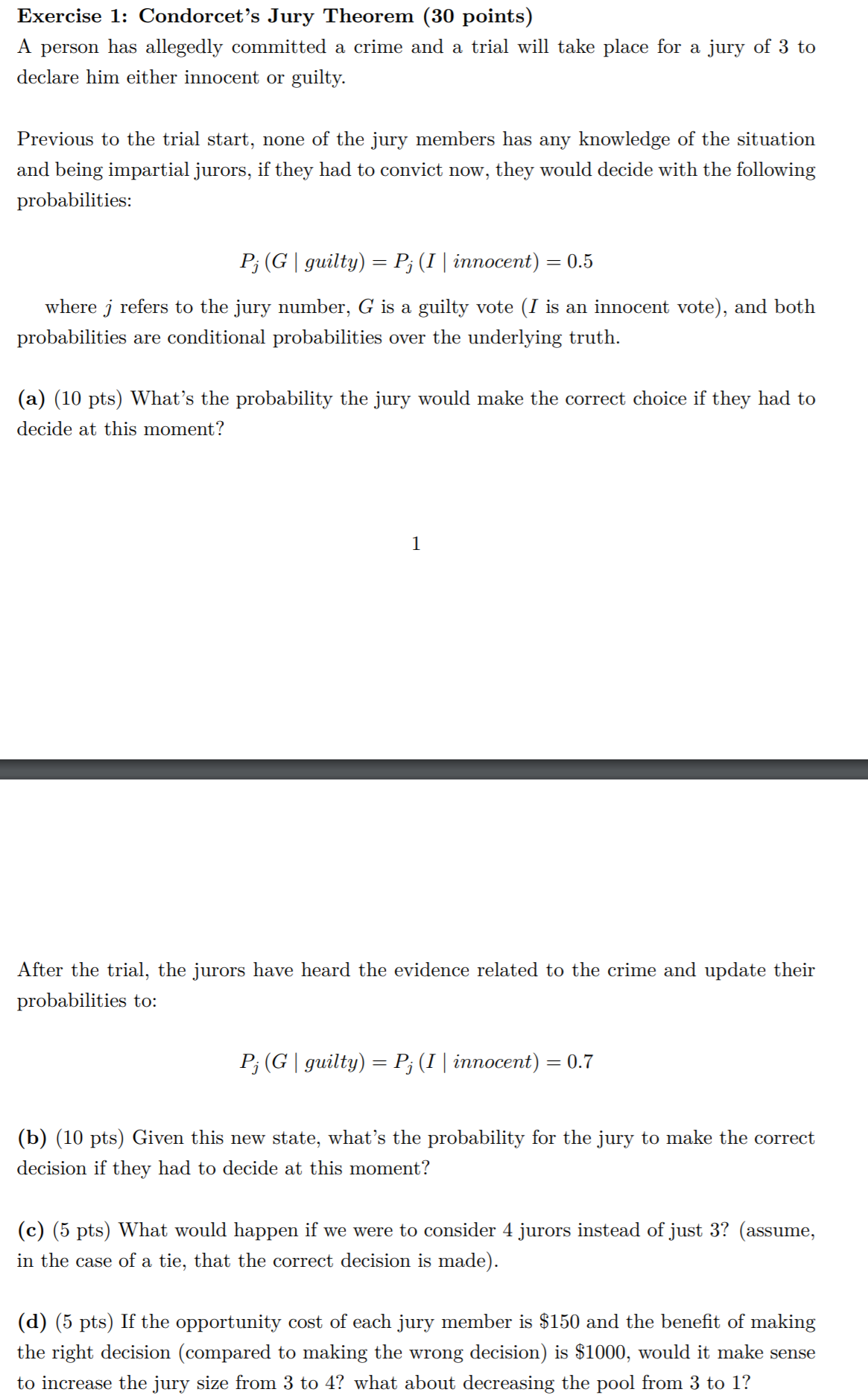
Exercise 1: Condorcet's Jury Theorem (30 points) A person has allegedly committed a crime and a trial will take place for a jury of 3 to declare him either innocent or guilty. Previous to the trial start, none of the jury members has any knowledge of the situation and being impartial jurors, if they had to convict now, they would decide with the following probabilities: P}- (G | guilty) 2 P},- (I | innocent) = 0.5 where 3' refers to the jury number, G is a guilty vote (I is an innocent vote), and both probabilities are conditional probabilities over the underlying truth. (a) (10 pts) What's the probability the jury would make the correct choice if they had to decide at this moment? After the trial, the jurors have heard the evidence related to the crime and update their probabilities to: P]- (G | guilty) 2 P} (I | innocent) = 0.7 (b) (10 pts) Given this new state, what '3 the probability for the jury to make the correct decision if they had to decide at this moment? ((3) (5 pts) What would happen if we were to consider 4 jurors instead of just 3? (assume, in the case of a tie, that the correct decision is made). ((1) (5 pts) If the opportunity cost of each jury member is $150 and the benet of making the right decision (compared to making the wrong decision) is $1000, would it make sense to increase the jury size from 3 to 4? what about decreasing the pool from 3 to 1
Step by Step Solution
There are 3 Steps involved in it

Get step-by-step solutions from verified subject matter experts
 Study Help