Question: Please assist. Clear formatting please so am able to easily understand. Thank you. Problem 1.6 The propagator of a particle is defined as K(x, X';1
Please assist.
Clear formatting please so am able to easily understand.
Thank you.
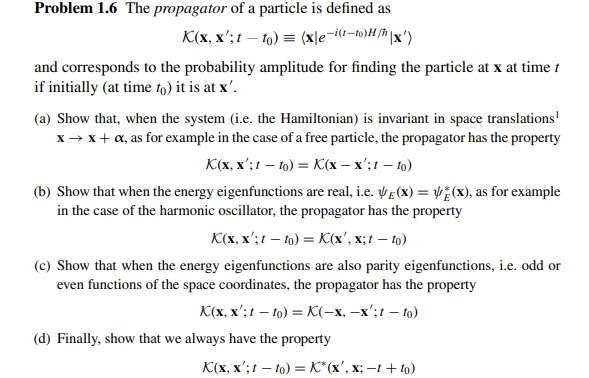
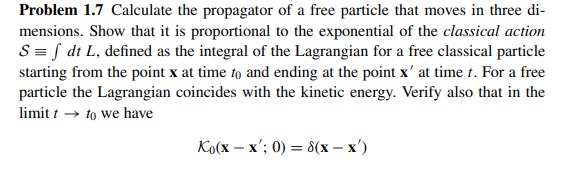
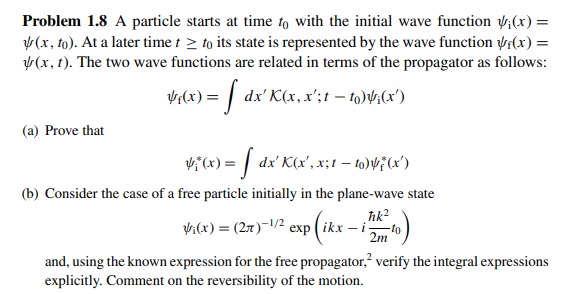
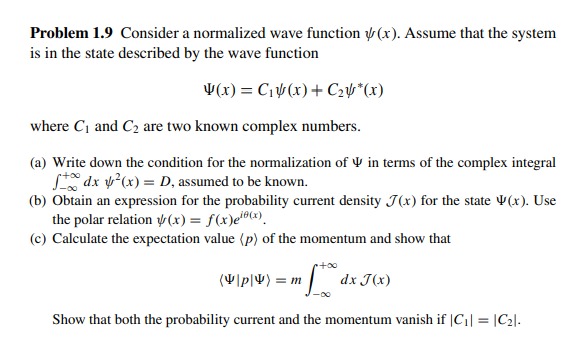
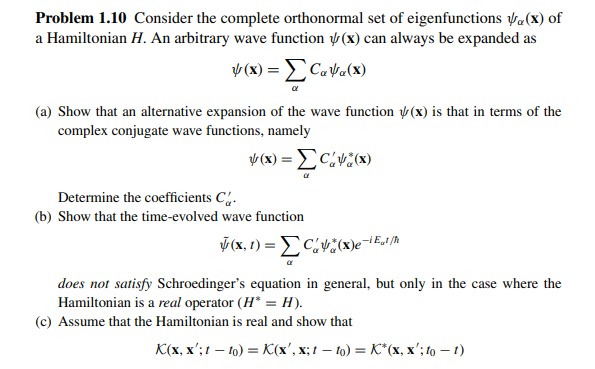
Problem 1.6 The propagator of a particle is defined as K(x, X';1 - to) = (xe-i(-1)H/x') and corresponds to the probability amplitude for finding the particle at x at time f if initially (at time to) it is at x'. (a) Show that, when the system (i.e. the Hamiltonian) is invariant in space translations x - X + ox, as for example in the case of a free particle, the propagator has the property K(x. X'; 1 - 10) = K(x - x';1 - to) (b) Show that when the energy eigenfunctions are real, i.e. v=(x) = v(x), as for example in the case of the harmonic oscillator, the propagator has the property K(X, X'; 1 - 10) = K(x . x; 1 - to) (c) Show that when the energy eigenfunctions are also parity eigenfunctions, i.e. odd or even functions of the space coordinates, the propagator has the property K(X, X';1 - 10) = K(-X, -X'; 1 - 10) (d) Finally, show that we always have the property K(x, X';1 - to) = K*(x', x; -1+ to)Problem 1.7 Calculate the propagator of a free particle that moves in three di- mensions. Show that it is proportional to the exponential of the classical action S= / dt L, defined as the integral of the Lagrangian for a free classical particle starting from the point x at time to and ending at the point x' at time f. For a free particle the Lagrangian coincides with the kinetic energy. Verify also that in the limit f - to we have Ko(x - X'; 0) = 8(x - X )Problem 1.8 A particle starts at time to with the initial wave function ;(x) = V (x, to). At a later time f > to its state is represented by the wave function vr(x) = V(x, 1). The two wave functions are related in terms of the propagator as follows: Vr (x ) = / dx' K(x, x;t - to );(x') (a) Prove that Vi(x)= dx' K(x', x;1 - to); (x' ) (b) Consider the case of a free particle initially in the plane-wave state hik2 Vi(x) = (2x)-1/2 exp (ikx - i 2m -to and, using the known expression for the free propagator, verify the integral expressions explicitly. Comment on the reversibility of the motion.Problem 1.9 Consider a normalized wave function aria]. Assume that the system is in the state described by the wave function WI) = CHE-{I} + (INTI) where C1 and C2 are two known complex numbers. {a} Write down the condition for the normalization of ID in terms of the complex integral If: it with} = D, assumed tohe known. {h} Obtain an expression for the probability current density 3(1) for the state this]. Use the polar relation so) = nears}. {c} Calculate the expectation 1saloe II: p} of the momentum and show that 1-2:] {also} = m f roam I'.'.I} Show that both the probability current and the momentum Isanish if |C 1| = |C1|. Problem 1.10 Consider the complete orthonormal set of eigenfunctions v. (x) of a Hamiltonian . An arbitrary wave function v (x) can always be expanded as V(x) = >Cava(x) (a) Show that an alternative expansion of the wave function w(x) is that in terms of the complex conjugate wave functions, namely V ( x) = [cav:(x) Determine the coefficients CA. (b) Show that the time-evolved wave function does not satisfy Schroedinger's equation in general, but only in the case where the Hamiltonian is a real operator (H* = H). (c) Assume that the Hamiltonian is real and show that K(X, X ; 1 - 10) = K(x', x; I - to) = K*(X, X'; to - 1)