







Question: Please Can somebody help me solving Part C Consider the relation R consisting of all pairs (x, y) such that x and y are bit
Please Can somebody help me solving Part C
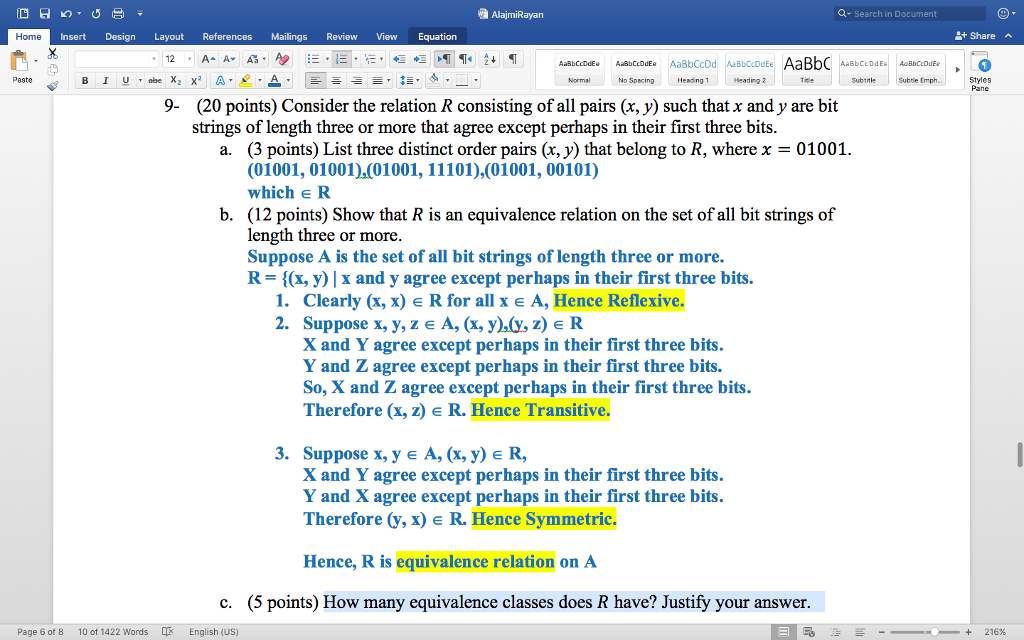
Consider the relation R consisting of all pairs (x, y) such that x and y are bit strings of length three or more that agree except perhaps in their first three bits. a. List three distinct order pairs (x, y) that belong to R, where x = 01001. (01001, 01001), (01001, 11101), (01001,00101) which elementof R b. Show that R is an equivalence relation on the set of all bit strings of length three or more. Suppose A is the set of all bit strings of length three or more. R = {(x, y)|x and y agree except perhaps in their first three bits. 1. Clearly (x, x) elementof R for all x elementof A, Hence Reflexive. 2. Suppose x, y, z elementof A, (x, y), (y, z) elementof R X and Y agree except perhaps in their first three bits. Y and Z agree except perhaps in their first three bits. So, X and Z agree except perhaps in their first three bits. Therefore (x, z) elementof R. Hence Transitive. 3. Suppose x, y elementof A, (x, y) elementof R, X and Y agree except perhaps in their first three bits. Y and X agree except perhaps in their first three bits. Therefore (y, x) elementof R. Hence Symmetric. Hence, R is equivalence relation on A c. How many equivalence classes does R have? Justify your answer. Consider the relation R consisting of all pairs (x, y) such that x and y are bit strings of length three or more that agree except perhaps in their first three bits. a. List three distinct order pairs (x, y) that belong to R, where x = 01001. (01001, 01001), (01001, 11101), (01001,00101) which elementof R b. Show that R is an equivalence relation on the set of all bit strings of length three or more. Suppose A is the set of all bit strings of length three or more. R = {(x, y)|x and y agree except perhaps in their first three bits. 1. Clearly (x, x) elementof R for all x elementof A, Hence Reflexive. 2. Suppose x, y, z elementof A, (x, y), (y, z) elementof R X and Y agree except perhaps in their first three bits. Y and Z agree except perhaps in their first three bits. So, X and Z agree except perhaps in their first three bits. Therefore (x, z) elementof R. Hence Transitive. 3. Suppose x, y elementof A, (x, y) elementof R, X and Y agree except perhaps in their first three bits. Y and X agree except perhaps in their first three bits. Therefore (y, x) elementof R. Hence Symmetric. Hence, R is equivalence relation on A c. How many equivalence classes does R have? Justify your
Step by Step Solution
There are 3 Steps involved in it

Get step-by-step solutions from verified subject matter experts
 Study Help