







Question: PLEASE CHECK IF I USED THE CORRECT RESEARCH DESIGN, SAMPLING TECHNIQUE, STATISTICAL TREATMENT THAT WILL MATCH IN MY RESEARCH TITLE AS WELL AS ITS STATEMENT
PLEASE CHECK IF I USED THE CORRECT RESEARCH DESIGN, SAMPLING TECHNIQUE, STATISTICAL TREATMENT THAT WILL MATCH IN MY RESEARCH TITLE AS WELL AS ITS STATEMENT OF THE PROBLEM.
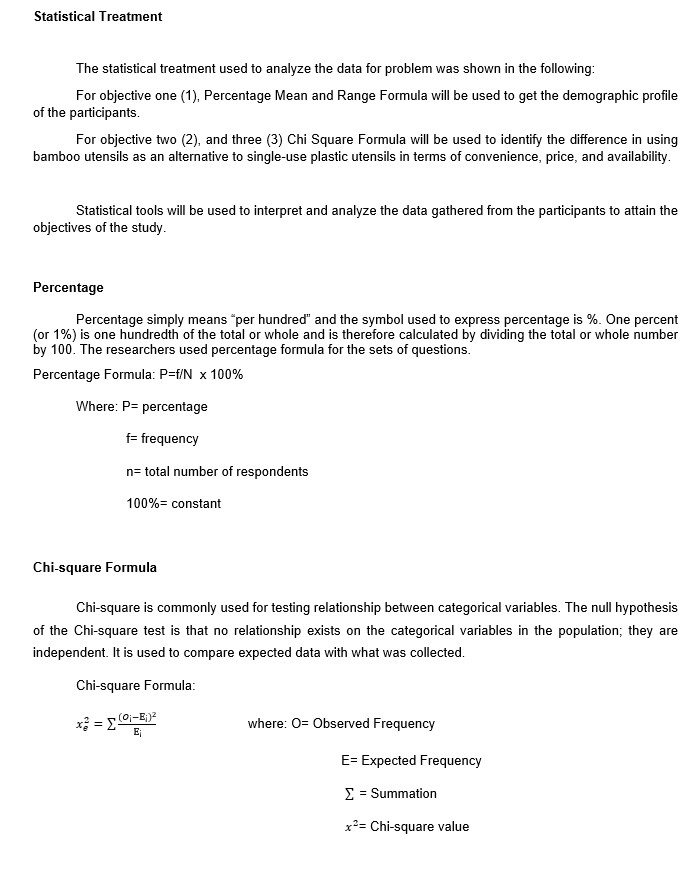
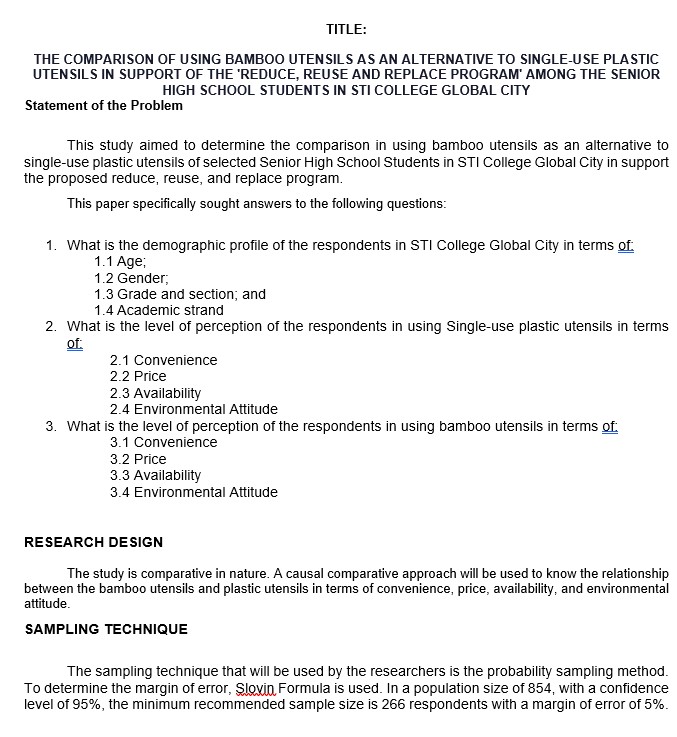
Statistical Treatment The statistical treatment used to analyze the data for problem was shown in the following: For objective one (1), Percentage Mean and Range Formula will be used to get the demographic profile of the participants. For objective two (2), and three (3) Chi Square Formula will be used to identify the difference in using bamboo utensils as an alternative to single-use plastic utensils in terms of convenience, price, and availability. Statistical tools will be used to interpret and analyze the data gathered from the participants to attain the objectives of the study. Percentage Percentage simply means "per hundred" and the symbol used to express percentage is %. One percent (or 1%) is one hundredth of the total or whole and is therefore calculated by dividing the total or whole number by 100. The researchers used percentage formula for the sets of questions. Percentage Formula: P=f/N x 100% Where: P= percentage f= frequency n= total number of respondents 100%= constant Chi-square Formula Chi-square is commonly used for testing relationship between categorical variables. The null hypothesis of the Chi-square test is that no relationship exists on the categorical variables in the population; they are independent. It is used to compare expected data with what was collected. Chi-square Formula: where: O= Observed Frequency E= Expected Frequency E = Summation x2= Chi-square valueTITLE: THE COMPARISON OF U SING BAMBOO UTEN SILS AS AN ALTERNATIVE TO SINGLEUSE PLASTIC UTENSILS IN SUPPORT OF THE 'REDUCE, REUSE AND REPLACE PROGRAM AMONG THE SENIOR HIGH SCHOOL STUDENTS IN STI COLLEGE GLOBAL CITY Statement of the Problem This study aimed to determine the comparison in using bamboo utensils as an alternative to singleuse plastic utensils of selected Senior High School Students in STi College Global City in support the proposed reduce. reuse, and replace program. This paper specically sought answers to the following questions: 1. What is the demographic prole ofthe respondents in STI College Global City in terms o_t; \"1.1 Age; 1.2 Gender; 1.3 Grade and section; and 1 .4 Academic strand 2. What is the level of perception of the respondents in using Singleuse plastic utensils in terms tit. 2.1 Convenience 2.2 Price 2.3 Availability 2.4 Environmental Attitude 3. What is the level of perception of the respondents in using bamboo utensils in tEI'IT'iS o_t 3.1 Convenience 3.2 Price 3.3 Availability 3.4 Environmental Attitude RE SEARCH DESIGN The study is comparative in nature. A causal comparative approach will be used to know the relationship between the bamboo utensis and plastic utensils in terms of convenience, price, availability, and environmental attitude. SAMPLING TECHNIQUE The sampling technique that will be used by the researchers is the probability sampling method. To determine the margin of error, Sigmmrmula is used. In a population size of 854, with a condence level of 95%, the minimum recommended sample size is 256 respondents with a margin of error of 5%
Step by Step Solution
There are 3 Steps involved in it

Get step-by-step solutions from verified subject matter experts
 Study Help