







Question: Please check whether my interpretation is correct. Check if any change is required to get it fixed. 0) Students who take more number of courses
Please check whether my interpretation is correct. Check if any change is required to get it fixed.
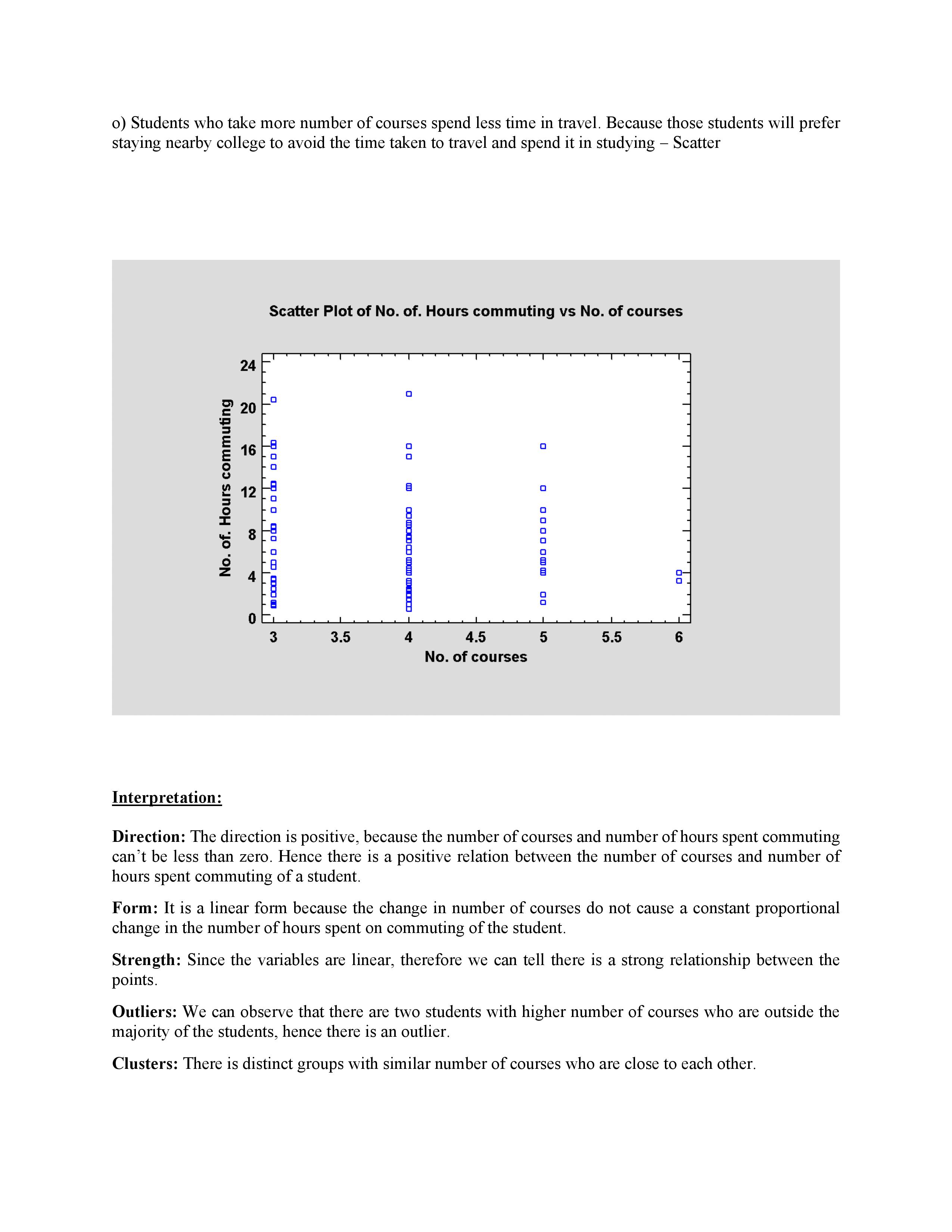
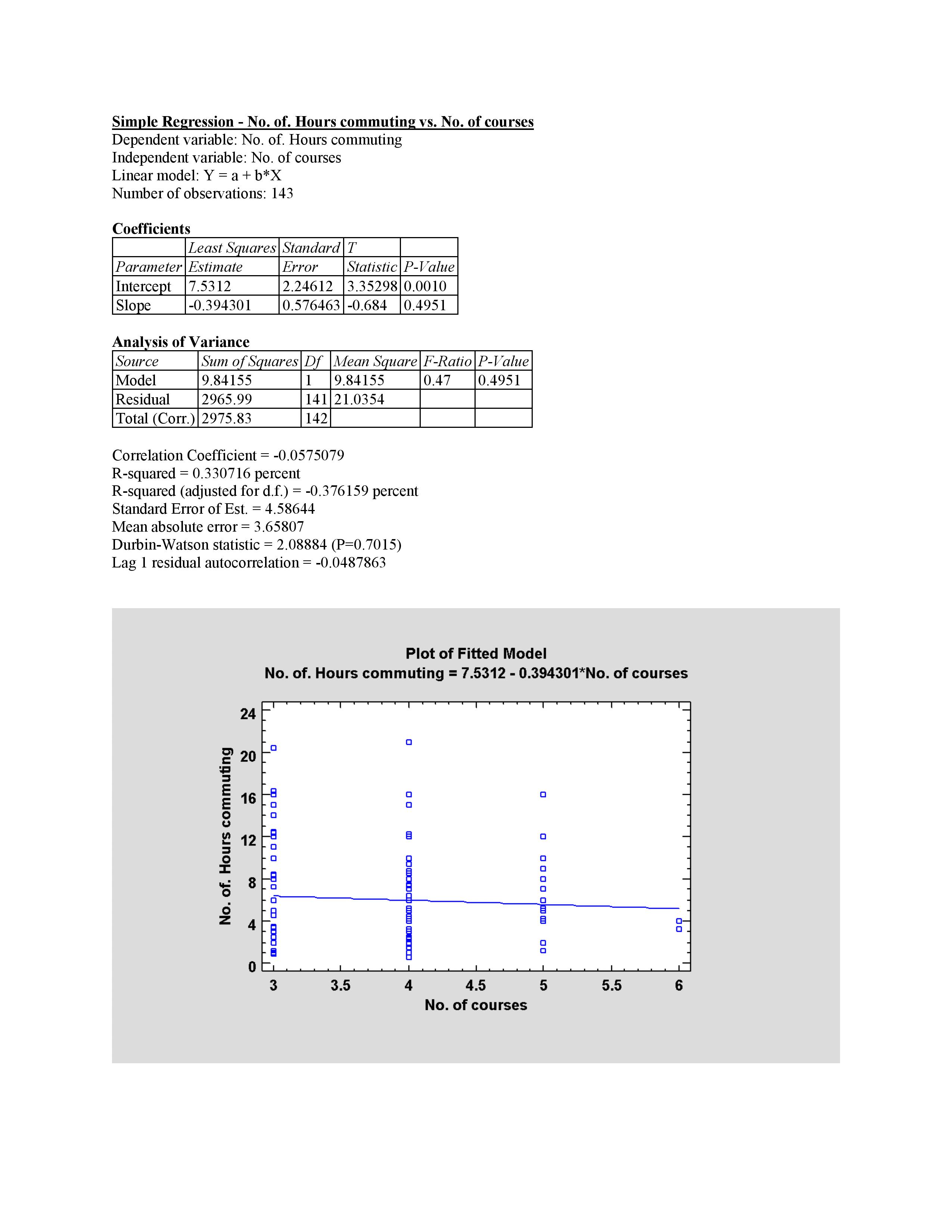
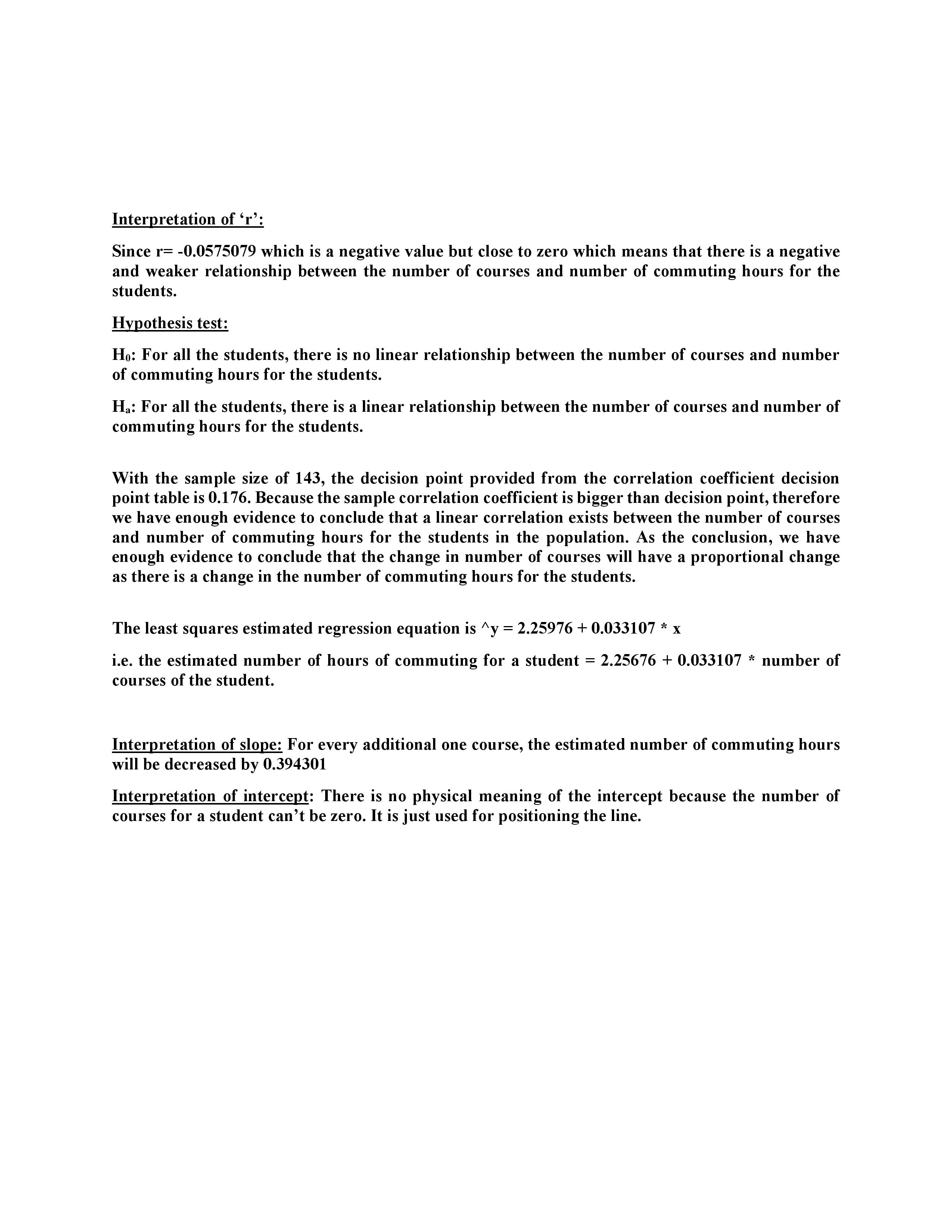
0) Students who take more number of courses spend less time in travel. Because those students will prefer staying nearby college to avoid the time taken to travel and spend it in studying Scatter Interp ret ation: Direction: The direction is positive, because the number of courses and number of hours spent commuting can't be less than zero. Hence there is a positive relation between the number of courses and number of hours spent commuting of a student. Form: It is a linear form because the change in number of courses do not cause a constant proportional change in the number of hours spent on commuting of the student. Strength: Since the variables are linear, therefore we can tell there is a strong relationship between the points. Outliers: We can observe that there are two students with higher number of courses who are outside the majority of the students, hence there is an outlier. Clusters: There is distinct groups with similar number of courses who are close to each other. Simple Regression - No. of. Hours commuting vs. No. of courses Dependent variable: No. of. Hours commuting Independent variable: No. of courses Linear model: Y = a + b*X Number of observations: 143 Coefficients Least Squares Standard T Parameter Estimate Error Statistic P-Value Intercept 7.5312 2.24612 3.35298 0.0010 Slope -0.394301 0.576463 -0.684 0.4951 Analysis of Variance Source Sum of Squares Df Mean Square F-Ratio P-Value Model 9.84155 1 9.84155 10.47 0.4951 Residual 2965.99 141 21.0354 Total (Corr.) 2975.83 142 Correlation Coefficient = -0.0575079 R-squared = 0.330716 percent R-squared (adjusted for d.f.) = -0.376159 percent Standard Error of Est. = 4.58644 Mean absolute error = 3.65807 Durbin-Watson statistic = 2.08884 (P=0.7015) Lag 1 residual autocorrelation = -0.0487863 Plot of Fitted Model No. of. Hours commuting = 7.5312 - 0.394301*No. of courses 24 No. of. Hours commuting 20 C 16 12 00 A 4 1.5 5 5.5 No. of coursesInterpretation of 'r': Since r= -0.0575079 which is a negative value but close to zero which means that there is a negative and weaker relationship between the number of courses and number of commuting hours for the students. Hypothesis test: Ho: For all the students, there is no linear relationship between the number of courses and number of commuting hours for the students. Ha: For all the students, there is a linear relationship between the number of courses and number of commuting hours for the students. With the sample size of 143, the decision point provided from the correlation coefficient decision point table is 0.176. Because the sample correlation coefficient is bigger than decision point, therefore we have enough evidence to conclude that a linear correlation exists between the number of courses and number of commuting hours for the students in the population. As the conclusion, we have enough evidence to conclude that the change in number of courses will have a proportional change as there is a change in the number of commuting hours for the students. The least squares estimated regression equation is Ay = 2.25976 + 0.033107 * x i.e. the estimated number of hours of commuting for a student = 2.25676 + 0.033107 * number of courses of the student. Interpretation of slope: For every additional one course, the estimated number of commuting hours will be decreased by 0.394301 Interpretation of intercept: There is no physical meaning of the intercept because the number of courses for a student can't be zero. It is just used for positioning the line
Step by Step Solution
There are 3 Steps involved in it

Get step-by-step solutions from verified subject matter experts
 Study Help