Question: Please check work and correct with work if anything is wrong. Friday Inc. has been presented a deal in which it can obtain immediate delivery||
Please check work and correct with work if anything is wrong.
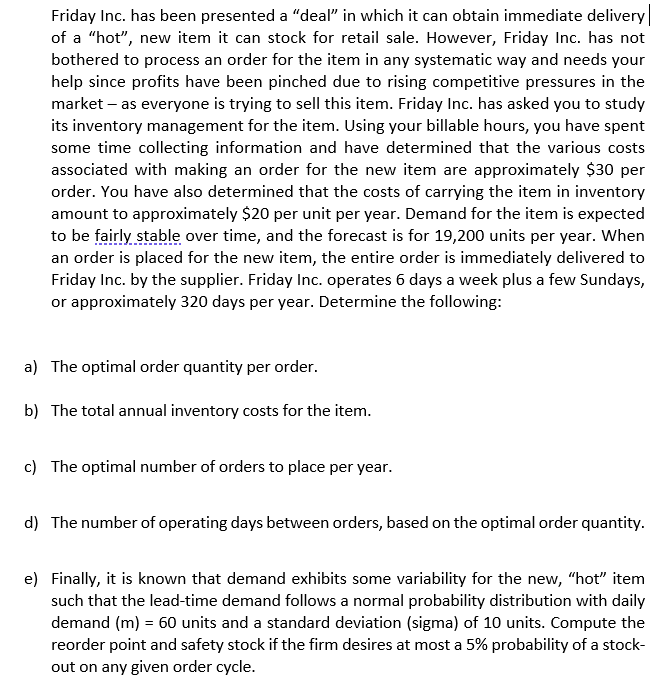
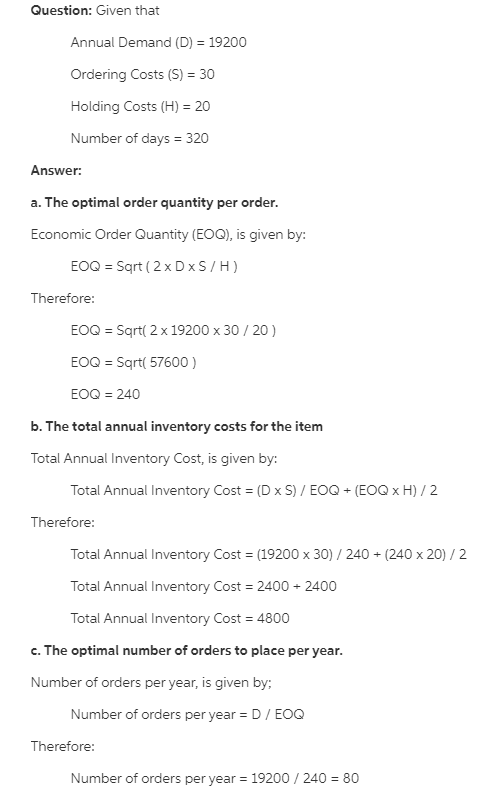
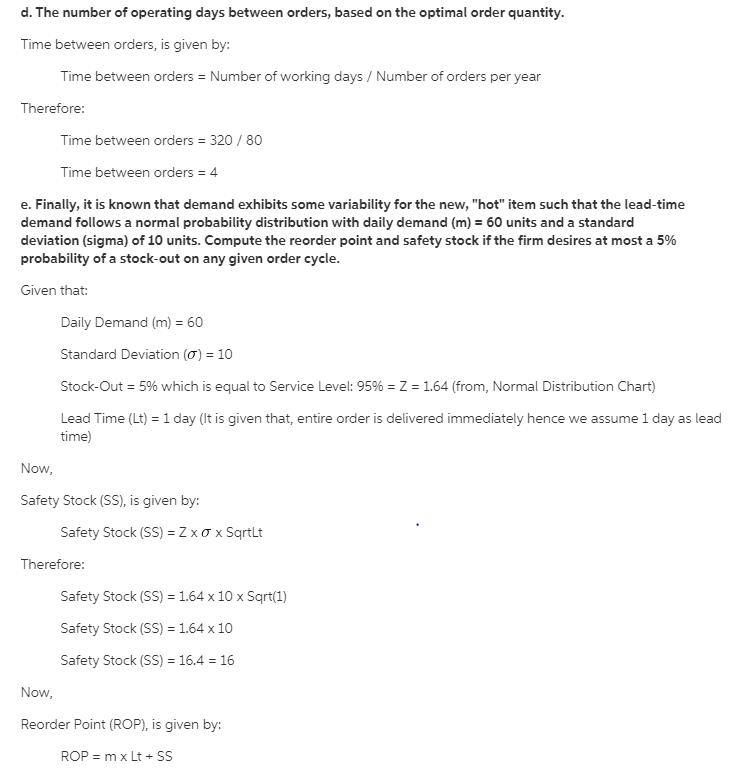
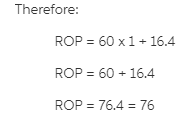
Friday Inc. has been presented a "deal" in which it can obtain immediate delivery|| of a "hot", new item it can stock for retail sale. However, Friday Inc. has not bothered to process an order for the item in any systematic way and needs your help since profits have been pinched due to rising competitive pressures in the market - as everyone is trying to sell this item. Friday Inc. has asked you to study its inventory management for the item. Using your billable hours, you have spent some time collecting information and have determined that the various costs associated with making an order for the new item are approximately $30 per order. You have also determined that the costs of carrying the item in inventory amount to approximately $20 per unit per year. Demand for the item is expected to be fairly stable over time, and the forecast is for 19,200 units per year. When an order is placed for the new item, the entire order is immediately delivered to Friday Inc. by the supplier. Friday Inc. operates 6 days a week plus a few Sundays, or approximately 320 days per year. Determine the following: a) The optimal order quantity per order. b) The total annual inventory costs for the item. c) The optimal number of orders to place per year. d) The number of operating days between orders, based on the optimal order quantity. e) Finally, it is known that demand exhibits some variability for the new, "hot" item such that the lead-time demand follows a normal probability distribution with daily demand (m) = 60 units and a standard deviation (sigma) of 10 units. Compute the reorder point and safety stock if the firm desires at most a 5% probability of a stock- out on any given order cycle. Question: Given that Annual Demand (D) = 19200 Ordering Costs (5) = 30 Holding Costs (H) = 20 Number of days = 320 Answer: a. The optimal order quantity per order. Economic Order Quantity (EOQ), is given by: EOQ = Sqrt (2 x D x S/H) Therefore: EOQ = Sqrt(2 x 19200 x 30 / 20 ) EOQ = Sqrt(57600) EOQ = 240 b. The total annual inventory costs for the item Total Annual Inventory Cost, is given by: Total Annual Inventory Cost = (D x S) / EOQ + (EOQ x H)/2 Therefore: Total Annual Inventory Cost = (19200 x 30) / 240 + (240 x 20)/2 Total Annual Inventory Cost = 2400 2400 Total Annual Inventory Cost = 4800 c. The optimal number of orders to place per year. Number of orders per year, is given by; Number of orders per year = D/EOQ Therefore: Number of orders per year = 19200/240 = 80 d. The number of operating days between orders, based on the optimal order quantity. Time between orders, is given by: Time between orders = Number of working days / Number of orders per year Therefore: Time between orders = 320 / 80 Time between orders = 4 e. Finally, it is known that demand exhibits some variability for the new, "hot" item such that the lead-time demand follows a normal probability distribution with daily demand (m) = 60 units and a standard deviation (sigma) of 10 units. Compute the reorder point and safety stock if the firm desires at most a 5% probability of a stock-out on any given order cycle. Given that: Daily Demand (m) = 60 Standard Deviation (0) = 10 Stock-Out = 5% which is equal to Service Level: 95% = Z = 1.64 (from, Normal Distribution Chart) Lead Time (Lt) = 1 day (It is given that, entire order is delivered immediately hence we assume 1 day as lead time) Now, Safety Stock (SS), is given by: Safety Stock (SS) = Z xo x SartLt Therefore: Safety Stock (SS) = 1.64 x 10 x Sart(1) Safety Stock (SS) = 1.64 x 10 Safety Stock (SS) = 16.4 = 16 Now, Reorder Point (ROP), is given by: ROP = mx Lt + SS Therefore: ROP = 60 x 1 +16.4 ROP = 60 + 16.4 ROP = 76.4 = 76









 Study Help