







Question: please comment on the attached article. 250 word minimum To Do Assignment Details Ethical lssues of Business Notes on Ghillyer, Ch. 3 - Organizational Ethics
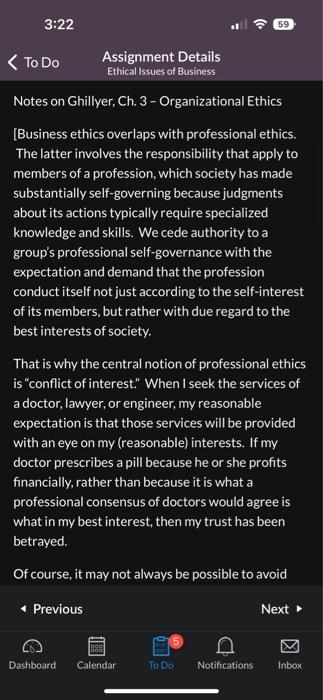
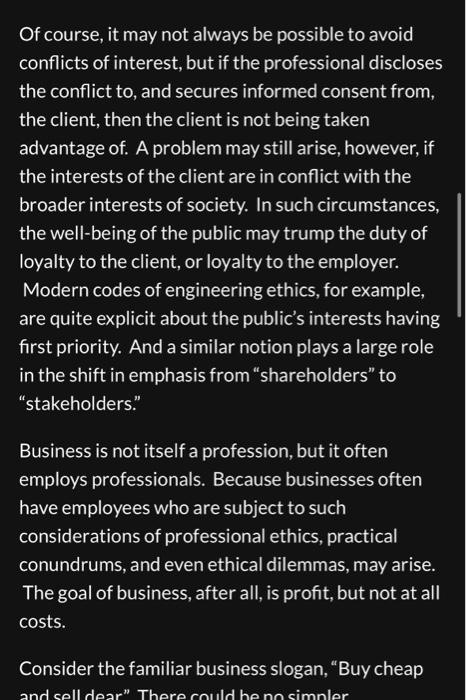
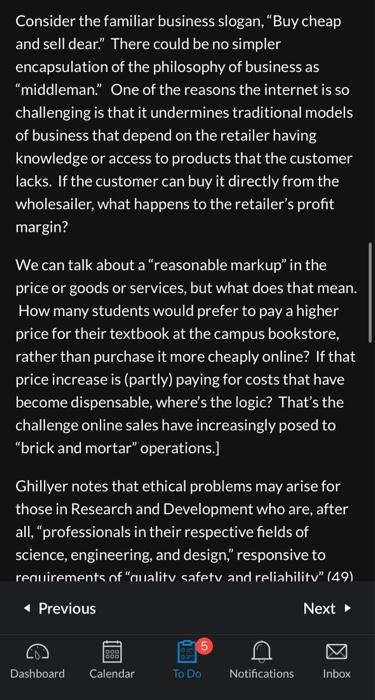
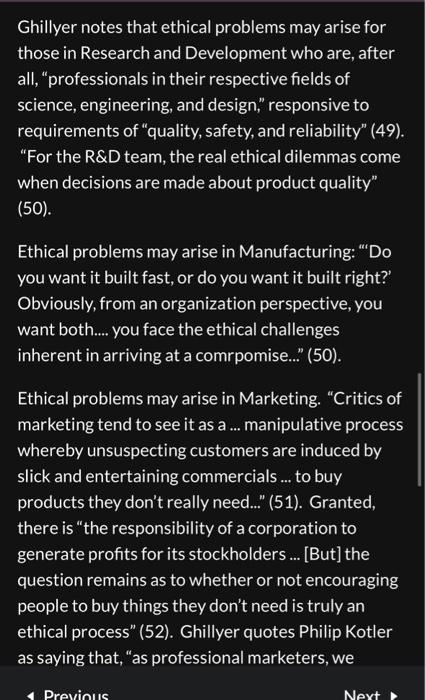
To Do Assignment Details Ethical lssues of Business Notes on Ghillyer, Ch. 3 - Organizational Ethics [Business ethics overlaps with professional ethics. The latter involves the responsibility that apply to members of a profession, which society has made substantially self-governing because judgments about its actions typically require specialized knowledge and skills. We cede authority to a group's professional self-governance with the expectation and demand that the profession conduct itself not just according to the self-interest of its members, but rather with due regard to the best interests of society. That is why the central notion of professional ethics is "conflict of interest." When I seek the services of a doctor, lawyer, or engineer, my reasonable expectation is that those services will be provided with an eye on my (reasonable) interests. If my doctor prescribes a pill because he or she profits financially, rather than because it is what a professional consensus of doctors would agree is what in my best interest, then my trust has been betrayed. Of course, it may not always be possible to avoid 4 Previous Next Of course, it may not always be possible to avoid conflicts of interest, but if the professional discloses the conflict to, and secures informed consent from, the client, then the client is not being taken advantage of. A problem may still arise, however, if the interests of the client are in conflict with the broader interests of society. In such circumstances, the well-being of the public may trump the duty of loyalty to the client, or loyalty to the employer. Modern codes of engineering ethics, for example, are quite explicit about the public's interests having first priority. And a similar notion plays a large role in the shift in emphasis from "shareholders" to "stakeholders." Business is not itself a profession, but it often employs professionals. Because businesses often have employees who are subject to such considerations of professional ethics, practical conundrums, and even ethical dilemmas, may arise. The goal of business, after all, is profit, but not at all costs. Consider the familiar business slogan, "Buy cheap Consider the familiar business slogan, "Buy cheap and sell dear." There could be no simpler encapsulation of the philosophy of business as "middleman." One of the reasons the internet is so challenging is that it undermines traditional models of business that depend on the retailer having knowledge or access to products that the customer lacks. If the customer can buy it directly from the wholesailer, what happens to the retailer's profit margin? We can talk about a "reasonable markup" in the price or goods or services, but what does that mean. How many students would prefer to pay a higher price for their textbook at the campus bookstore, rather than purchase it more cheaply online? If that price increase is (partly) paying for costs that have become dispensable, where's the logic? That's the challenge online sales have increasingly posed to "brick and mortar" operations.] Ghillyer notes that ethical problems may arise for those in Research and Development who are, after all, "professionals in their respective fields of science, engineering, and design," responsive to renuirements of "cualitv safetv and reliahilitv" (49) - Previous Next (1) Ghillyer notes that ethical problems may arise for those in Research and Development who are, after all, "professionals in their respective fields of science, engineering, and design," responsive to requirements of "quality, safety, and reliability" (49). "For the R\&D team, the real ethical dilemmas come when decisions are made about product quality" (50). Ethical problems may arise in Manufacturing: " Do you want it built fast, or do you want it built right?' Obviously, from an organization perspective, you want both.... you face the ethical challenges inherent in arriving at a comrpomise..." (50). Ethical problems may arise in Marketing. "Critics of marketing tend to see it as a ... manipulative process whereby unsuspecting customers are induced by slick and entertaining commercials ... to buy products they don't really need..." (51). Granted, there is "the responsibility of a corporation to generate profits for its stockholders ... [But] the question remains as to whether or not encouraging people to buy things they don't need is truly an ethical process" (52). Ghillyer quotes Philip Kotler as saying that, "as professional marketers, we generate profits for its stockholders ... [But] the question remains as to whether or not encouraging people to buy things they don't need is truly an ethical process" (52). Ghillyer quotes Philip Kotler as saying that, "as professional marketers, we should have the same ambivalence as nuclear scientists who help build nuclear bombs" (52). Ghillyer's discussion of ethics in Human Resources, the examples all actually involve actions that would actually be illegal (53-54). But his main concern is to emphasize that "HR should be at the center of any corporate code of ethics" (54). Ethical problems may arise, notoriously, in Finance, and not only because of the uncertain guidance provided by "generally accepted accounting principles" (GAAP). "The accounting/ auditing firm is paid by the corporation, but it really serves the general public, who are in search of an impartial and objective review" (57). Ghillyer discusses "conflicts of interest." For example, "what is best for your shareholders (increased profits) may not be best for your employees and the community." And you might be selling "a product that has the potential to be objective review" (57). Ghillyer discusses "conflicts of interest." For example, "what is best for your shareholders (increased profits) may not be best for your employees and the community." And you might be selling "a product that has the potential to be harmful to your customers ... [or] harmful to the environment" (58). To focus narrowly on the shareholders may merely provide an excuse for bad behavior: "... the obligation to deliver profits to owners or shareholders has created a convenient'get out of jail free' card, where all kinds of behavior can be justified in the name of meeting your obligations to your shareholders" (59). But this is usually counterproductive: "They fudged the numbers for one quarter and managed to get away with it, but all that did was raise investor expectations for the next quarter, and they found themselves on a train they couldn't get off" (59). Matt lies about training videos (47,60)
Step by Step Solution
There are 3 Steps involved in it

Get step-by-step solutions from verified subject matter experts
 Study Help