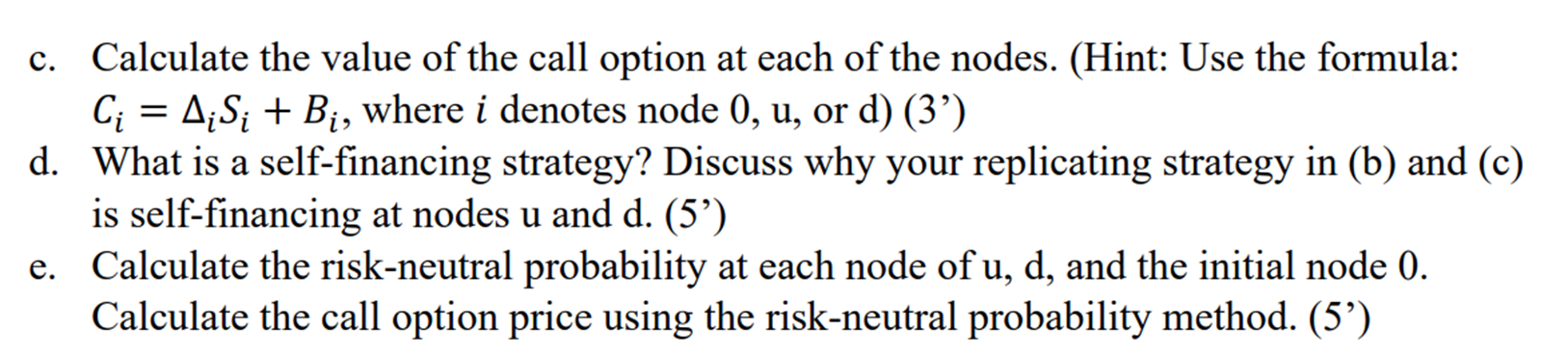
Question: Please complete c, d, and e. Thanks! Problem 2. (Binomial model, 23') Consider a European call option with a maturity of6 months and a strike

Please complete c, d, and e. Thanks!
Please complete c, d, and e. Thanks! Problem 2.Please complete c, d, and e. Thanks! Problem 2.
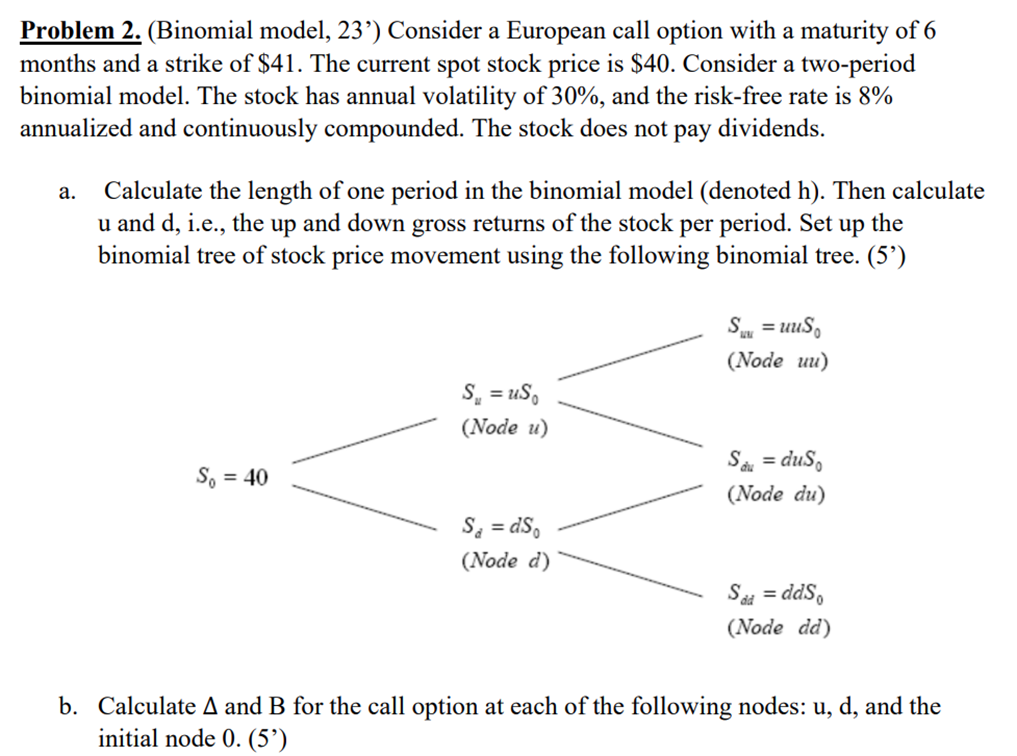
Problem 2. (Binomial model, 23') Consider a European call option with a maturity of6 months and a strike of $41. The current spot stock price is $40. Consider a two-period binomial model. The stock has annual volatility of 30%, and the risk-free rate is 8% annualized and continuously compounded. The stock does not pay dividends. a. Calculate the length of one period in the binomial model (denoted h). Then calculate u and d, i.e., the up and down gross returns of the stock per period. Set up the binomial tree of stock price movement using the following binomial tree. (5') - 3hh = HHS) // //// (Node I'm) 3'. = NS) H5- // "' (Node u) "EH-HR s 40 \"z/ 3a = ans. 0 _ HRH\" //" (Node (In) \"a s, = as. , /' (JVOde d) \"HEM\" \"*-_.___ (Node dd) b. Calculate A. and B for the call option at each of the following nodes: u, d, and the initial node 0. (5') Calculate the value of the call option at each of the nodes. (Hint: Use the formula: Cl- = AiSi + Bi, where i denotes node 0, u, or d) (3') . What is a selfnancing strategy? Discuss why your replicating strategy in (b) and (c) is self-nancing at nodes u and d. (5') Calculate the risk-neutral probability at each node of u, d, and the initial node 0. Calculate the call option price using the risk-neutral probability method. (5')

Step by Step Solution

There are 3 Steps involved in it

1 Expert Approved Answer
Step: 1 Unlock blur-text-image

Question Has Been Solved by an Expert!

Get step-by-step solutions from verified subject matter experts

Step: 2 Unlock
Step: 3 Unlock

Students Have Also Explored These Related Finance Questions!