Question: Please create an entity relationship diagram. Use the entity relationship diagram to identify the entities, relationships and attributes based on the information above in the
 Please create an entity relationship diagram. Use the entity relationship diagram to identify the entities, relationships and attributes based on the information above in the pictures.
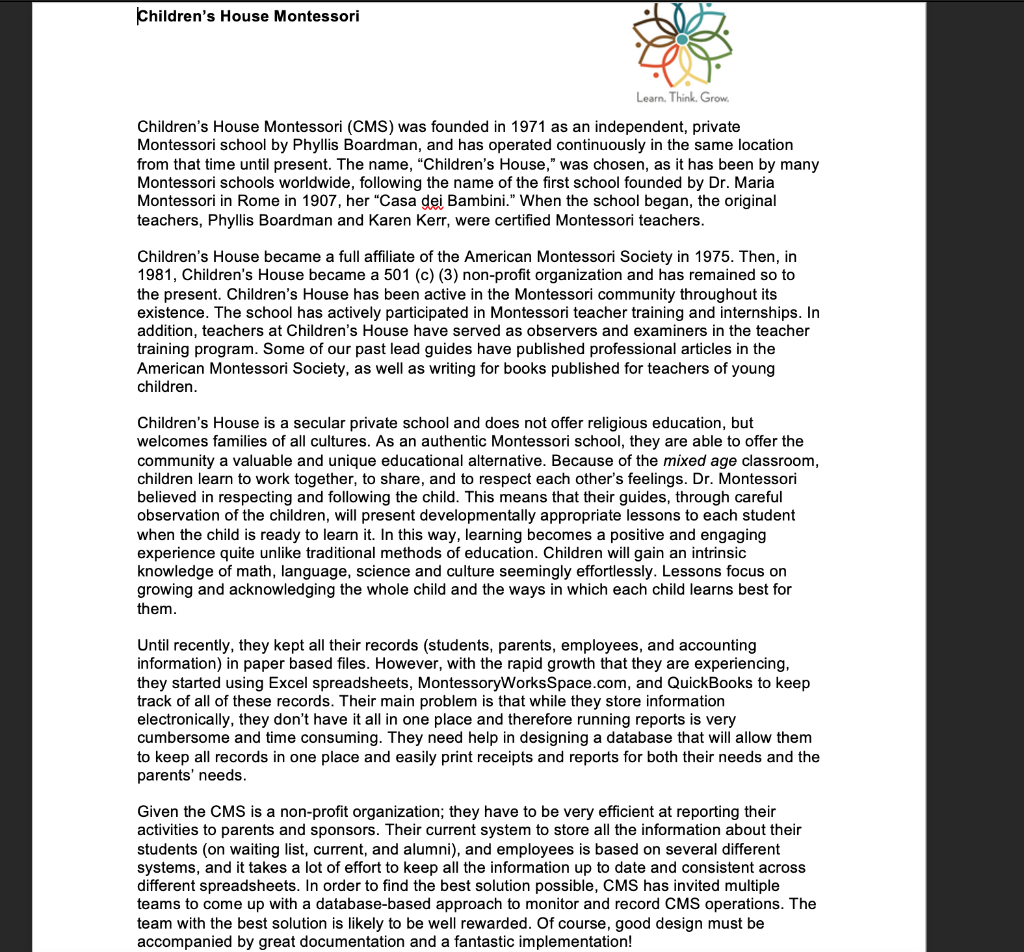
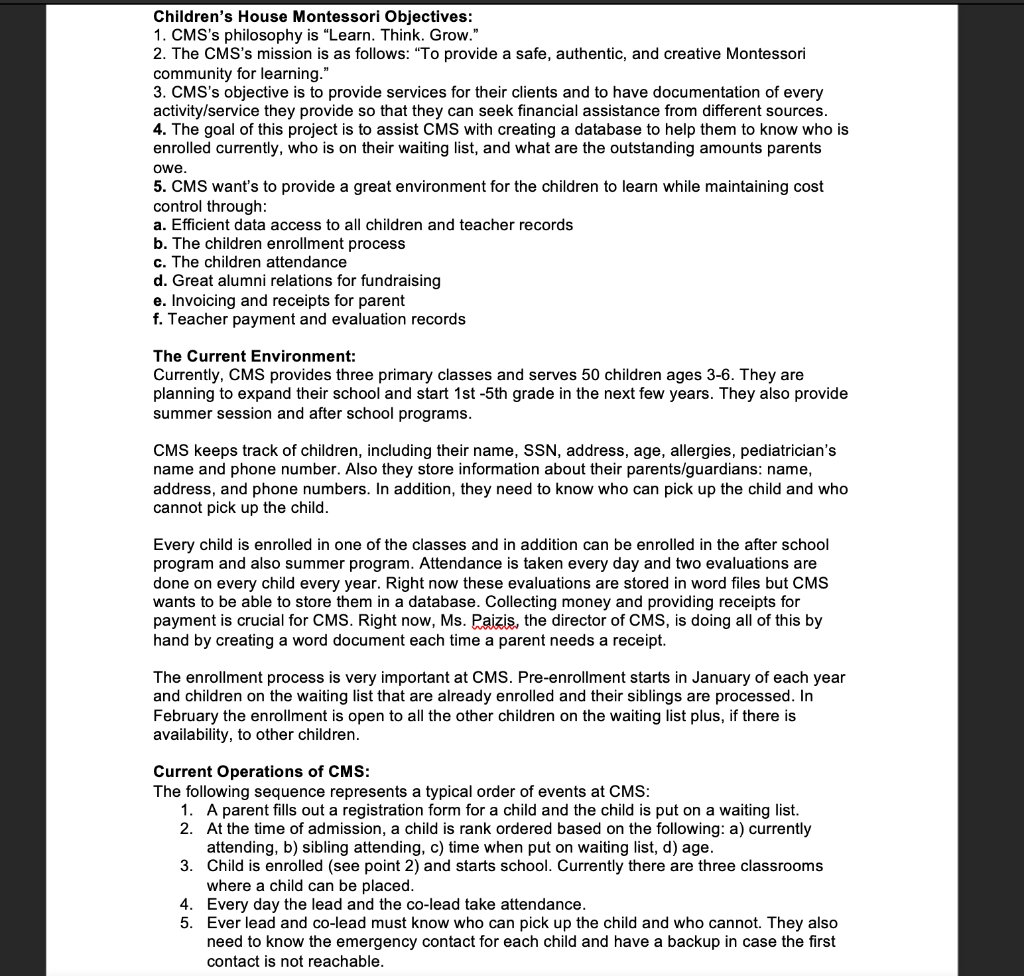
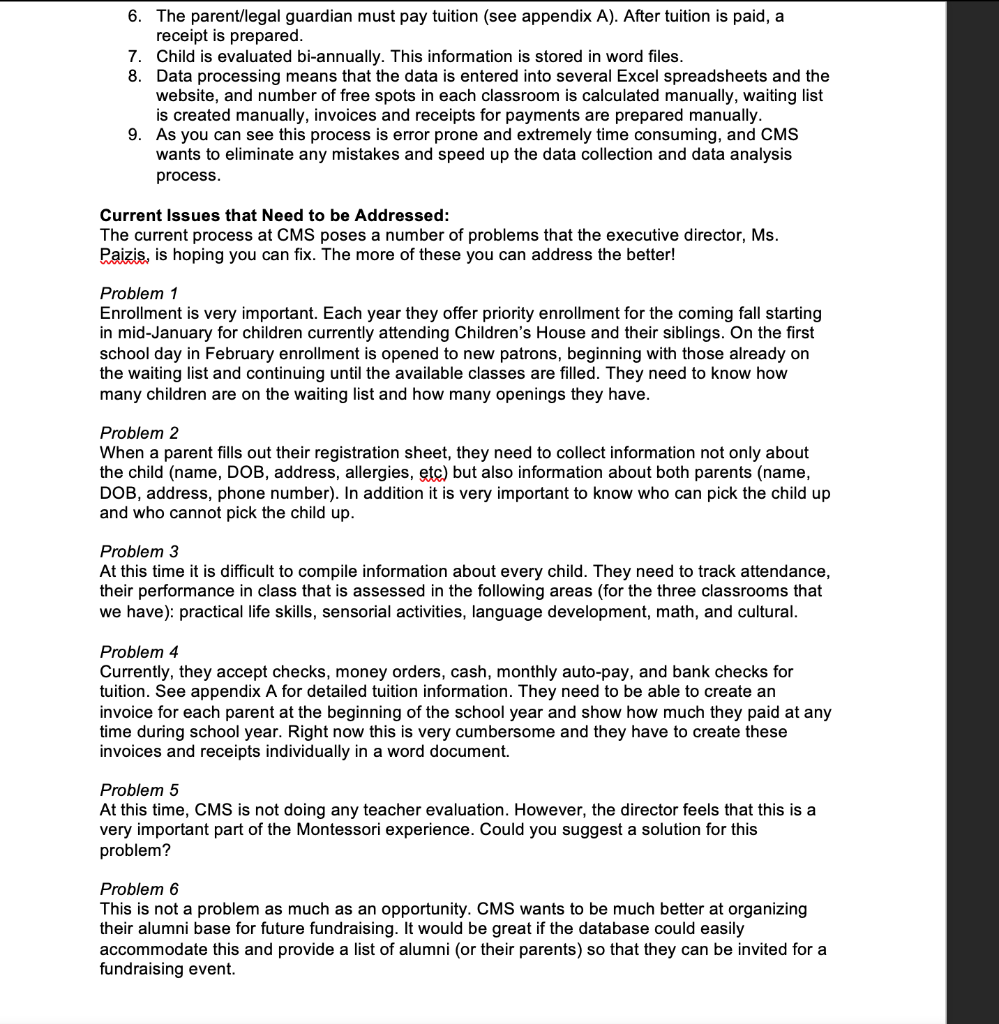
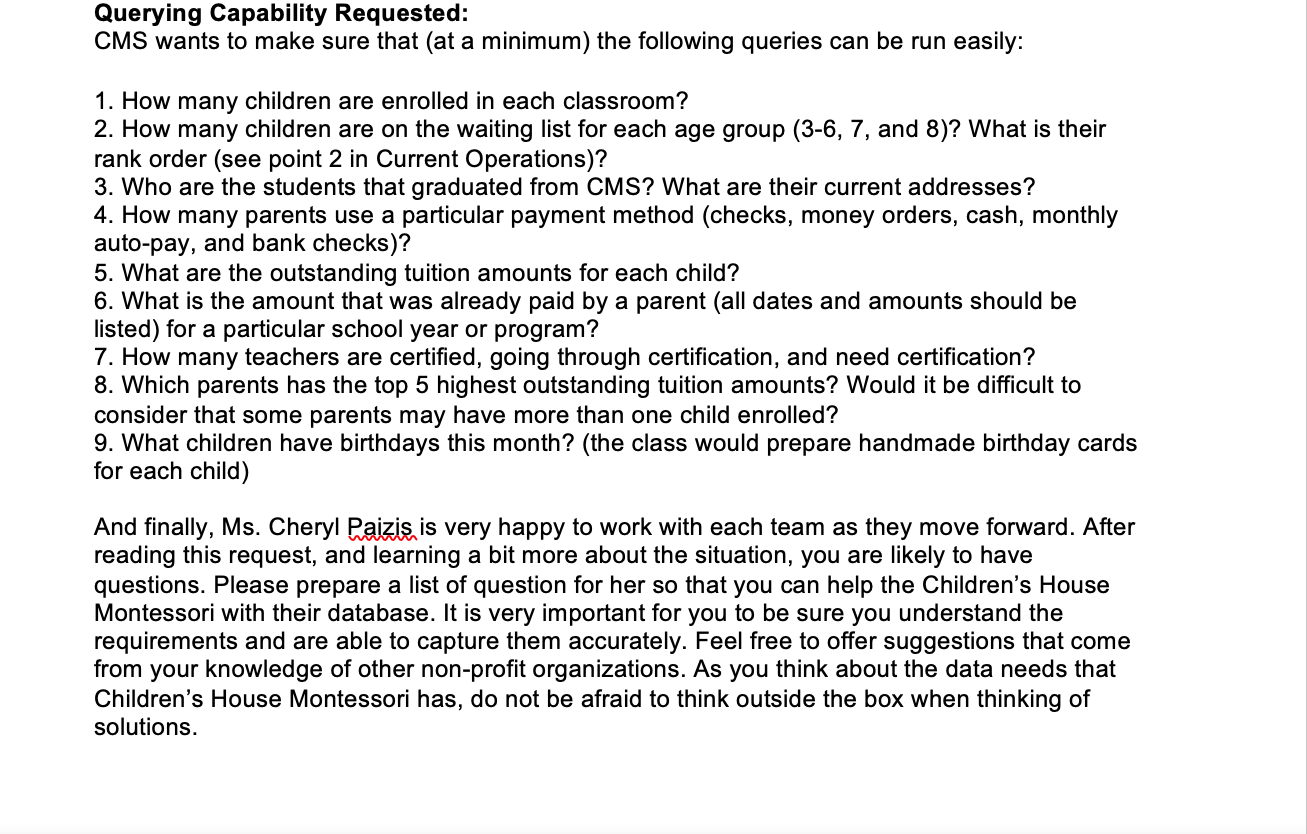
Children's House Montessori Learn. Think. Grow. Children's House Montessori (CMS) was founded in 1971 as an independent, private Montessori school by Phyllis Boardman, and has operated continuously in the same location from that time until present. The name, "Children's House," was chosen, as it has been by many Montessori schools worldwide, following the name of the first school founded by Dr. Maria Montessori in Rome in 1907, her "Casa dei Bambini." When the school began, the original teachers, Phyllis Boardman and Karen Kerr, were certified Montessori teachers. Children's House became a full affiliate of the American Montessori Society in 1975. Then, in 1981, Children's House became a 501 (c)(3) non-profit organization and has remained so to the present. Children's House has been active in the Montessori community throughout its existence. The school has actively participated in Montessori teacher training and internships. In addition, teachers at Children's House have served as observers and examiners in the teacher training program. Some of our past lead guides have published professional articles in the American Montessori Society, as well as writing for books published for teachers of young children. Children's House is a secular private school and does not offer religious education, but welcomes families of all cultures. As an authentic Montessori school, they are able to offer the community a valuable and unique educational alternative. Because of the mixed age classroom, children learn to work together, to share, and to respect each other's feelings. Dr. Montessori believed in respecting and following the child. This means that their guides, through careful observation of the children, will present developmentally appropriate lessons to each student when the child is ready to learn it. In this way, learning becomes a positive and engaging experience quite unlike traditional methods of education. Children will gain an intrinsic knowledge of math, language, science and culture seemingly effortlessly. Lessons focus on growing and acknowledging the whole child and the ways in which each child learns best for them. Until recently, they kept all their records (students, parents, employees, and accounting information) in paper based files. However, with the rapid growth that they are experiencing, they started using Excel spreadsheets, MontessoryWorks Space.com, and QuickBooks to keep track of all of these records. Their main problem is that while they store information electronically, they don't have it all in one place and therefore running reports is very cumbersome and time consuming. They need help in designing a database that will allow them to keep all records in one place and easily print receipts and reports for both their needs and the parents' needs. Given the CMS is a non-profit organization; they have to be very efficient at reporting their activities to parents and sponsors. Their current system to store all the information about their students (on waiting list, current, and alumni), and employees is based on several different systems, and it takes a lot of effort to keep all the information up to date and consistent across different spreadsheets. In order to find the best solution possible, CMS has invited multiple teams to come up with a database-based approach to monitor and record CMS operations. The team with the best solution is likely to be well rewarded. Of course, good design must be accompanied by great documentation and a fantastic implementation! Children's House Montessori Objectives: 1. CMS's philosophy is "Learn. Think. Grow." 2. The CMS's mission is as follows: "To provide a safe, authentic, and creative Montessori community for learning." 3. CMS's objective is to provide services for their clients and to have documentation of every activity/service they provide so that they can seek financial assistance from different sources. 4. The goal of this project is to assist CMS with creating a database to help them to know who is enrolled currently, who is on their waiting list, and what are the outstanding amounts parents owe. 5. CMS wants to provide a great environment for the children to learn while maintaining cost control through: a. Efficient data access to all children and teacher records b. The children enrollment process c. The children attendance d. Great alumni relations for fundraising e. Invoicing and receipts for parent f. Teacher payment and evaluation records The Current Environment: Currently, CMS provides three primary classes and serves 50 children ages 3-6. They are planning to expand their school and start 1st-5th grade in the next few years. They also provide summer session and after school programs. CMS keeps track of children, including their name, SSN, address, age, allergies, pediatrician's name and phone number. Also they store information about their parents/guardians: name, address, and phone numbers. In addition, they need to know who can pick up the child and who cannot pick up the child. Every child is enrolled in one of the classes and in addition can be enrolled in the after school program and also summer program. Attendance is taken every day and two evaluations are done on every child every year. Right now these evaluations are stored in word files but CMS wants to be able to store them in a database. Collecting money and providing receipts for payment is crucial for CMS. Right now, Ms. Paizis, the director of CMS, is doing all of this by hand by creating a word document each time a parent needs a receipt. The enrollment process is very important at CMS. Pre-enrollment starts in January of each year and children on the waiting list that are already enrolled and their siblings are processed. In February the enrollment is open to all the other children on the waiting list plus, if there is availability, to other children. Current Operations of CMS: The following sequence represents a typical order of events at CMS: 1. A parent fills out a registration form for a child and the child is put on a waiting list. 2. At the time of admission, a child is rank ordered based on the following: a) currently attending, b) sibling attending, c) time when put on waiting list, d) age. 3. Child is enrolled (see point 2) and starts school. Currently there are three classrooms where a child can be placed. 4. Every day the lead and the co-lead take attendance. 5. Ever lead and co-lead must know who can pick up the child and who cannot. They also need to know the emergency contact for each child and have a backup in case the first contact is not reachable. 6. The parent/legal guardian must pay tuition (see appendix A). After tuition is paid, a receipt is prepared. 7. Child is evaluated bi-annually. This information is stored in word files. 8. Data processing means that the data is entered into several Excel spreadsheets and the website, and number of free spots in each classroom is calculated manually, waiting list is created manually, invoices and receipts for payments are prepared manually. 9. As you can see this process is error prone and extremely time consuming, and CMS wants to eliminate any mistakes and speed up the data collection and data analysis process. Current Issues that Need to be Addressed: The current process at CMS poses a number of problems that the executive director, Ms. Paizis, is hoping you can fix. The more of these you can address the better! Problem 1 Enrollment is very important. Each year they offer priority enrollment for the coming fall starting in mid-January for children currently attending Children's House and their siblings. On the first school day in February enrollment is opened to new patrons, beginning with those already on the waiting list and continuing until the available classes are filled. They need to know how many children are on the waiting list and how many openings they have. Problem 2 When a parent fills out their registration sheet, they need to collect information not only about the child (name, DOB, address, allergies, etc) but also information about both parents (name, DOB, address, phone number). In addition it is very important to know who can pick the child up and who cannot pick the child up. Problem 3 At this time it is difficult to compile information about every child. They need to track attendance, their performance in class that is assessed in the following areas (for the three classrooms that we have): practical life skills, sensorial activities, language development, math, and cultural. Problem 4 Currently, they accept checks, money orders, cash, monthly auto-pay, and bank checks for tuition. See appendix A for detailed tuition information. They need to be able to create an invoice for each parent at the beginning of the school year and show how much they paid at any time during school year. Right now this is very cumbersome and they have to create these invoices and receipts individually in a word document. Problem 5 At this time, CMS is not doing any teacher evaluation. However, the director feels that this is a very important part of the Montessori experience. Could you suggest a solution for this problem? Problem 6 This is not a problem as much as an opportunity. CMS wants to be much better at organizing their alumni base for future fundraising. It would be great if the database could easily accommodate this and provide a list of alumni (or their parents) so that they can be invited for a fundraising event. Querying Capability Requested: CMS wants to make sure that (at a minimum) the following queries can be run easily: 1. How many children are enrolled in each classroom? 2. How many children are on the waiting list for each age group (3-6, 7, and 8)? What is their rank order (see point 2 in Current Operations)? 3. Who are the students that graduated from CMS? What are their current addresses? 4. How many parents use a particular payment method (checks, money orders, cash, monthly auto-pay, and bank checks)? 5. What are the outstanding tuition amounts for each child? 6. What is the amount that was already paid by a parent (all dates and amounts should be listed) for a particular school year or program? 7. How many teachers are certified, going through certification, and need certification? 8. Which parents has the top 5 highest outstanding tuition amounts? Would it be difficult to consider that some parents may have more than one child enrolled? 9. What children have birthdays this month? (the class would prepare handmade birthday cards for each child) And finally, Ms. Cheryl Laizis, is very happy to work with each team as they move forward. After reading this request, and learning a bit more about the situation, you are likely to have questions. Please prepare a list of question for her so that you can help the Children's House Montessori with their database. It is very important for you to be sure you understand the requirements and are able to capture them accurately. Feel free to offer suggestions that come from your knowledge of other non-profit organizations. As you think about the data needs that Children's House Montessori has, do not be afraid to think outside the box when thinking of solutions. Children's House Montessori Learn. Think. Grow. Children's House Montessori (CMS) was founded in 1971 as an independent, private Montessori school by Phyllis Boardman, and has operated continuously in the same location from that time until present. The name, "Children's House," was chosen, as it has been by many Montessori schools worldwide, following the name of the first school founded by Dr. Maria Montessori in Rome in 1907, her "Casa dei Bambini." When the school began, the original teachers, Phyllis Boardman and Karen Kerr, were certified Montessori teachers. Children's House became a full affiliate of the American Montessori Society in 1975. Then, in 1981, Children's House became a 501 (c)(3) non-profit organization and has remained so to the present. Children's House has been active in the Montessori community throughout its existence. The school has actively participated in Montessori teacher training and internships. In addition, teachers at Children's House have served as observers and examiners in the teacher training program. Some of our past lead guides have published professional articles in the American Montessori Society, as well as writing for books published for teachers of young children. Children's House is a secular private school and does not offer religious education, but welcomes families of all cultures. As an authentic Montessori school, they are able to offer the community a valuable and unique educational alternative. Because of the mixed age classroom, children learn to work together, to share, and to respect each other's feelings. Dr. Montessori believed in respecting and following the child. This means that their guides, through careful observation of the children, will present developmentally appropriate lessons to each student when the child is ready to learn it. In this way, learning becomes a positive and engaging experience quite unlike traditional methods of education. Children will gain an intrinsic knowledge of math, language, science and culture seemingly effortlessly. Lessons focus on growing and acknowledging the whole child and the ways in which each child learns best for them. Until recently, they kept all their records (students, parents, employees, and accounting information) in paper based files. However, with the rapid growth that they are experiencing, they started using Excel spreadsheets, MontessoryWorks Space.com, and QuickBooks to keep track of all of these records. Their main problem is that while they store information electronically, they don't have it all in one place and therefore running reports is very cumbersome and time consuming. They need help in designing a database that will allow them to keep all records in one place and easily print receipts and reports for both their needs and the parents' needs. Given the CMS is a non-profit organization; they have to be very efficient at reporting their activities to parents and sponsors. Their current system to store all the information about their students (on waiting list, current, and alumni), and employees is based on several different systems, and it takes a lot of effort to keep all the information up to date and consistent across different spreadsheets. In order to find the best solution possible, CMS has invited multiple teams to come up with a database-based approach to monitor and record CMS operations. The team with the best solution is likely to be well rewarded. Of course, good design must be accompanied by great documentation and a fantastic implementation! Children's House Montessori Objectives: 1. CMS's philosophy is "Learn. Think. Grow." 2. The CMS's mission is as follows: "To provide a safe, authentic, and creative Montessori community for learning." 3. CMS's objective is to provide services for their clients and to have documentation of every activity/service they provide so that they can seek financial assistance from different sources. 4. The goal of this project is to assist CMS with creating a database to help them to know who is enrolled currently, who is on their waiting list, and what are the outstanding amounts parents owe. 5. CMS wants to provide a great environment for the children to learn while maintaining cost control through: a. Efficient data access to all children and teacher records b. The children enrollment process c. The children attendance d. Great alumni relations for fundraising e. Invoicing and receipts for parent f. Teacher payment and evaluation records The Current Environment: Currently, CMS provides three primary classes and serves 50 children ages 3-6. They are planning to expand their school and start 1st-5th grade in the next few years. They also provide summer session and after school programs. CMS keeps track of children, including their name, SSN, address, age, allergies, pediatrician's name and phone number. Also they store information about their parents/guardians: name, address, and phone numbers. In addition, they need to know who can pick up the child and who cannot pick up the child. Every child is enrolled in one of the classes and in addition can be enrolled in the after school program and also summer program. Attendance is taken every day and two evaluations are done on every child every year. Right now these evaluations are stored in word files but CMS wants to be able to store them in a database. Collecting money and providing receipts for payment is crucial for CMS. Right now, Ms. Paizis, the director of CMS, is doing all of this by hand by creating a word document each time a parent needs a receipt. The enrollment process is very important at CMS. Pre-enrollment starts in January of each year and children on the waiting list that are already enrolled and their siblings are processed. In February the enrollment is open to all the other children on the waiting list plus, if there is availability, to other children. Current Operations of CMS: The following sequence represents a typical order of events at CMS: 1. A parent fills out a registration form for a child and the child is put on a waiting list. 2. At the time of admission, a child is rank ordered based on the following: a) currently attending, b) sibling attending, c) time when put on waiting list, d) age. 3. Child is enrolled (see point 2) and starts school. Currently there are three classrooms where a child can be placed. 4. Every day the lead and the co-lead take attendance. 5. Ever lead and co-lead must know who can pick up the child and who cannot. They also need to know the emergency contact for each child and have a backup in case the first contact is not reachable. 6. The parent/legal guardian must pay tuition (see appendix A). After tuition is paid, a receipt is prepared. 7. Child is evaluated bi-annually. This information is stored in word files. 8. Data processing means that the data is entered into several Excel spreadsheets and the website, and number of free spots in each classroom is calculated manually, waiting list is created manually, invoices and receipts for payments are prepared manually. 9. As you can see this process is error prone and extremely time consuming, and CMS wants to eliminate any mistakes and speed up the data collection and data analysis process. Current Issues that Need to be Addressed: The current process at CMS poses a number of problems that the executive director, Ms. Paizis, is hoping you can fix. The more of these you can address the better! Problem 1 Enrollment is very important. Each year they offer priority enrollment for the coming fall starting in mid-January for children currently attending Children's House and their siblings. On the first school day in February enrollment is opened to new patrons, beginning with those already on the waiting list and continuing until the available classes are filled. They need to know how many children are on the waiting list and how many openings they have. Problem 2 When a parent fills out their registration sheet, they need to collect information not only about the child (name, DOB, address, allergies, etc) but also information about both parents (name, DOB, address, phone number). In addition it is very important to know who can pick the child up and who cannot pick the child up. Problem 3 At this time it is difficult to compile information about every child. They need to track attendance, their performance in class that is assessed in the following areas (for the three classrooms that we have): practical life skills, sensorial activities, language development, math, and cultural. Problem 4 Currently, they accept checks, money orders, cash, monthly auto-pay, and bank checks for tuition. See appendix A for detailed tuition information. They need to be able to create an invoice for each parent at the beginning of the school year and show how much they paid at any time during school year. Right now this is very cumbersome and they have to create these invoices and receipts individually in a word document. Problem 5 At this time, CMS is not doing any teacher evaluation. However, the director feels that this is a very important part of the Montessori experience. Could you suggest a solution for this problem? Problem 6 This is not a problem as much as an opportunity. CMS wants to be much better at organizing their alumni base for future fundraising. It would be great if the database could easily accommodate this and provide a list of alumni (or their parents) so that they can be invited for a fundraising event. Querying Capability Requested: CMS wants to make sure that (at a minimum) the following queries can be run easily: 1. How many children are enrolled in each classroom? 2. How many children are on the waiting list for each age group (3-6, 7, and 8)? What is their rank order (see point 2 in Current Operations)? 3. Who are the students that graduated from CMS? What are their current addresses? 4. How many parents use a particular payment method (checks, money orders, cash, monthly auto-pay, and bank checks)? 5. What are the outstanding tuition amounts for each child? 6. What is the amount that was already paid by a parent (all dates and amounts should be listed) for a particular school year or program? 7. How many teachers are certified, going through certification, and need certification? 8. Which parents has the top 5 highest outstanding tuition amounts? Would it be difficult to consider that some parents may have more than one child enrolled? 9. What children have birthdays this month? (the class would prepare handmade birthday cards for each child) And finally, Ms. Cheryl Laizis, is very happy to work with each team as they move forward. After reading this request, and learning a bit more about the situation, you are likely to have questions. Please prepare a list of question for her so that you can help the Children's House Montessori with their database. It is very important for you to be sure you understand the requirements and are able to capture them accurately. Feel free to offer suggestions that come from your knowledge of other non-profit organizations. As you think about the data needs that Children's House Montessori has, do not be afraid to think outside the box when thinking of solutions









 Study Help