







Question: Please create the data table shell requested in step 8 keeping appropriate fields blank as this is pre-lab. You may need to use the other
Please create the data table shell requested in step 8 keeping appropriate fields blank as this is pre-lab. You may need to use the other information in Part 2, but I only need help with designing the table.
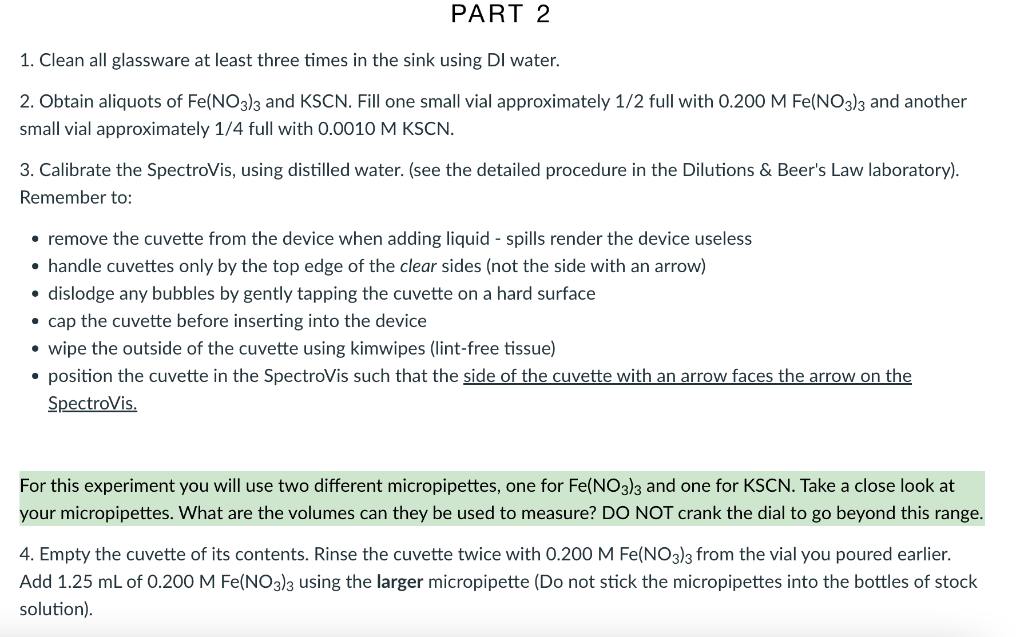
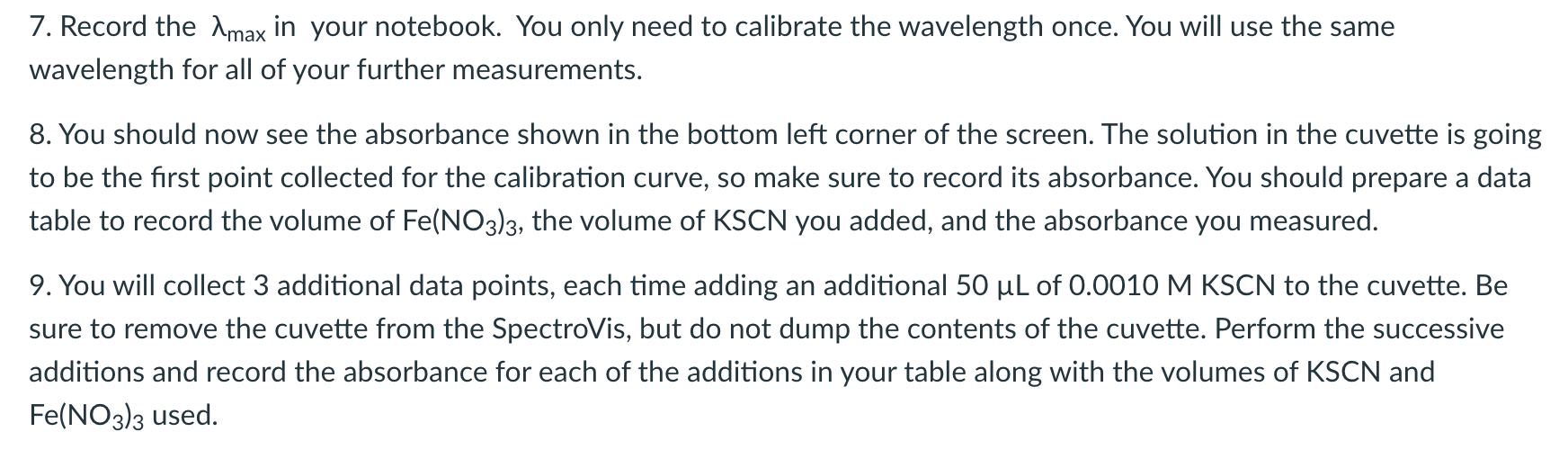
1. Clean all glassware at least three times in the sink using DI water. 2. Obtain aliquots of Fe(NO3)3 and KSCN. Fill one small vial approximately 1/2 full with 0.200MFe(NO3)3 and another small vial approximately 1/4 full with 0.0010MKSCN. 3. Calibrate the SpectroVis, using distilled water. (see the detailed procedure in the Dilutions \& Beer's Law laboratory). Remember to: - remove the cuvette from the device when adding liquid - spills render the device useless - handle cuvettes only by the top edge of the clear sides (not the side with an arrow) - dislodge any bubbles by gently tapping the cuvette on a hard surface - cap the cuvette before inserting into the device - wipe the outside of the cuvette using kimwipes (lint-free tissue) - position the cuvette in the SpectroVis such that the side of the cuvette with an arrow faces the arrow on the SpectroVis. For this experiment you will use two different micropipettes, one for Fe(NO3)3 and one for KSCNN. Take a close look at your micropipettes. What are the volumes can they be used to measure? DO NOT crank the dial to go beyond this range. 4. Empty the cuvette of its contents. Rinse the cuvette twice with 0.200MFe(NO3)3 from the vial you poured earlier. Add 1.25mL of 0.200MFe(NO3)3 using the larger micropipette (Do not stick the micropipettes into the bottles of stock solution). 7. Record the max in your notebook. You only need to calibrate the wavelength once. You will use the same wavelength for all of your further measurements. 8. You should now see the absorbance shown in the bottom left corner of the screen. The solution in the cuvette is going to be the first point collected for the calibration curve, so make sure to record its absorbance. You should prepare a data table to record the volume of Fe(NO3)3, the volume of KSCN you added, and the absorbance you measured. 9. You will collect 3 additional data points, each time adding an additional 50L of 0.0010MKSCN to the cuvette. Be sure to remove the cuvette from the SpectroVis, but do not dump the contents of the cuvette. Perform the successive additions and record the absorbance for each of the additions in your table along with the volumes of KSCN and Fe(NO3)3 used
Step by Step Solution
There are 3 Steps involved in it

Get step-by-step solutions from verified subject matter experts
 Study Help