Question: Please develop a complete Project Charter with key metrics within the problem statement. State if this is a Lean-oriented problem or a Six-Sigma oriented problem,
Please develop a complete Project Charter with key metrics within the problem statement. State if this is a Lean-oriented problem or a Six-Sigma oriented problem, appropriately. One page. 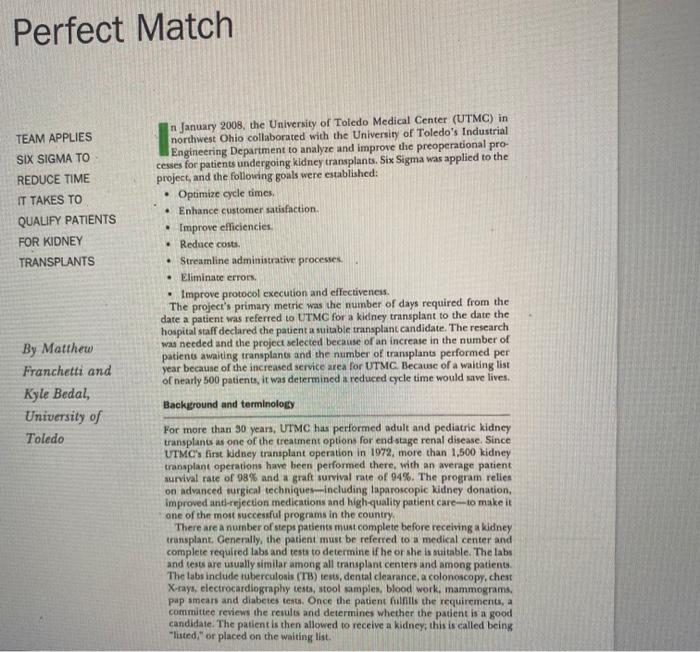
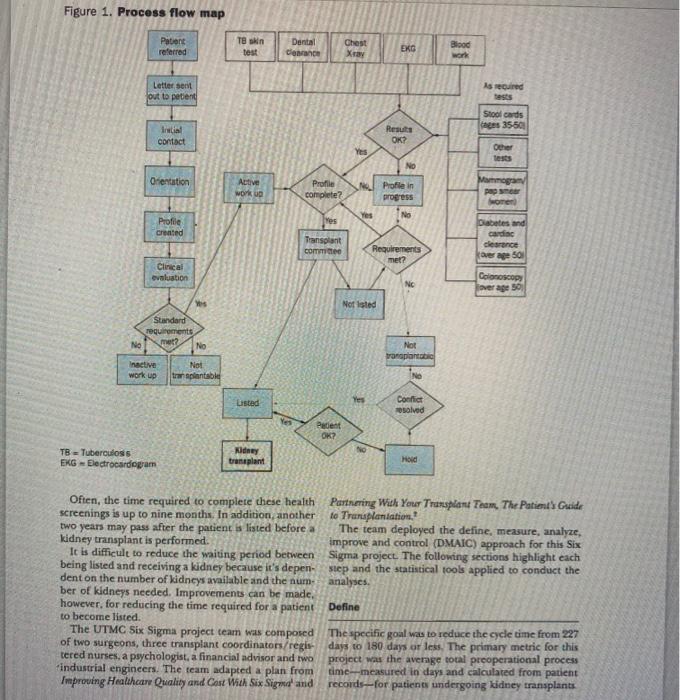
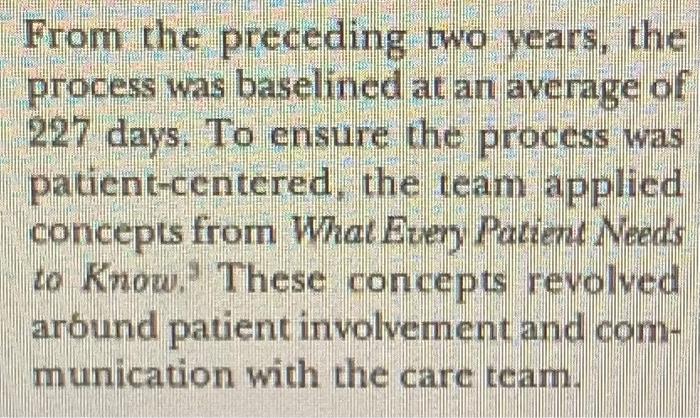
Perfect Match TEAM APPLIES SIX SIGMA TO REDUCE TIME IT TAKES TO QUALIFY PATIENTS FOR KIDNEY TRANSPLANTS n January 2008, the University of Toledo Medical Center (UTMC) in northwest Ohio collaborated with the University of Toledo's Industrial Engineering Department to analyze and improve the preoperational pro- cesses for patients undergoing kidney transplants. Six Sigma was applied to the project, and the following goals were established: Optimize cycle times, Enhance customer satisfaction. Improve efficiencies Reduce costs Streamline administrative processes Eliminate errors. Improve protocol execution and effectiveness The project's primary metric was the number of days required from the date a patient was referred to UTMC for a kidney transplant to the date the hospital staff declared the patient a suitable transplant candidate. The research was needed and the project selected because of an increase in the number of patients awaiting transplant and the number of transplants performed per year because of the increased service area for UTMG. Because of a waiting list of nearly 500 patients, it was determined a reduced cycle time would save lives. Background and terminology By Matthew Franchetti and Kyle Bedal, University of Toledo For more than 30 years, UTMC has performed adult and pediatric kidney transplants as one of the treatment options for end stage renal disease. Since UTMC's first kidney transplant operation in 1972, more than 1,500 kidney transplant operations have been performed there, with an average patient survival rate of 98% and a graft survival rate of 94%. The program relies on advanced surgical techniques including laparoscopic kidney donation, improved anti-rejection medications and highquality patient care to make it one of the most successful programs in the country, There are a number of steps patients must complete before receiving a kidney transplant. Generally, the patient must be referred to a medical center and complete required labs and tests to determine if he or she is suitable. The labs and tests are usually similar among all transplant centers and among patients. The labs include tuberculosis (TB) tests, dental clearance, a colonoscopy. chest X-rays, electrocardiography tests, stool samples, blood work. mammograms. pap smeans and diabetes tests. Once the patient fulfills the requirements, a committee reviews the results and determines whether the patient is a good candidate. The patient is then allowed to receive a kidney, this is called being "listed," or placed on the waiting list. Figure 1. Process flow map Patent referred TB skin test Dental comanda Chest Xroy EXG Blood work Lettersent out to patient secured tests Stool cards Cars 35500 Ini contact Results OK? Yes Other tests No Orientation Mammon Active work Profile complete? Profile in progress per women Yes No Yes Profile created Transplant Committee Biabetes and cardiac clearance Koves age 50 Requirements met? Clinical evaluation Nc Colonoscopy werage 30 Not listed Standard requirements No met? No Not Transplantati work up Not transplantable Ne Listad Conflict osolved Peder OK? NO TB - Tuberculosis EKG Electrocardogram Kidney transplant Hold Often, the time required to complete these health Partnering With Your Transplant Team, The Patients Guide screenings is up to nine months. In addition, another to Transplantation . two years may pass after the patient is listed before a The team deployed the define measure, analyze, kidney transplant is performed. improve and control (DMAIC) approach for this Six It is difficult to reduce the waiting period between Sigma project. The following section highlight each being listed and receiving a kidney because it's depen- step and the statistical tools applied to conduct the dent on the number of kidneys available and the num. analyses. ber of kidneys needed. Improvements can be made, however, for reducing the time required for a patient Define to become listed. The UTMC Six Sigma project team was composed The specific goal was to reduce the cycle time from 227 of two surgeons, three transplant coordinators/regis- days to 180 days or less. The primary metric for this tered nurses, a psychologist, a financial advisor and two project was the average total preoperational process industrial engineers. The team adapted a plan from time-measured in days and calculated from patient Improving Healthcare Quality and Cost With Six Sigma and records--for patients undergoing kidney transplant From the preceding two years, the process was baselined at an average of 227 days. To ensure the process was patient-centered the team applied concepts from What Eren Patient Needs to know. These concepts revolved around patient involvement and com- munication with the care team









 Study Help