Question: please do a general lesson plan template for human resource development course, i posted some examples on how it should be done. thank you. draw
please do a general lesson plan template for human resource development course, i posted some examples on how it should be done. thank you.
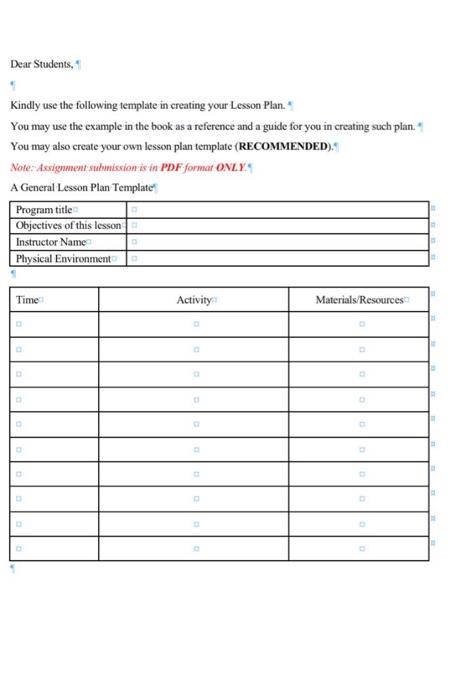
draw the table like this as given below
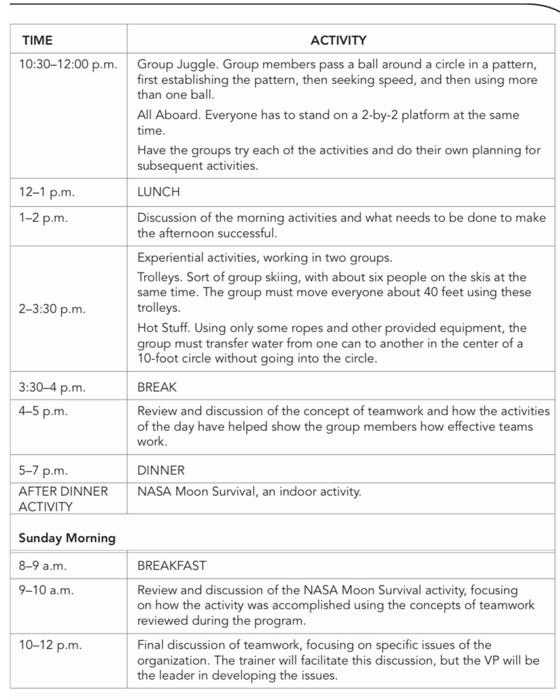
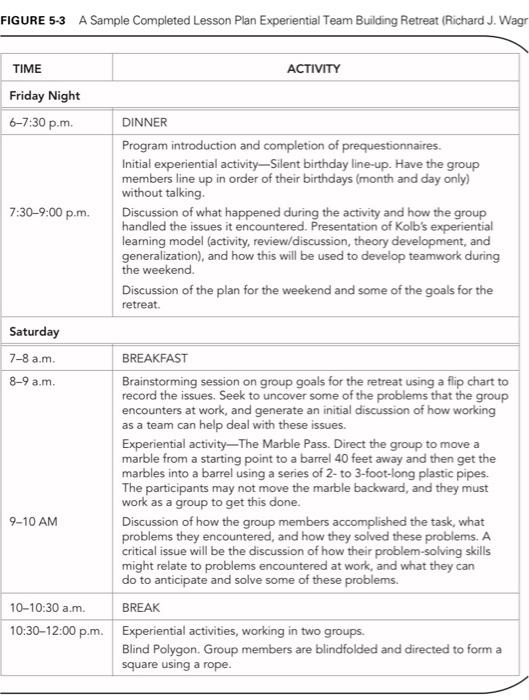
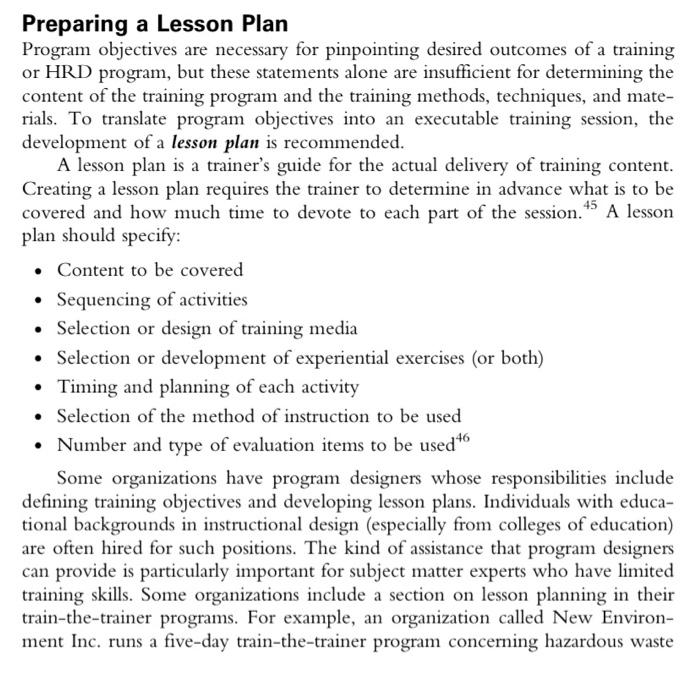
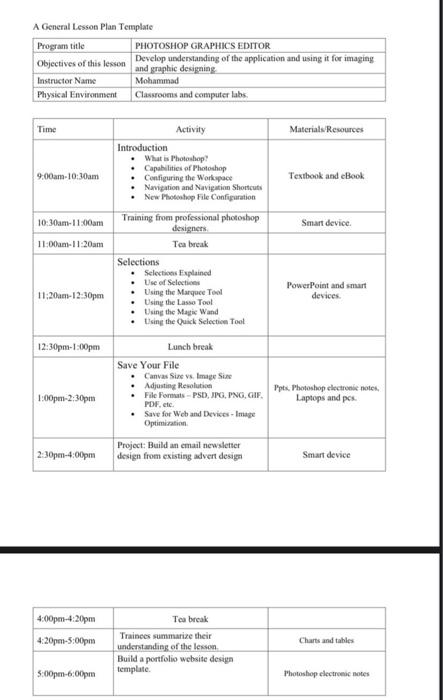
Dear Students, 1 Kindly use the following template in creating your Lesson Plan. You may use the example in the book as a reference and a guide for you in creating such plan. You may also create your own lesson plan template (RECOMMENDED). Note: Assignment submission is in PDF format ONLY A General Lesson Plan Template Program title Objectives of this lesson Instructor Name Physical Environment Time Activity Materials Resources TIME ACTIVITY 10:30-12:00p.m. Group Juggle. Group members pass a ball around a circle in a pattern, first establishing the pattern, then seeking speed, and then using more than one ball. All Aboard. Everyone has to stand on a 2-by-2 platform at the same time. Have the groups try each of the activities and do their own planning for subsequent activities 12-1 p.m. LUNCH 1-2 p.m. Discussion of the morning activities and what needs to be done to make the afternoon successful. Experiential activities, working in two groups. Trolleys. Sort of group skiing, with about six people on the skis at the same time. The group must move everyone about 40 feet using these 2-3:30 p.m. trolleys. Hot Stuff. Using only some ropes and other provided equipment, the group must transfer water from one can to another in the center of a 10-foot circle without going into the circle. 3:30-4p.m. BREAK Review and discussion of the concept of teamwork and how the activities of the day have helped show the group members how effective teams work 5-7 p.m. DINNER AFTER DINNER NASA Moon Survival, an indoor activity. ACTIVITY 4-5 p.m. Sunday Morning 8-9 a.m. 9-10 a.m. BREAKFAST Review and discussion of the NASA Moon Survival activity, focusing on how the activity was accomplished using the concepts of teamwork reviewed during the program. Final discussion of teamwork, focusing on specific issues of the organization. The trainer will facilitate this discussion, but the VP will be the leader in developing the issues. 10-12 p.m. FIGURE 5-3 A Sample Completed Lesson Plan Experiential Team Building Retreat (Richard J. Wagr TIME ACTIVITY Friday Night 6-7:30 p.m. DINNER Program introduction and completion of prequestionnaires. Initial experiential activity-Silent birthday line-up. Have the group members line up in order of their birthdays (month and day only) without talking. 7:30-9:00 p.m. Discussion of what happened during the activity and how the group handled the issues it encountered. Presentation of Kolb's experiential learning model (activity, review/discussion, theory development, and generalization), and how this will be used to develop teamwork during the weekend. Discussion of the plan for the weekend and some of the goals for the retreat Saturday 7-8 a.m. BREAKFAST 8-9 a.m. Brainstorming session on group goals for the retreat using a flip chart to record the issues. Seek to uncover some of the problems that the group encounters at work, and generate an initial discussion of how working as a team can help deal with these issues. Experiential activity-The Marble Pass. Direct the group to move a marble from a starting point to a barrel 40 feet away and then get the marbles into a barrel using a series of 2- to 3-foot-long plastic pipes. The participants may not move the marble backward, and they must work as a group to get this done. 9-10 AM Discussion of how the group members accomplished the task, what problems they encountered, and how they solved these problems. A critical issue will be the discussion of how their problem-solving skills might relate to problems encountered at work, and what they can do to anticipate and solve some of these problems. 10-10:30 a.m. BREAK 10:30-12:00p.m. Experiential activities, working in two groups. Blind Polygon. Group members are blindfolded and directed to form a square using a rope. . . Preparing a Lesson Plan Program objectives are necessary for pinpointing desired outcomes of a training or HRD program, but these statements alone are insufficient for determining the content of the training program and the training methods, techniques, and mate- rials. To translate program objectives into an executable training session, the development of a lesson plan is recommended. A lesson plan is a trainer's guide for the actual delivery of training content. Creating a lesson plan requires the trainer to determine in advance what is to be covered and how much time to devote to each part of the session." A lesson plan should specify: Content to be covered Sequencing of activities Selection or design of training media Selection or development of experiential exercises (or both) Timing and planning of each activity Selection of the method of instruction to be used Number and type of evaluation items to be used Some organizations have program designers whose responsibilities include defining training objectives and developing lesson plans. Individuals with educa- tional backgrounds in instructional design (especially from colleges of education) are often hired for such positions. The kind of assistance that program designers can provide is particularly important for subject matter experts who have limited training skills. Some organizations include a section on lesson planning in their train-the-trainer programs. For example, an organization called New Environ- ment Inc. runs a five-day train-the-trainer program concerning hazardous waste A General Lesson Plan Template Program title PHOTOSHOP GRAPHICS EDITOR Objectives of this lesson Develop understanding of the application and using it for imaging and graphic designing Instructor Name Mohammad Physical Environment Classrooms and computer labs Time Materials Resources 9:00am-10:30am Textbook and eBook 10:30am-11:00am Activity Introduction What is Photoshop Capabilities of Photoshop Configuring the Workspace Navigation and Navigation Shortcuts New Photoshop File Configuration Training from professional photoshop designers Tea break Selections Selections Explained Use of Selections Using the Marque Tool Using the Lasso Tool Using the Male Wand Using the Ouick Selection Tool Smart device 11:00am-11:20am 11:20am-12:30pm Power Point and smart devices 12:30pm-1:00pm Lunch break Save Your File Canvas Sine vs. Image Se Adjusting Resolution File Format - PSD, JPG, PNG, GIF. PDF, etc. Suve for Web and Devices - Image Optimization 1:00pm-2:30pm 'pts, Photoshop electronic notes Laptops and pos. 2:30pm-4:00pm Project: Build an email newsletter design from existing advert design Smart device 4:00pm-4:20pm 4:20pm-5:00pm Tea break Trainees summarize their understanding of the lesson Build a portfolio website design template Charts and tables 5:00pm-6:00pm Photoshop electronic notes Dear Students, 1 Kindly use the following template in creating your Lesson Plan. You may use the example in the book as a reference and a guide for you in creating such plan. You may also create your own lesson plan template (RECOMMENDED). Note: Assignment submission is in PDF format ONLY A General Lesson Plan Template Program title Objectives of this lesson Instructor Name Physical Environment Time Activity Materials Resources TIME ACTIVITY 10:30-12:00p.m. Group Juggle. Group members pass a ball around a circle in a pattern, first establishing the pattern, then seeking speed, and then using more than one ball. All Aboard. Everyone has to stand on a 2-by-2 platform at the same time. Have the groups try each of the activities and do their own planning for subsequent activities 12-1 p.m. LUNCH 1-2 p.m. Discussion of the morning activities and what needs to be done to make the afternoon successful. Experiential activities, working in two groups. Trolleys. Sort of group skiing, with about six people on the skis at the same time. The group must move everyone about 40 feet using these 2-3:30 p.m. trolleys. Hot Stuff. Using only some ropes and other provided equipment, the group must transfer water from one can to another in the center of a 10-foot circle without going into the circle. 3:30-4p.m. BREAK Review and discussion of the concept of teamwork and how the activities of the day have helped show the group members how effective teams work 5-7 p.m. DINNER AFTER DINNER NASA Moon Survival, an indoor activity. ACTIVITY 4-5 p.m. Sunday Morning 8-9 a.m. 9-10 a.m. BREAKFAST Review and discussion of the NASA Moon Survival activity, focusing on how the activity was accomplished using the concepts of teamwork reviewed during the program. Final discussion of teamwork, focusing on specific issues of the organization. The trainer will facilitate this discussion, but the VP will be the leader in developing the issues. 10-12 p.m. FIGURE 5-3 A Sample Completed Lesson Plan Experiential Team Building Retreat (Richard J. Wagr TIME ACTIVITY Friday Night 6-7:30 p.m. DINNER Program introduction and completion of prequestionnaires. Initial experiential activity-Silent birthday line-up. Have the group members line up in order of their birthdays (month and day only) without talking. 7:30-9:00 p.m. Discussion of what happened during the activity and how the group handled the issues it encountered. Presentation of Kolb's experiential learning model (activity, review/discussion, theory development, and generalization), and how this will be used to develop teamwork during the weekend. Discussion of the plan for the weekend and some of the goals for the retreat Saturday 7-8 a.m. BREAKFAST 8-9 a.m. Brainstorming session on group goals for the retreat using a flip chart to record the issues. Seek to uncover some of the problems that the group encounters at work, and generate an initial discussion of how working as a team can help deal with these issues. Experiential activity-The Marble Pass. Direct the group to move a marble from a starting point to a barrel 40 feet away and then get the marbles into a barrel using a series of 2- to 3-foot-long plastic pipes. The participants may not move the marble backward, and they must work as a group to get this done. 9-10 AM Discussion of how the group members accomplished the task, what problems they encountered, and how they solved these problems. A critical issue will be the discussion of how their problem-solving skills might relate to problems encountered at work, and what they can do to anticipate and solve some of these problems. 10-10:30 a.m. BREAK 10:30-12:00p.m. Experiential activities, working in two groups. Blind Polygon. Group members are blindfolded and directed to form a square using a rope. . . Preparing a Lesson Plan Program objectives are necessary for pinpointing desired outcomes of a training or HRD program, but these statements alone are insufficient for determining the content of the training program and the training methods, techniques, and mate- rials. To translate program objectives into an executable training session, the development of a lesson plan is recommended. A lesson plan is a trainer's guide for the actual delivery of training content. Creating a lesson plan requires the trainer to determine in advance what is to be covered and how much time to devote to each part of the session." A lesson plan should specify: Content to be covered Sequencing of activities Selection or design of training media Selection or development of experiential exercises (or both) Timing and planning of each activity Selection of the method of instruction to be used Number and type of evaluation items to be used Some organizations have program designers whose responsibilities include defining training objectives and developing lesson plans. Individuals with educa- tional backgrounds in instructional design (especially from colleges of education) are often hired for such positions. The kind of assistance that program designers can provide is particularly important for subject matter experts who have limited training skills. Some organizations include a section on lesson planning in their train-the-trainer programs. For example, an organization called New Environ- ment Inc. runs a five-day train-the-trainer program concerning hazardous waste A General Lesson Plan Template Program title PHOTOSHOP GRAPHICS EDITOR Objectives of this lesson Develop understanding of the application and using it for imaging and graphic designing Instructor Name Mohammad Physical Environment Classrooms and computer labs Time Materials Resources 9:00am-10:30am Textbook and eBook 10:30am-11:00am Activity Introduction What is Photoshop Capabilities of Photoshop Configuring the Workspace Navigation and Navigation Shortcuts New Photoshop File Configuration Training from professional photoshop designers Tea break Selections Selections Explained Use of Selections Using the Marque Tool Using the Lasso Tool Using the Male Wand Using the Ouick Selection Tool Smart device 11:00am-11:20am 11:20am-12:30pm Power Point and smart devices 12:30pm-1:00pm Lunch break Save Your File Canvas Sine vs. Image Se Adjusting Resolution File Format - PSD, JPG, PNG, GIF. PDF, etc. Suve for Web and Devices - Image Optimization 1:00pm-2:30pm 'pts, Photoshop electronic notes Laptops and pos. 2:30pm-4:00pm Project: Build an email newsletter design from existing advert design Smart device 4:00pm-4:20pm 4:20pm-5:00pm Tea break Trainees summarize their understanding of the lesson Build a portfolio website design template Charts and tables 5:00pm-6:00pm Photoshop electronic notes









 Study Help