







Question: Please do all letters Consider classical and quantum harmonic oscillators. When the classical harmonic oscillator is in the ground state, i.e., at rest, it sits
Please do all letters
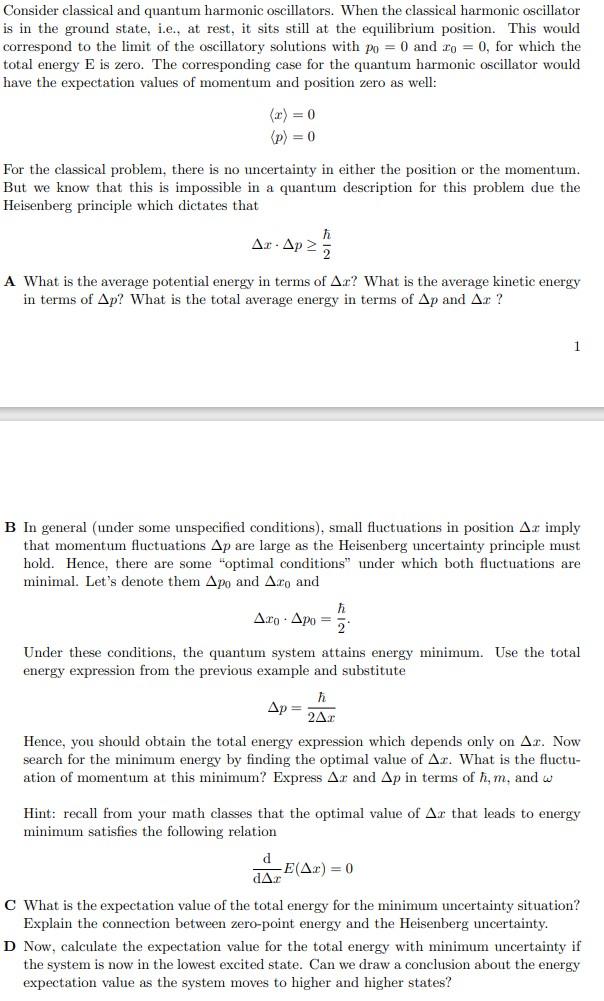
Consider classical and quantum harmonic oscillators. When the classical harmonic oscillator is in the ground state, i.e., at rest, it sits still at the equilibrium position. This would correspond to the limit of the oscillatory solutions with po = 0 and ro = 0, for which the total energy E is zero. The corresponding case for the quantum harmonic oscillator would have the expectation values of momentum and position zero as well: (c) = 0 (p) = 0 For the classical problem, there is no uncertainty in either the position or the momentum. But we know that this is impossible in a quantum description for this problem due the Heisenberg principle which dictates that Ar - Ap2 A What is the average potential energy in terms of Ax? What is the average kinetic energy in terms of Ap? What is the total average energy in terms of Ap and Ar ? 1 B In general (under some unspecified conditions), small fluctuations in position Ar imply that momentum fluctuations Ap are large as the Heisenberg uncertainty principle must hold. Hence, there are some "optimal conditions" under which both fluctuations are minimal. Let's denote them Apo and Aro and Aco. Apo = 2 Under these conditions, the quantum system attains energy minimum. Use the total energy expression from the previous example and substitute Ap= 2A.C Hence, you should obtain the total energy expression which depends only on Ar. Now search for the minimum energy by finding the optimal value of Ar. What is the fluctu- ation of momentum at this minimum? Express Ar and Ap in terms of h, m, and w Hint: recall from your math classes that the optimal value of Ar that leads to energy minimum satisfies the following relation de E(42) = 0 C What is the expectation value of the total energy for the minimum uncertainty situation? Explain the connection between zero-point energy and the Heisenberg uncertainty. D Now, calculate the expectation value for the total energy with minimum uncertainty if the system is now in the lowest excited state. Can we draw a conclusion about the energy expectation value as the system moves to higher and higher states
Step by Step Solution
There are 3 Steps involved in it

Get step-by-step solutions from verified subject matter experts
 Study Help