







Question: please do all the questions! (a) An equivalence relation that partitions the sets into infinitely many equlvalence classes (b) A set C that is contained
please do all the questions! 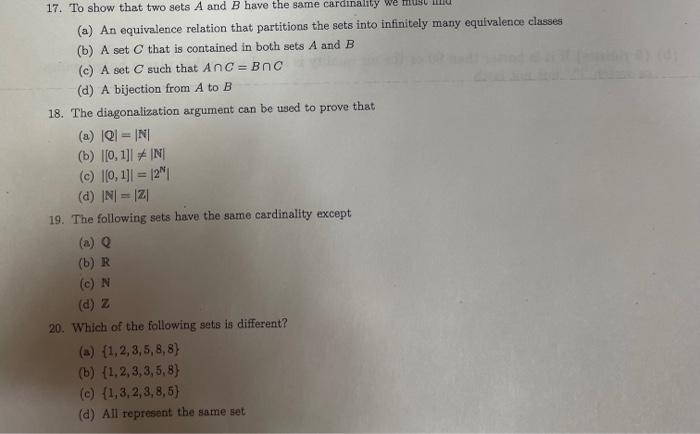
(a) An equivalence relation that partitions the sets into infinitely many equlvalence classes (b) A set C that is contained in both sets A and B (c) A set C such that AC=BC (d) A bijection from A to B 18. The diagonalization argument can be used to prove that (a) Q=N (b) [0,1]=N (c) [0,1]=2N (d) N=Z 19. The following sets have the same cardinality except (a) Q (b) R (c) N (d) Z 20. Which of the following sets is different? (a) {1,2,3,5,8,8} (b) {1,2,3,3,5,8} (c) {1,3,2,3,8,5} (d) All represent the same set
Step by Step Solution
There are 3 Steps involved in it
1 Expert Approved Answer
Step: 1 Unlock

Question Has Been Solved by an Expert!
Get step-by-step solutions from verified subject matter experts
Step: 2 Unlock
Step: 3 Unlock
 Study Help