







Question: Please do exercise 61.2. only EXERCISES 61.1. Many state laws say that for each 10 m.p.h. (16 k.p.h.) of speed you should stay at least
Please do exercise 61.2. only
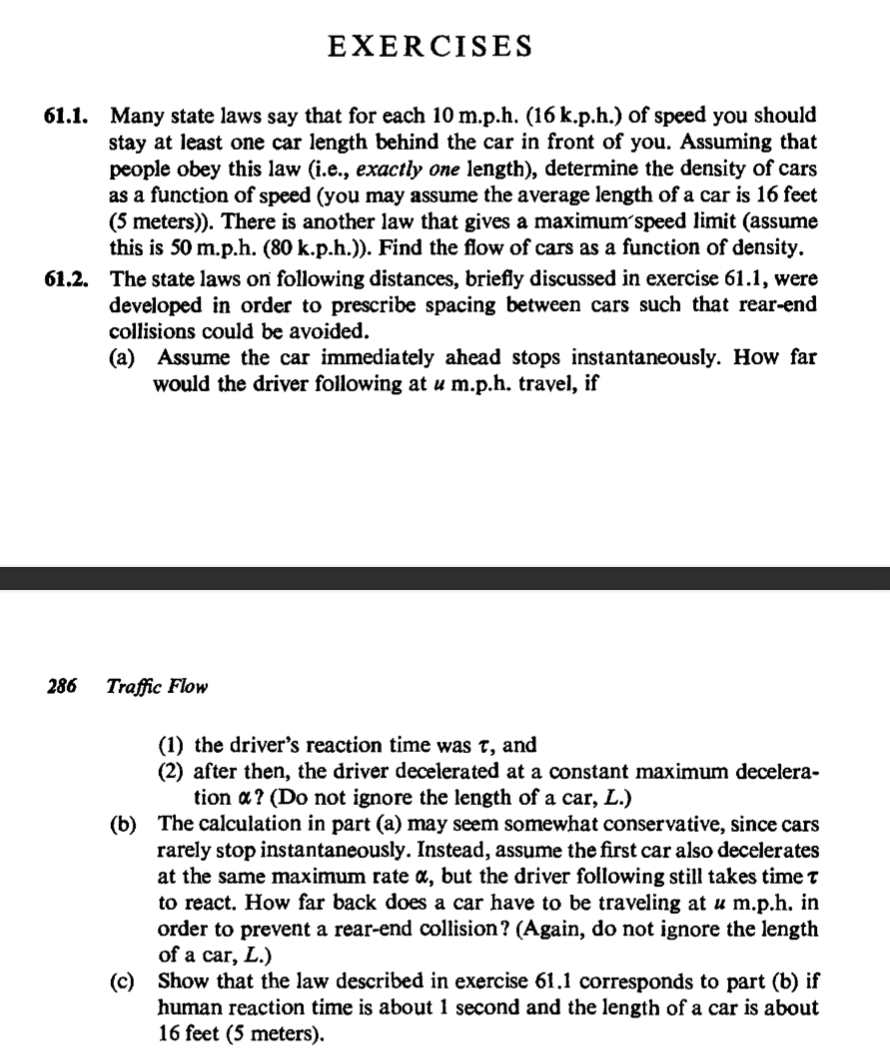
EXERCISES 61.1. Many state laws say that for each 10 m.p.h. (16 k.p.h.) of speed you should stay at least one car length behind the car in front of you. Assuming that people obey this law (i.e., exactly one length), determine the density of cars as a function of speed (you may assume the average length of a car is 16 feet (5 meters)). There is another law that gives a maximum'speed limit (assume this is 50 m.p.h. (80 k.p.h.)). Find the flow of cars as a function of density. 61.2. The state laws on following distances, briefly discussed in exercise 61.1, were developed in order to prescribe spacing between cars such that rear-end collisions could be avoided. (a) Assume the car immediately ahead stops instantaneously. How far would the driver following at u m.p.h. travel, if 286 Traffic Flow (1) the driver's reaction time was t, and (2) after then, the driver decelerated at a constant maximum decelera- tion a ? (Do not ignore the length of a car, L.) (b) The calculation in part (a) may seem somewhat conservative, since cars rarely stop instantaneously. Instead, assume the first car also decelerates at the same maximum rate a, but the driver following still takes time t to react. How far back does a car have to be traveling at u m.p.h, in order to prevent a rear-end collision ? (Again, do not ignore the length of a car, L.) (c) Show that the law described in exercise 61.1 corresponds to part (b) if human reaction time is about 1 second and the length of a car is about 16 feet (5 meters). EXERCISES 61.1. Many state laws say that for each 10 m.p.h. (16 k.p.h.) of speed you should stay at least one car length behind the car in front of you. Assuming that people obey this law (i.e., exactly one length), determine the density of cars as a function of speed (you may assume the average length of a car is 16 feet (5 meters)). There is another law that gives a maximum'speed limit (assume this is 50 m.p.h. (80 k.p.h.)). Find the flow of cars as a function of density. 61.2. The state laws on following distances, briefly discussed in exercise 61.1, were developed in order to prescribe spacing between cars such that rear-end collisions could be avoided. (a) Assume the car immediately ahead stops instantaneously. How far would the driver following at u m.p.h. travel, if 286 Traffic Flow (1) the driver's reaction time was t, and (2) after then, the driver decelerated at a constant maximum decelera- tion a ? (Do not ignore the length of a car, L.) (b) The calculation in part (a) may seem somewhat conservative, since cars rarely stop instantaneously. Instead, assume the first car also decelerates at the same maximum rate a, but the driver following still takes time t to react. How far back does a car have to be traveling at u m.p.h, in order to prevent a rear-end collision ? (Again, do not ignore the length of a car, L.) (c) Show that the law described in exercise 61.1 corresponds to part (b) if human reaction time is about 1 second and the length of a car is about 16 feet (5 meters)
Step by Step Solution
There are 3 Steps involved in it

Get step-by-step solutions from verified subject matter experts
 Study Help