







Question: * * * Please , do not answer if you do not know how to * * * HELP WITH THE FOLLOWING ASSIGNMENT GIVEN THE
Please do not answer if you do not know how to
HELP WITH THE FOLLOWING ASSIGNMENT GIVEN THE FEEDBACK THAT WAS PROVIDED:
Based on the equal loudness contour on slide of "loudness matching" lecture, Hz comparison tone usually needs a higher level than Hz comparison tone, and in turn than Hz comparison tone, to achieve equal loudness. Are you sure your results are consistent with such expectation?
In this homework, you are asked to match the loudness of a comparison tone to that
of a standard Hz tone. Detailed instructions and acoustic sounds can be found
here on this slide darr darr. Click the loudspeaker symbols on the slide to play the sounds
and adjust your computer volume to be comfortably loud. Once set, the computer
volume should be fixed when you listen to the three sets of sounds. Report your
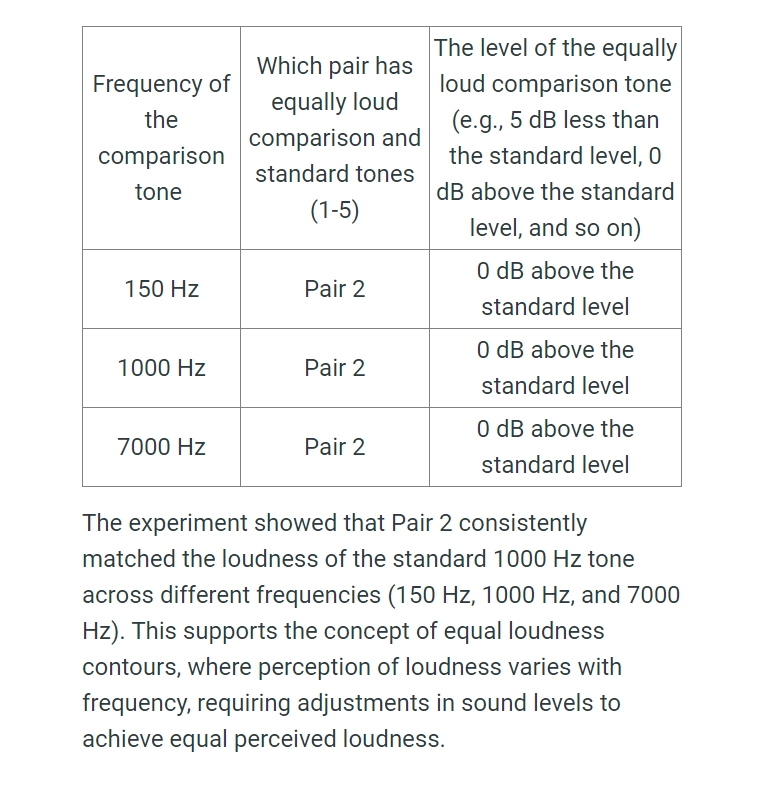
results using the following table in text entry. Describe how the level of the equally
loud comparison tone varies with the frequency of the comparison tone. Are your
results consistent with the equal loudness contour described in our lectures?
Loudness Matching
There are three comparison tones at and Hz The standard tone is
Hz Each comparison tone is played five times following the standard tone.
The level of the comparison tone starts at dB less than that of the standard tone
and then increases in dB steps for the remaining four comparison tones. You
are to decide which pair has equally loud comparison and standard tones.
For each comparison tone, write down the level of the equally loud comparison
tone pair : dB less than the level of the standard tone, pair : dB above, pair
: dB above, and so on
Hz Comparison
Hz Comparison
Hz Comparison
A
Step by Step Solution
There are 3 Steps involved in it
1 Expert Approved Answer
Step: 1 Unlock

Question Has Been Solved by an Expert!
Get step-by-step solutions from verified subject matter experts
Step: 2 Unlock
Step: 3 Unlock
 Study Help