







Question: Please do not answer if you are going to respond with steps on how to solve the problem; I need assistance with the answers, not
Please do not answer if you are going to respond with steps on how to solve the problem; I need assistance with the answers, not steps
What will your investment portfolio be worth in 10 years? In 20 years? When do you stop working? The Human Resources Department at Four Corners Corporation was asked to develop a financial planning model that would help employees address these questions. Tom Gifford was asked to lead this effort and decided to begin by developing a personal financial plan. Tom has a degree in business and, at the age of 40, is making $85,000 per year. Through contributions to the companys retirement program and the receipt of a small inheritance, Tom has accumulated a portfolio valued at $50,000. Tom plans to work 20 more years and hopes to accumulate a portfolio valued at $1,000,000. Can Tom do it? Tom began with a few assumptions about future salary, new investment contributions, and the portfolio growth rate. Tom assumed a 5% annual salary growth rate and plans to make new investment contributions at 6% of the annual salary. After some research on historical stock market performance, Tom decided that a 10% annual portfolio growth rate was reasonable. Using these assumptions, Tom developed the following Excel worksheet: The worksheet provides a financial projection for the next five years. In computing the portfolio earnings for a given year, Tom assumed that their new investment contribution
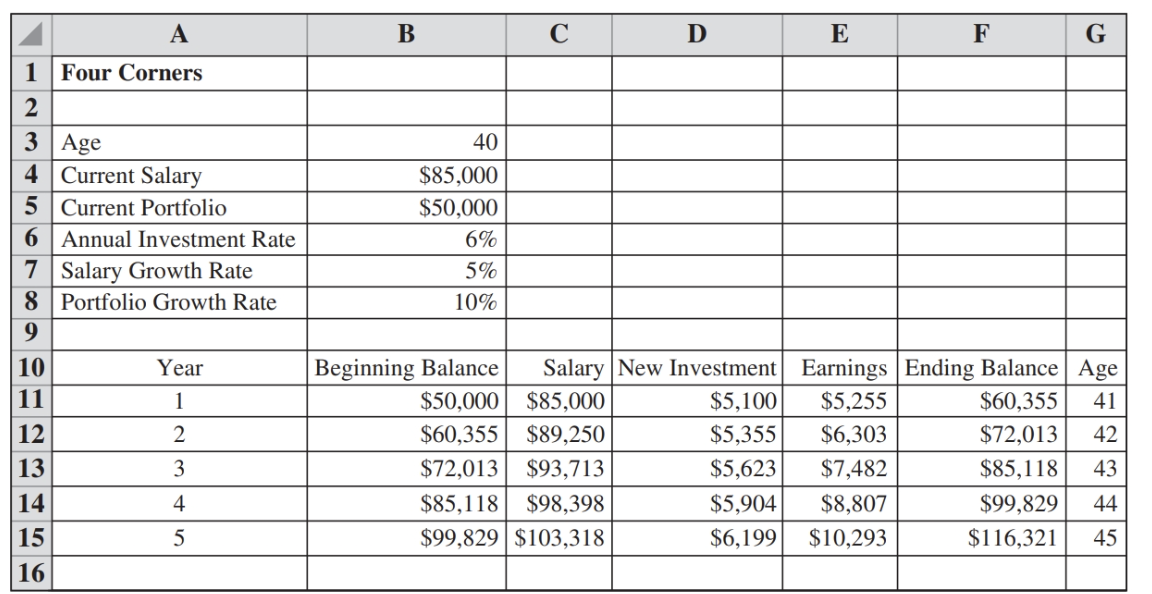
ould occur evenly throughout the year, and thus half of the new investment could be included in the computation of the portfolio earnings for the year. From the worksheet, we see that, at age 45, Tom is projected to have a portfolio valued at $116,321. Toms plan was to use this worksheet as a template to develop financial plans for the com-panys employees. The data in the spreadsheet would be tailored for each employee, and rows would be added to it to reflect the employees planning horizon. After adding another 15 rows to the worksheet, Tom found that one could expect to have a portfolio of $772,722 after 20 years. Tom then took the results to show senior human resources manager, Kate Krystkowiak. Although Kate was pleased with Toms progress, there was still room for improvement. One of the criticisms was the assumption of a constant annual salary growth rate. Most employees experience some variation in the annual salary growth rate from year to year. In addition, the constant annual portfolio growth rate was unrealistic and that the actual growth rate would vary considerably from year to year. Kate and Tom both agreed that a simulation model for the portfolio projection would allow them to account for the random variability in the salary growth rate and the portfolio growth rate. After some research, Tom and Kate decided to assume that the annual salary growth rate would vary from 0% to 5% and that a uniform probability distribution would provide a real-istic approximation. Four Corners accountants suggested that the annual portfolio growth rate could be approximated by a normal probability distribution with a mean of 10% and a standard deviation of 5%. With this information, Tom set off to redesign the spreadsheet so that it could be used by the companys employees for financial planning.
Play the role of Tom Gifford, and develop a simulation model for financial planning. Write a report for Toms boss and, at a minimum, include the following:
1. Without considering the random variability, extend the current worksheet to 20 years. Confirm that by using the constant annual salary growth rate and the constant annual portfolio growth rate, Tom can expect to have a 20-year portfolio of $772,722. What would Toms annual investment rate have to increase to in order for the portfolio to reach a 20-year, $1,000,000 goal? Hint: Use Goal Seek in Excel.
2. Redesign the spreadsheet model to incorporate the random variability of the annual salary growth rate and the annual portfolio growth rate into a simulation model. Assume that Tom is willing to use the annual investment rate that predicted a 20-year, $1,000,000 portfolio in part (1). Show how to simulate Toms 20-year financial plan. Use results from the simulation model to comment on the uncertainty associated with Tom reaching the 20-year, $1,000,000 goal.
3. What recommendations do you have for employees with a current profile similar to Toms after seeing the impact of the uncertainty in the annual salary growth rate and the annual portfolio growth rate?
4. Assume that Tom is willing to consider working 25 more years instead of 20 years. What is your assessment of this strategy if Toms goal is to have a portfolio worth $1,000,000? 5. Discuss how the financial planning model developed for Tom Gifford can be used as a template to develop a financial plan for any of the companys employees.
\begin{tabular}{|c|c|c|c|c|c|c|c|} \hline 4 & A & B & C & D & E & F & G \\ \hline 1 & \begin{tabular}{|l|} Four Corners \\ \end{tabular} & & & & & & \\ \hline \multicolumn{8}{|l|}{2} \\ \hline 3 & Age & 40 & & & & & \\ \hline 4 & Current Salary & $85,000 & & & & & \\ \hline 5 & Current Portfolio & $50,000 & & & & & \\ \hline 6 & Annual Investment Rate & 6% & & & & & \\ \hline 7 & Salary Growth Rate & 5% & & & & & \\ \hline 8 & Portfolio Growth Rate & 10% & & & & & \\ \hline \multicolumn{8}{|c|}{9} \\ \hline 10 & Year & Beginning Balance & Salary & New Investment & Earnings & Ending Balance & Age \\ \hline 11 & 1 & $50,000 & $85,000 & $5,100 & $5,255 & $60,355 & 41 \\ \hline 12 & 2 & $60,355 & $89,250 & $5,355 & $6,303 & $72,013 & 42 \\ \hline 13 & 3 & $72,013 & $93,713 & $5,623 & $7,482 & $85,118 & 43 \\ \hline 14 & 4 & $85,118 & $98,398 & $5,904 & $8,807 & $99,829 & 44 \\ \hline 15 & 5 & $99,829 & $103,318 & $6,199 & $10,293 & $116,321 & 45 \\ \hline 16 & & & & & & & \\ \hline \end{tabular}
Step by Step Solution
There are 3 Steps involved in it

Get step-by-step solutions from verified subject matter experts
 Study Help