







Question: please do not answer if you do not know thank you! Community Medical Associates (CMA) is a large health BADAN mer and 56 outpatient clinics.
please do not answer if you do not know thank you! 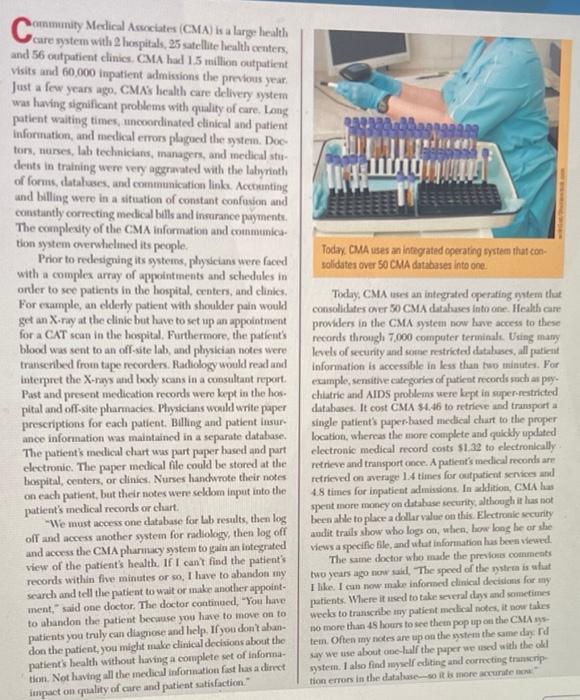

Community Medical Associates (CMA) is a large health BADAN mer and 56 outpatient clinics. CMAhad 1.5 million outpatient Visits and 60,000 inpatient admissions the previous year, Just a few years ago, CMAs health care delivery system was having significant problems with quality of care. Long patient waiting times, uncoordinated clinical and patient Information, and medical errors plagued the system. Doc tors, nurses, lab technicians, managers, and medical stru dents in training were very aggravated with the labyrinth of forms, databases, and communication links. Actunting und billing were in a situation of constant confusion and constantly correcting medical bills and insurance payments The complexity of the CMA information and communica tion system overwhelmed its people. Prior to redesigning its systems, plysicians were faced with a complex array of appointments and schedules in order to see patients in the hospital, centers, and clinics. For example, an elderly patient with shoulder pain would get an X-ray at the clinic but have to set up an appointment for a CAT scan in the hospital. Furthermore, the patient' blood wils sent to an off-site lab, and physician notes were transcribed from tape recorders. Radiology would read and interpret the X-rays and body scans in a consultant report. Past and present medication records were kept in the hos pital and off-site pharmacies. Physicians would write paper prescriptions for each patient. Billing and patient insur ance information was maintained in a separate database. The patient's medical chart was part paper based and part electronic. The paper medical file could be stored at the hospital, centers, or clinics. Nurses handwrote their notes on each patient, but their notes were seldom input into the patient's medical records or clart, "We must access one database for Lab results, then log off and access another system for radiology, then log off and access the CMA pharmacy system to gain an integrated view of the patient's health. If I can't find the patient's records within five minutes or so, I have to abandon my search and tell the patient to wait or make another appoint- ment," said one doctor. The doctor continued, "You have to abandon the patient because you have to move on to patients you truly can diagnose and help. If you don't abu- don the patient, you might make clinical decisions about the patient's health without having a complete set of inforna- tion. Not having all the medical information fist has a diret impact on quality of care and patient satisfaction." Today. CMA uses an integrated operating system that con solidates over 50 CMA databases into one. Today, CMA uses an integrated operating system that consolidates over 50 CMA databases into one. Health care providers in the CMA system now have access to these records through 7,000 computer terminal. Using many levels of security and some restricted databases, all patient information is accessible in less than two minutes. Por example, sensitive categories of patient records such as poy. chiatric and AIDS problems were kept in super restricted databases. It cost CMA $4.46 to retrieve and transporta single patient's paper-based medical churt to the proper location, whereas the more complete and quickly updated electronic medical record costs $1.32 to electronically retrieve and transport once. A patient's medical records are retrieved on average 14 times for outpatient services and 4.8 times for inpatient admissions. In addition, CMA spent more money on database security, although it has not been able to place a dollar value on this. Electronic security audit trails show who logs on, when, low long he or she views a specific file and utut information has been viewed The same doctor who made the presiones comments two years ago now said. "The speed of the strais what I like. I can now make informed clinical decidons for any patients. Where it used to take several days and sometimes weeks to transcribe my patient medical notes, it now takes no more than 4 hours to see them pop up on the CMA - tem. Often my notes are up on the system the same day Rd say we use about one-half the paper we used with the oll system. I also find myself editing and correcting transcrip tion errors in the database it is more sunt ompare. 3. What is the total annual record retrieval cost savings with the old (paper-based) versus new (electronic) systems Step by Step Solution
There are 3 Steps involved in it
1 Expert Approved Answer
Step: 1 Unlock

Question Has Been Solved by an Expert!
Get step-by-step solutions from verified subject matter experts
Step: 2 Unlock
Step: 3 Unlock
 Study Help