







Question: PLEASE DO NOT ANSWER THIS QUESTION IF YOU DO NOT ACTUALLY KNOW THE ANSWER. SO MANY PEOPLE HAVE BEEN ANSWERING WITH INCORRECTNESS. THE BELOW SHOULD
PLEASE DO NOT ANSWER THIS QUESTION IF YOU DO NOT ACTUALLY KNOW THE ANSWER. SO MANY PEOPLE HAVE BEEN ANSWERING WITH INCORRECTNESS. THE BELOW SHOULD USE SIMPLIFIED VERSION OF THE TESLA ARCHITECTURE PTX ISA !!! That is what is being reffered to in this problem.
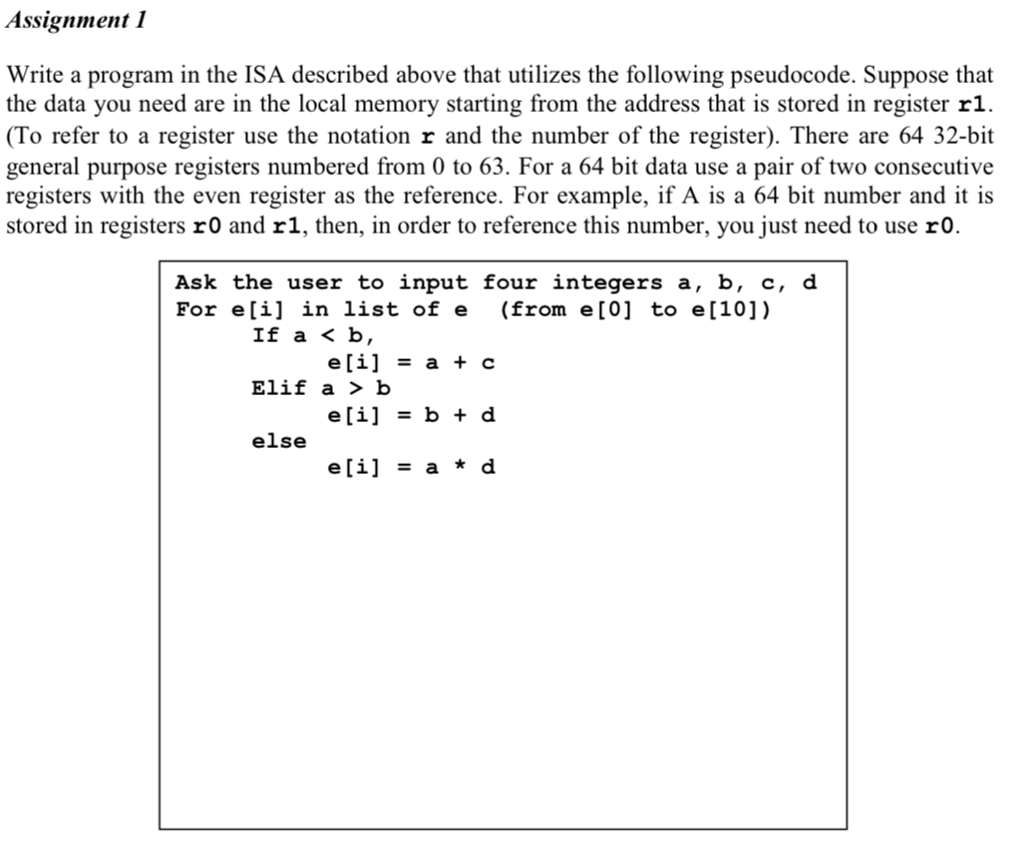
Assignment 1 Write a program in the ISA described above that utilizes the following pseudocode. Suppose that the data you need are in the local memory starting from the address that is stored in register rl. (To refer to a register use the notation r and the number of the register). There are 64 32-bit general purpose registers numbered from 0 to 63. For a 64 bit data use a pair of two consecutive registers with the even register as the reference. For example, if A is a 64 bit number and it is stored in registers rO and r1, then, in order to reference this number, you just need to use ro. Ask the user to input four integers a, b, c, d For e[i] in list of e (from e[0] to e[10]) If ab, Elif a > b else e[i] e[i] = a + c e[i] = b + d Assignment 1 Write a program in the ISA described above that utilizes the following pseudocode. Suppose that the data you need are in the local memory starting from the address that is stored in register rl. (To refer to a register use the notation r and the number of the register). There are 64 32-bit general purpose registers numbered from 0 to 63. For a 64 bit data use a pair of two consecutive registers with the even register as the reference. For example, if A is a 64 bit number and it is stored in registers rO and r1, then, in order to reference this number, you just need to use ro. Ask the user to input four integers a, b, c, d For e[i] in list of e (from e[0] to e[10]) If ab, Elif a > b else e[i] e[i] = a + c e[i] = b + d
Step by Step Solution
There are 3 Steps involved in it

Get step-by-step solutions from verified subject matter experts
 Study Help