







Question: please do not copy and past the answers and also do not do too long answers. thank you from: Essentials of Management Information Systems, 13th
please do not copy and past the answers and also do not do too long answers. thank you
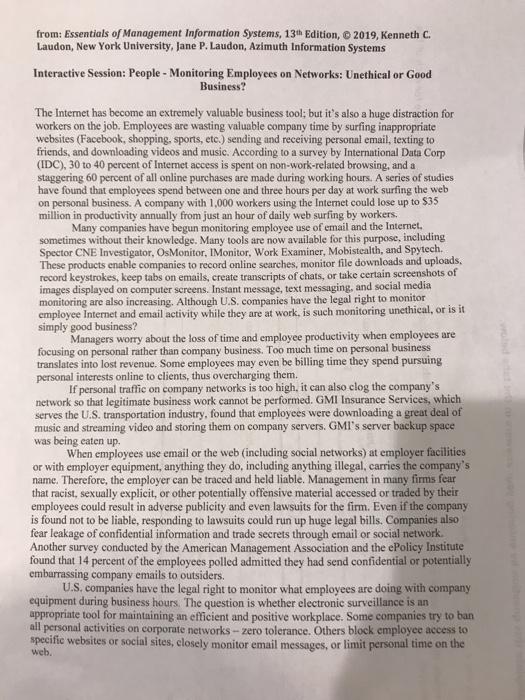
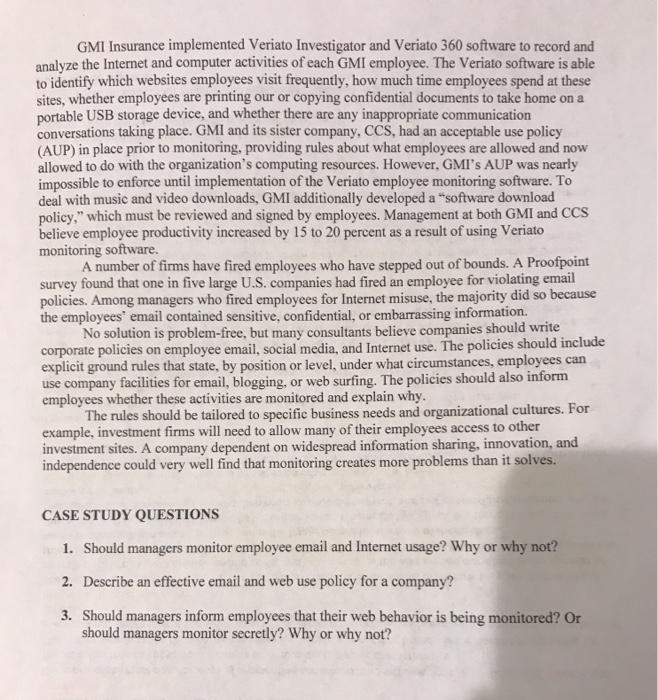
from: Essentials of Management Information Systems, 13th Edition, 2019, Kenneth C. Laudon, New York University, Jane P. Laudon, Azimuth Information Systems Interactive Session: People - Monitoring Employees on Networks: Unethical or Good Business? The Internet has become an extremely valuable business tool; but it's also a huge distraction for workers on the job. Employees are wasting valuable company time by surfing inappropriate websites (Facebook, shopping, sports, etc.) sending and receiving personal email , texting to friends, and downloading videos and music. According to a survey by International Data Corp (IDC), 30 to 40 percent of Internet access is spent on non-work-related browsing, and a staggering 60 percent of all online purchases are made during working hours. A series of studies have found that employees spend between one and three hours per day at work surfing the web on personal business. A company with 1,000 workers using the Internet could lose up to $35 million in productivity annually from just an hour of daily web surfing by workers. Many companies have begun monitoring employee use of email and the Internet. sometimes without their knowledge. Many tools are now available for this purpose, including Spector CNE Investigator, OsMonitor, Monitor, Work Examiner, Mobistealth, and Spytech. These products enable companies to record online searches, monitor file downloads and uploads record keystrokes, keep tabs on emails, create transcripts of chats, or take certain screenshots of images displayed on computer screens. Instant message, text messaging, and social media monitoring are also increasing. Although U.S. companies have the legal right to monitor employee Internet and email activity while they are at work, is such monitoring unethical, or is it simply good business? Managers worry about the loss of time and employee productivity when employees are focusing on personal rather than company business. Too much time on personal business translates into lost revenue. Some employees may even be billing time they spend pursuing personal interests online to clients, thus overcharging them. If personal traffic on company networks is too high, it can also clog the company's network so that legitimate business work cannot be performed. GMI Insurance Services, which serves the U.S. transportation industry, found that employees were downloading a great deal of music and streaming video and storing them on company servers. GMI's server backup space was being eaten up When employees use email or the web (including social networks) at employer facilities or with employer equipment, anything they do, including anything illegal, carries the company's name. Therefore, the employer can be traced and held liable. Management in many firms fear that racist, sexually explicit, or other potentially offensive material accessed or traded by their employees could result in adverse publicity and even lawsuits for the firm. Even if the company is found not to be liable, responding to lawsuits could run up huge legal bills. Companies also fear leakage of confidential information and trade secrets through email or social network Another survey conducted by the American Management Association and the ePolicy Institute found that 14 percent of the employees polled admitted they had send confidential or potentially emburrassing company emails to outsiders. U.S. companies have the legal right to monitor what employees are doing with company equipment during business hours. The question is whether electronic surveillance is an appropriate tool for maintaining an efficient and positive workplace. Some companies try to ban all personal activities on corporate networks - zero tolerance. Others block employee access to specific websites or social sites, closely monitor email messages, or limit personal time on the web. GMI Insurance implemented Veriato Investigator and Veriato 360 software to record and analyze the Internet and computer activities of each GMI employee. The Veriato software is able to identify which websites employees visit frequently, how much time employees spend at these sites, whether employees are printing our or copying confidential documents to take home on a portable USB storage device, and whether there are any inappropriate communication conversations taking place. GMI and its sister company, CCS, had an acceptable use policy (AUP) in place prior to monitoring, providing rules about what employees are allowed and now allowed to do with the organization's computing resources. However, GMI'S AUP was nearly impossible to enforce until implementation of the Veriato employee monitoring software. To deal with music and video downloads, GMI additionally developed a "software download policy," which must be reviewed and signed by employees. Management at both GMI and CCS believe employee productivity increased by 15 to 20 percent as a result of using Veriato monitoring software. A number of firms have fired employees who have stepped out of bounds. A Proofpoint survey found that one in five large U.S. companies had fired an employee for violating email policies. Among managers who fired employees for Internet misuse, the majority did so because the employees' email contained sensitive, confidential, or embarrassing information. No solution is problem-free, but many consultants believe companies should write corporate policies on employee email, social media, and Internet use. The policies should include explicit ground rules that state, by position or level, under what circumstances, employees can use company facilities for email, blogging, or web surfing. The policies should also inform employees whether these activities are monitored and explain why. The rules should be tailored to specific business needs and organizational cultures. For example, investment firms will need to allow many of their employees access to other investment sites. A company dependent on widespread information sharing, innovation, and independence could very well find that monitoring creates more problems than it solves. CASE STUDY QUESTIONS 1. Should managers monitor employee email and Internet usage? Why or why not? 2. Describe an effective email and web use policy for a company? 3. Should managers inform employees that their web behavior is being monitored? Or should managers monitor secretly? Why or why not Step by Step Solution
There are 3 Steps involved in it
1 Expert Approved Answer
Step: 1 Unlock

Question Has Been Solved by an Expert!
Get step-by-step solutions from verified subject matter experts
Step: 2 Unlock
Step: 3 Unlock
 Study Help