







Question: PLEASE DO NOT COPY PASTE FROM CHEGG/OTHERWISE I'LL REPORT YOU Selection Statements for the Theory Review Selection statements in Java allow you to choose actions
PLEASE DO NOT COPY PASTE FROM CHEGG/OTHERWISE I'LL REPORT YOU
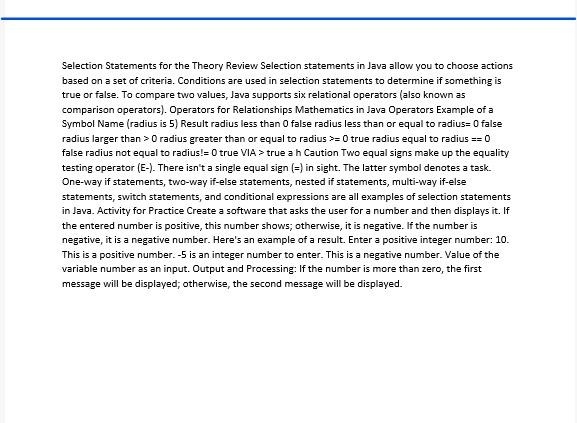
Selection Statements for the Theory Review Selection statements in Java allow you to choose actions based on a set of criteria. Conditions are used in selection statements to determine if something is true or false. To compare two values, Java supports six relational operators (also known as comparison operators). Operators for Relationships Mathematics in Java Operators Example of a Symbol Name (radius is 5) Result radius less than 0 false radius less than or equal to radius= 0 false radius larger than > O radius greater than or equal to radius >= 0 true radius equal to radius == 0 false radius not equal to radius!= 0 true VIA > true a h Caution Two equal signs make up the equality testing operator (E-). There isn't a single equal sign (=) in sight. The latter symbol denotes a task. One-way if statements, two-way if-else statements, nested if statements, multi-way if-else statements, switch statements, and conditional expressions are all examples of selection statements in Java. Activity for Practice Create a software that asks the user for a number and then displays it. If the entered number is positive, this number shows; otherwise, it is negative. If the number is negative, it is a negative number. Here's an example of a result. Enter a positive integer number: 10. This is a positive number. -5 is an integer number to enter. This is a negative number. Value of the variable number as an input. Output and Processing: If the number is more than zero, the first message will be displayed; otherwise, the second message will be displayed
Step by Step Solution
There are 3 Steps involved in it

Get step-by-step solutions from verified subject matter experts
 Study Help