







Question: PLEASE DO NOT COPY PASTE FROM OTHER ANSWERS ON CHEGG, AND IF YOU KNOW COMPLETE ANSWER THEN ONLY ANSWER, OTHERWISE SKIP IT. IF IT IS
PLEASE DO NOT COPY PASTE FROM OTHER ANSWERS ON CHEGG, AND IF YOU KNOW COMPLETE ANSWER THEN ONLY ANSWER, OTHERWISE SKIP IT. IF IT IS WRONG THEN I WILL DOWNVOTE AND REPORT YOUR ANSWER.
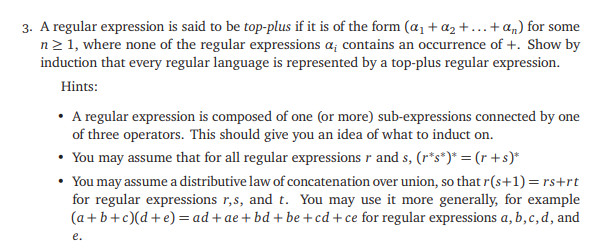
3. A regular expression is said to be top-plus if it is of the form (Q1 + a2 + ... +an) for some n> 1, where none of the regular expressions a contains an occurrence of +. Show by induction that every regular language is represented by a top-plus regular expression. Hints: A regular expression is composed of one or more) sub-expressions connected by one of three operators. This should give you an idea of what to induct on. You may assume that for all regular expressions r and s, (r*s*)* =(r +s)* You may assume a distributive law of concatenation over union, so that r(s+1)=rs+rt for regular expressions r,s, and t. You may use it more generally, for example (a+b+c)(d+e)= ad + ae+bd+be+cd + ce for regular expressions a, b,c,d, and e
Step by Step Solution
There are 3 Steps involved in it

Get step-by-step solutions from verified subject matter experts
 Study Help