







Question: PLEASE DO NOT COPY THE ANSWER FROM THE OTHER EXISTING QUESTIONS THAT THE BEGINIG IS THE SAME .PLEASE READ THE QUESTION UNTIL THE END. 2
PLEASE DO NOT COPY THE ANSWER FROM THE OTHER EXISTING QUESTIONS THAT THE BEGINIG IS THE SAME .PLEASE READ THE QUESTION UNTIL THE END.
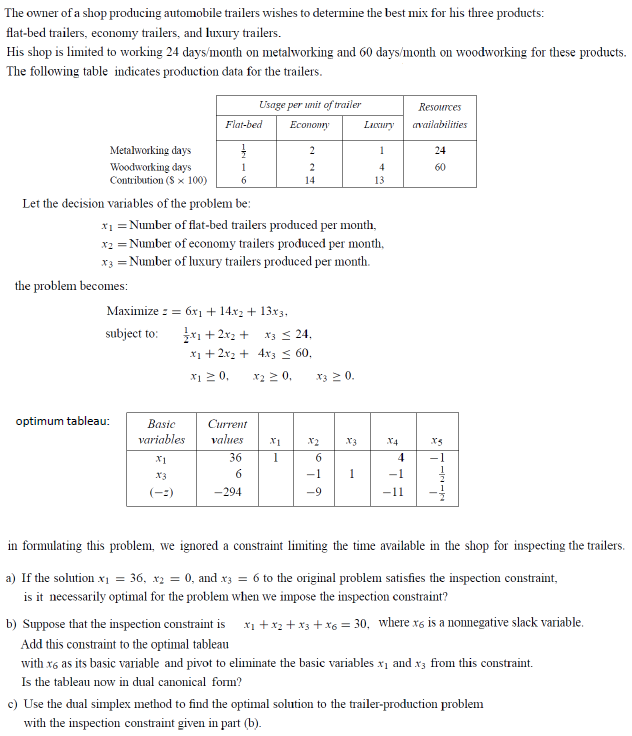
2 1 24 1 6 2 14 4 13 The owner of a shop producing automobile trailers wishes to determine the best mix for his three products: flat-bed trailers, economy trailers, and luxury trailers. His shop is limited to working 24 days/month on metalworking and 60 days/month on woodworking for these products. The following table indicates production data for the trailers. Usage per mir of trailer Resources Flat-bed Economy Luxury availabilities Metalworking days } Woodworking days Contribution (8 x 100) Let the decision variables of the problem be: x1 = Number of flat-bed trailers produced per month, x2 = Number of economy trailers produced per month, x3 = Number of luxury trailers produced per month. the problem becomes Maximize : = 6x1 +14.x2 + 13.43, subject to: * +212 + x1 + 2x2 + 4x3 0 X3 > 0. x'3 24. optimum tableau: Basic variables .84 Current values 36 6 -294 Yg -1 1 6 -1 1 .33 (-) 4 -1 -11 -9 in formulating this problem, we ignored a constraint limiting the time available in the shop for inspecting the trailers. a) If the solution x = 36, 12 = 0, and x3 = 6 to the original problem satisfies the inspection constraint, is it necessarily optimal for the problem when we impose the inspection constraint? b) Suppose that the inspection constraint is x1 + x2 + x3 + x6 = 30, where x6 is a nonnegative slack variable, Add this constraint to the optimal tableau with 26 as its basic variable and pivot to eliminate the basic variables x and x3 from this constraint. Is the tableau now in dual canonical form? c) Use the dual simplex method to find the optimal solution to the trailer-production problem with the inspection constraint given in part (b). 2 1 24 1 6 2 14 4 13 The owner of a shop producing automobile trailers wishes to determine the best mix for his three products: flat-bed trailers, economy trailers, and luxury trailers. His shop is limited to working 24 days/month on metalworking and 60 days/month on woodworking for these products. The following table indicates production data for the trailers. Usage per mir of trailer Resources Flat-bed Economy Luxury availabilities Metalworking days } Woodworking days Contribution (8 x 100) Let the decision variables of the problem be: x1 = Number of flat-bed trailers produced per month, x2 = Number of economy trailers produced per month, x3 = Number of luxury trailers produced per month. the problem becomes Maximize : = 6x1 +14.x2 + 13.43, subject to: * +212 + x1 + 2x2 + 4x3 0 X3 > 0. x'3 24. optimum tableau: Basic variables .84 Current values 36 6 -294 Yg -1 1 6 -1 1 .33 (-) 4 -1 -11 -9 in formulating this problem, we ignored a constraint limiting the time available in the shop for inspecting the trailers. a) If the solution x = 36, 12 = 0, and x3 = 6 to the original problem satisfies the inspection constraint, is it necessarily optimal for the problem when we impose the inspection constraint? b) Suppose that the inspection constraint is x1 + x2 + x3 + x6 = 30, where x6 is a nonnegative slack variable, Add this constraint to the optimal tableau with 26 as its basic variable and pivot to eliminate the basic variables x and x3 from this constraint. Is the tableau now in dual canonical form? c) Use the dual simplex method to find the optimal solution to the trailer-production problem with the inspection constraint given in part (b)
Step by Step Solution
There are 3 Steps involved in it
1 Expert Approved Answer
Step: 1 Unlock

Question Has Been Solved by an Expert!
Get step-by-step solutions from verified subject matter experts
Step: 2 Unlock
Step: 3 Unlock
 Study Help