







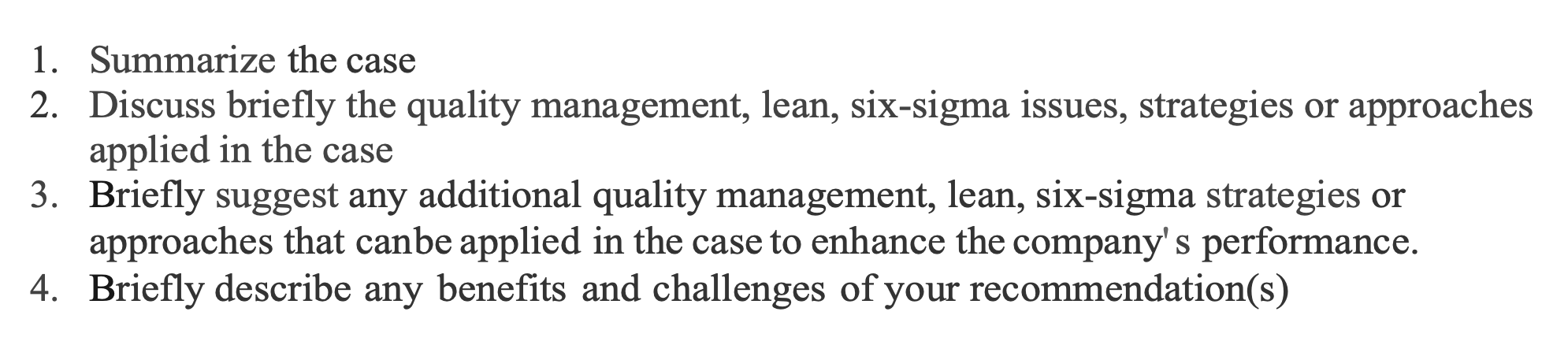
Question: please do not plagiarize, thank you! 1. Summarize the case 2. Discuss briefly the quality management, lean, six-sigma issues, strategies or approaches applied in the
please do not plagiarize, thank you!
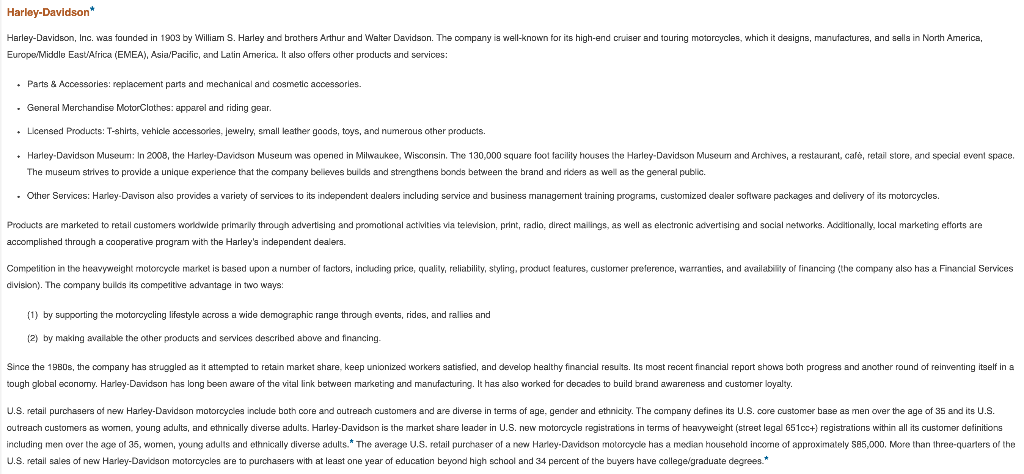
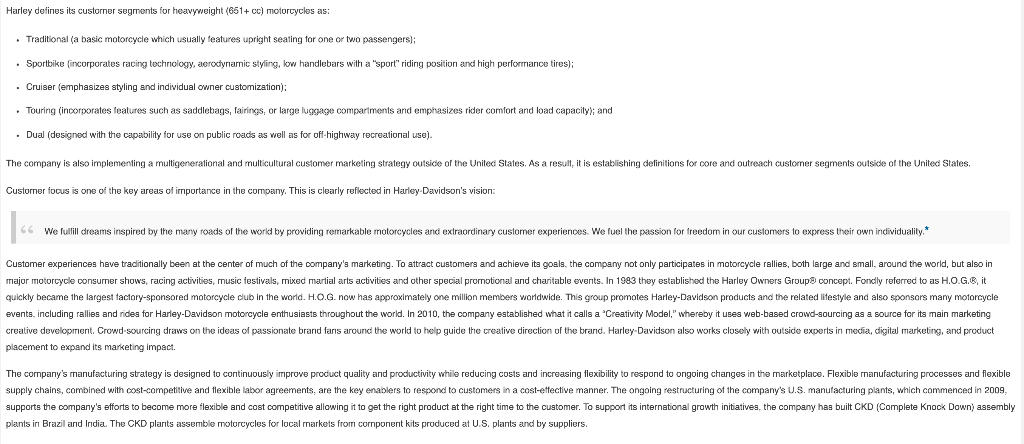
1. Summarize the case 2. Discuss briefly the quality management, lean, six-sigma issues, strategies or approaches applied in the case 3. Briefly suggest any additional quality management, lean, six-sigma strategies or approaches that canbe applied in the case to enhance the company's performance. 4. Briefly describe any benefits and challenges of your recommendation(s) Harley-Davidson Harley-Davidson, Inc. was founded in 1903 by William S. Harley and brothers Arthur and Walter Davidson. The company is well-known for its high-end cruiser and touring motorcycles, which it designs, manufactures, and sells in North America, Europe/Middle East Africa (EMEA), Asia/Pacific, and Latin America. It also offers other products and services: Parts & Accessories: replacement parts and mechanical and cosmetic accessories. . General Merchandise MotorClothes: apparel and riding gear. Licensed Products: T-shirts, vehicle accessories, Jewelry, small leather goods, toys, and numerous other products. Harley-Davidson Museum: In 2008, the Harley-Davidson Museum was opened in Milwaukee, Wisconsin. The 130,000 square foot facility houses the Harley-Davidson Museum and Archives, a restaurant, caf, retail store, and special event space. The museum strives to provide a unique experience that the company believes builds and strengthens bonds between the brand and riders as well as the general public Other Services: Harley-Davison also provides a variety of services to its independent dealers including service and business management training programs, customized dealer software packages and delivery of its motorcycles. Products are marketed to retail customers worldwide primarily through advertising and promotional activities via television, print, radio, direct mailings, as well as electronic advertising and social networks. Additionally, local marketing efforts are accomplished through a cooperative program with the Harley's independent dealers. Compelition in the heavyweight motorcycle market is based upon a number of factors, including price, quality, reliability, styling, product features, customer preference, warranties, and availability of financing the company also has a Financial Services division). The company builds its competitive advantage in two ways: (1) by supporting the motorcycling lifestyle across a wide demographic range through events, rides, and rallies and (2) by making available the other products and services described above and financing Since the 1980s, the company has struggled as it attempted to retain market share, keep unionized workers satisfied, and develop healthy financial results. Its most recent financial report shows both progress and another round of reinventing itself in a tough global economy. Harley-Davidson has long been aware of the vital link between marketing and manufacturing. It has also worked for decades to build brand awareness and customer loyalty. U.S. retail purchasers of new Harley-Davidson motorcycles include both core and outreach customers and are diverse in terms of age, gender and ethnicity. The company defines its U.S. core customer base as men over the age of 35 and its U.S. outreach customers as women, young adults, and ethnically diverse adults. Harley-Davidson is the market share leader in U.S. new motorcycle registrations in terms of heavyweight (street legal 65100+) registrations within all its customer definitions including men over the age of 35, women, young adults and ethnically diverse adults.* The average U.S. retail purchaser of a new Harley-Davidson motorcycle has a median household income of approximately 585,000. More than three-quarters of the U.S. retail sales of new Harley-Davidson motorcycles are to purchasers with at least one year of education beyond high school and 34 percent of the buyers have college graduate degrees.* Harley defines its customer segments for heavyweight (651+ cc) motorcycles as: Traditional (a basic motorcycle which usually features upright seating for one or two passengers); Sportbike Cincorporates racing technology, aerodynarnic styling, low handlebars with a "sport" riding position and high performance tires); . Cruiser (emphasizes styling and individual owner customization); Touring (incorporates features such as saddlebags, fairings, or large luggage compartments and emphasizes rider comfort and load capacity); and Dual (designed with the capability for use on public roads as well as for off-highway recreational use). The company is also implementing a multigenerational and multicultural customer marketing strategy outside of the United States. As a result, it is establishing definitions for core and outreach customer segments outside of the United States. Customer focus is one of the key areas of importance in the company. This is clearly reflected in Harley Davidson's vision: CG We fulfill dreams inspired by the many roads of the world by providing remarkable motorcycles and extraordinary customer experiences. We fuel the passion for freedom in our customers to express their own individuality.* Customer experiences have traditionally been at the center of much of the company's marketing. To attract customers and achieve its goals, the company not only participates in motorcycle rallies, both large and small around the world, but also in major motorcycle consumer shows, racing activities, music festivals, mixed martial arts activities and other special promotional and charitable events. In 1983 they established the Harley Owners Group concept. Fondly referred to as H.O.G.B, it quickly became the largest factory-sponsored motorcycle club in the world. H.O.G. now has approximately one million members worldwide. This group promotes Harley-Davidson products and the related lifestyle and also sponsors many motorcycle events, including rallies and rides for Harley-Davidson motorcycle enthusiasts throughout the world. In 2010, the company established what it calls a Creativity Model," whereby it uses web-based crowd-sourcing as a source for its main marketing Creative development. Crowd-sourcing draws on the ideas of passionate brand faris around the world to help guide the creative direction of the brand. Harley-Davidson also works closely with outside experts in media, digital marketing, and product placement to expand its marketing Impact. The company's manufacturing strategy is designed to continuously improve product quality and productivity while reducing costs and increasing flexibility to respond to ongoing changes in the marketplace. Flexible manufacturing processes and flexible supply chains, combined with cost-competitive and flexible labor agreements are the key enablers to respond to customers in a cost-effective manner. The ongoing restructuring of the company's U.S. manufacturing plants, which commenced in 2009, supports the company's efforts to become more flexible and cost competitive allowing it to get the right product at the right time to the customer. To support its international growth initiatives, the company has built CKD (Complete Knock Down) assembly plants in Brazil and India. The CKD plants assemble motorcycles for local markets from component kits produced at U.S. plants and by suppliersStep by Step Solution
There are 3 Steps involved in it
1 Expert Approved Answer
Step: 1 Unlock

Question Has Been Solved by an Expert!
Get step-by-step solutions from verified subject matter experts
Step: 2 Unlock
Step: 3 Unlock
 Study Help