







Question: Please do part B 4-16. Consecutive Reactions with One Unknown Concentration The analysis of diffusion with consecutive reactions in Example 4.4-1 focused on the interior
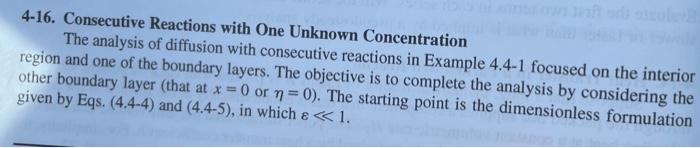
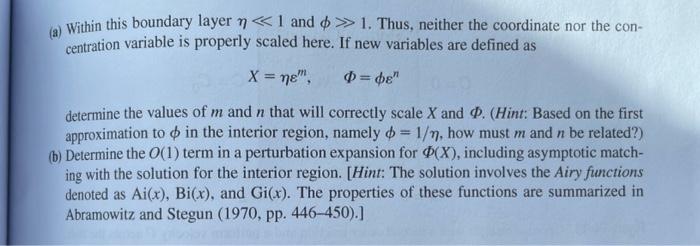
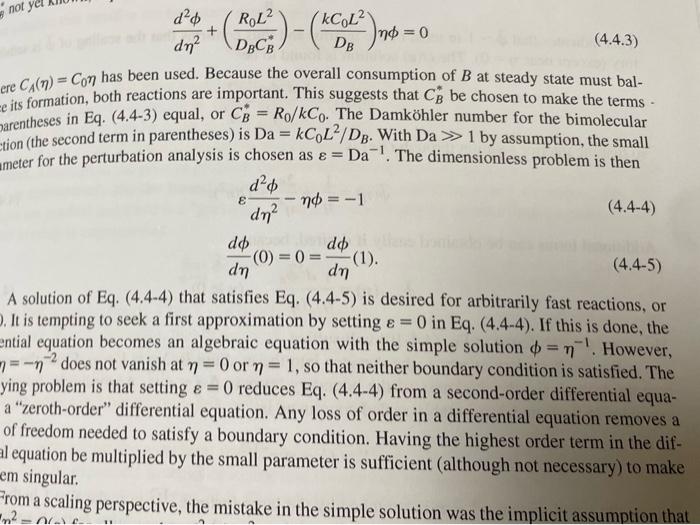
4-16. Consecutive Reactions with One Unknown Concentration The analysis of diffusion with consecutive reactions in Example 4.4-1 focused on the interior region and one of the boundary layers. The objective is to complete the analysis by considering the other boundary layer (that at x=0 or =0 ). The starting point is the dimensionless formulation given by Eqs. (4.4-4) and (4.4-5), in which 1. (a) Within this boundary layer 1 and 1. Thus, neither the coordinate nor the concentration variable is properly scaled here. If new variables are defined as X=m,=n determine the values of m and n that will correctly scale X and . (Hint: Based on the first approximation to in the interior region, namely =1/, how must m and n be related?) (b) Determine the O(1) term in a perturbation expansion for (X), including asymptotic matching with the solution for the interior region. [Hint: The solution involves the Airy functions denoted as Ai(x),Bi(x), and Gi(x). The properties of these functions are summarized in Abramowitz and Stegun (1970, pp. 446-450).] d2d2+(DBCBR0L2)(DBkC0L2)=0 ere CA()=C0 has been used. Because the overall consumption of B at steady state must balits formation, both reactions are important. This suggests that CB be chosen to make the terms arentheses in Eq. (4.4-3) equal, or CB=R0/kC0. The Damkhler number for the bimolecular tion (the second term in parentheses) is Da=kC0L2/DB. With Da1 by assumption, the small meter for the perturbation analysis is chosen as =Da1. The dimensionless problem is then d2d2=1dd(0)=0=dd(1). A solution of Eq. (4.4-4) that satisfies Eq. (4.4-5) is desired for arbitrarily fast reactions, or It is tempting to seek a first approximation by setting =0 in Eq. (4.4-4). If this is done, the ential equation becomes an algebraic equation with the simple solution =1. However, =2 does not vanish at =0 or =1, so that neither boundary condition is satisfied. The ying problem is that setting =0 reduces Eq.(4.44) from a second-order differential equaa "zeroth-order" differential equation. Any loss of order in a differential equation removes a of freedom needed to satisfy a boundary condition. Having the highest order term in the difal equation be multiplied by the small parameter is sufficient (although not necessary) to make em singular. rom a scaling perspective, the mistake in the simple solution was the implicit assumption that 4-16. Consecutive Reactions with One Unknown Concentration The analysis of diffusion with consecutive reactions in Example 4.4-1 focused on the interior region and one of the boundary layers. The objective is to complete the analysis by considering the other boundary layer (that at x=0 or =0 ). The starting point is the dimensionless formulation given by Eqs. (4.4-4) and (4.4-5), in which 1. (a) Within this boundary layer 1 and 1. Thus, neither the coordinate nor the concentration variable is properly scaled here. If new variables are defined as X=m,=n determine the values of m and n that will correctly scale X and . (Hint: Based on the first approximation to in the interior region, namely =1/, how must m and n be related?) (b) Determine the O(1) term in a perturbation expansion for (X), including asymptotic matching with the solution for the interior region. [Hint: The solution involves the Airy functions denoted as Ai(x),Bi(x), and Gi(x). The properties of these functions are summarized in Abramowitz and Stegun (1970, pp. 446-450).] d2d2+(DBCBR0L2)(DBkC0L2)=0 ere CA()=C0 has been used. Because the overall consumption of B at steady state must balits formation, both reactions are important. This suggests that CB be chosen to make the terms arentheses in Eq. (4.4-3) equal, or CB=R0/kC0. The Damkhler number for the bimolecular tion (the second term in parentheses) is Da=kC0L2/DB. With Da1 by assumption, the small meter for the perturbation analysis is chosen as =Da1. The dimensionless problem is then d2d2=1dd(0)=0=dd(1). A solution of Eq. (4.4-4) that satisfies Eq. (4.4-5) is desired for arbitrarily fast reactions, or It is tempting to seek a first approximation by setting =0 in Eq. (4.4-4). If this is done, the ential equation becomes an algebraic equation with the simple solution =1. However, =2 does not vanish at =0 or =1, so that neither boundary condition is satisfied. The ying problem is that setting =0 reduces Eq.(4.44) from a second-order differential equaa "zeroth-order" differential equation. Any loss of order in a differential equation removes a of freedom needed to satisfy a boundary condition. Having the highest order term in the difal equation be multiplied by the small parameter is sufficient (although not necessary) to make em singular. rom a scaling perspective, the mistake in the simple solution was the implicit assumption that
Step by Step Solution
There are 3 Steps involved in it

Get step-by-step solutions from verified subject matter experts
 Study Help