







Question: PLEASE DO PART E USING THE INSTRUCTIONS PROVIDED A CU triaxial test ( axial compression ) on a specimen of saturated overconsolidated clay was carried
PLEASE DO PART E USING THE INSTRUCTIONS PROVIDED
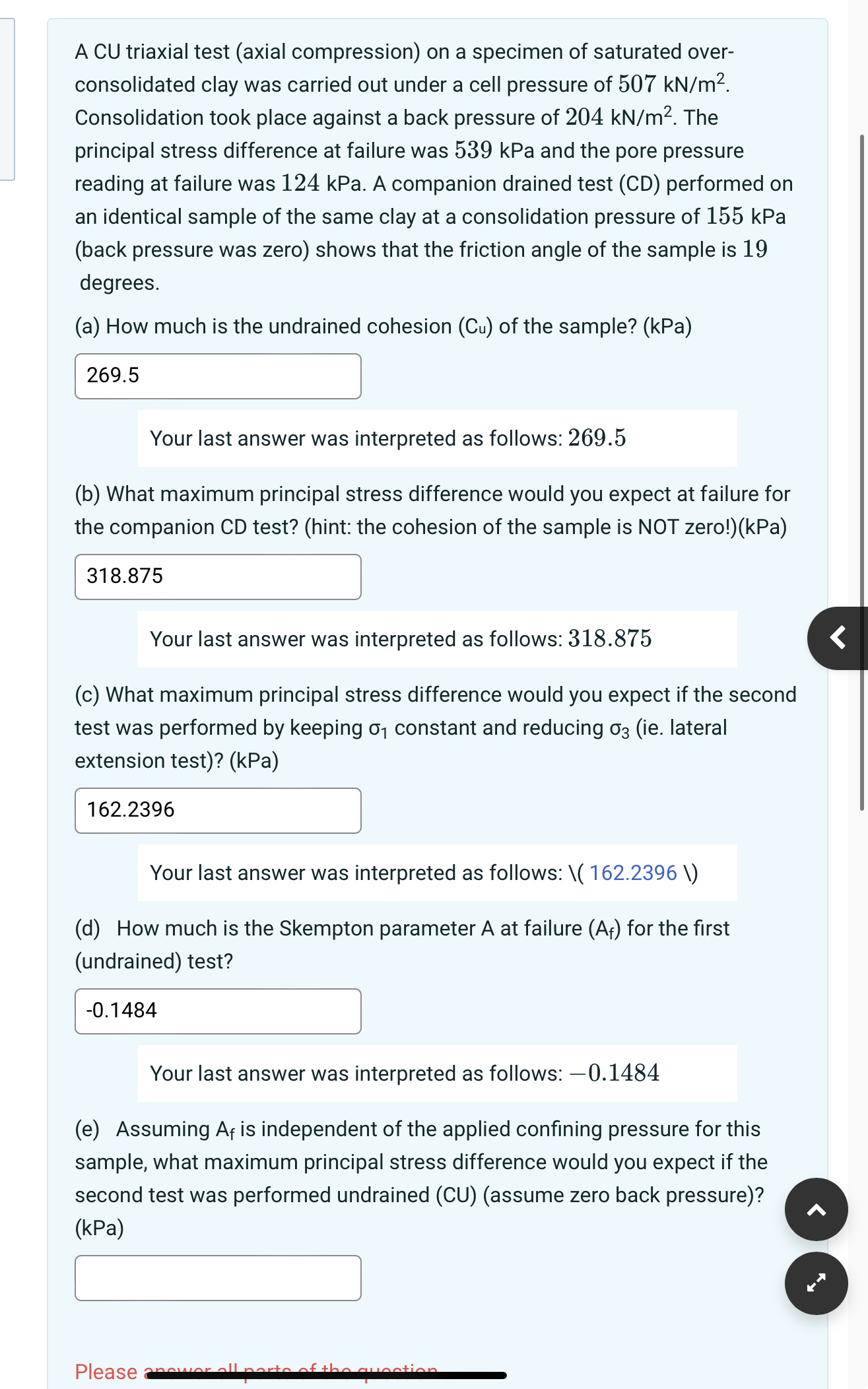
A CU triaxial test axial compression on a specimen of saturated overconsolidated clay was carried out under a cell pressure of mathrmkNmathrmm Consolidation took place against a back pressure of mathrmkNmathrmm The principal stress difference at failure was kPa and the pore pressure reading at failure was kPa A companion drained test CD performed on an identical sample of the same clay at a consolidation pressure of kPa back pressure was zero shows that the friction angle of the sample is degrees.
a How much is the undrained cohesion mathrmCu of the sample? mathrmkPa
Your last answer was interpreted as follows:
b What maximum principal stress difference would you expect at failure for the companion CD test? hint: the cohesion of the sample is NOT zero!kPa
Your last answer was interpreted as follows:
c What maximum principal stress difference would you expect if the second test was performed by keeping sigma constant and reducing sigmaie lateral extension testkPa
Your last answer was interpreted as follows:
d How much is the Skempton parameter A at failure leftAfright for the first undrained test?
Your last answer was interpreted as follows:
e Assuming mathrmAmathrmf is independent of the applied confining pressure for this sample, what maximum principal stress difference would you expect if the second test was performed undrained CUassume zero back pressurekPa
Part e is obtained by using simultaneous equations. The value Af for part d is used to setup
the equation for part e with uf deltasigmafinal Af Note that this deltasigmafinal is
what we are trying to find. Using the Mohr circle of total stress, you can shift that circle using uf
to get the effective stress Mohr circle. Sigmadash and sigmadash values will then be in
terms of uf and deltasigmafinal which you can put in any of the MohrCoulomb criterion
equations and solve simultaneously.
Part e is obtained by using simultaneous equations. The value Af for part d is used to setup
the equation for part e with uf deltasigmafinal Af Note that this deltasigmafinal is
what we are trying to find. Using the Mohr circle of total stress, you can shift that circle using uf
to get the effective stress Mohr circle. Sigmadash and sigmadash values will then be in
terms of uf and deltasigmafinal which you can put in any of the MohrCoulomb criterion
equations and solve simultaneously.
Step by Step Solution
There are 3 Steps involved in it
1 Expert Approved Answer
Step: 1 Unlock

Question Has Been Solved by an Expert!
Get step-by-step solutions from verified subject matter experts
Step: 2 Unlock
Step: 3 Unlock
 Study Help