Question: please do Question 1 Multiple-choice questions: Select one (1) correct answer for each of the following unless stated otherwise. In your answer booklet, write down

please do Question 1 please do Question 1 Multiple-choice questions:
please do Question 1 Multiple-choice questions:
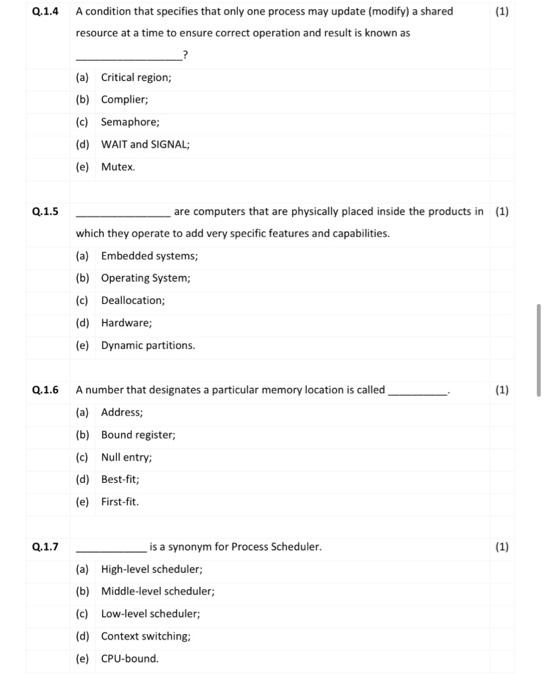
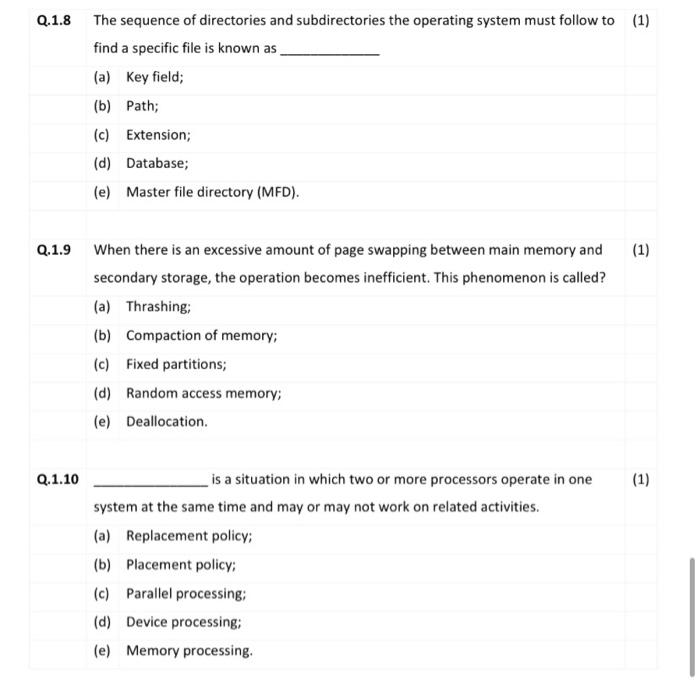
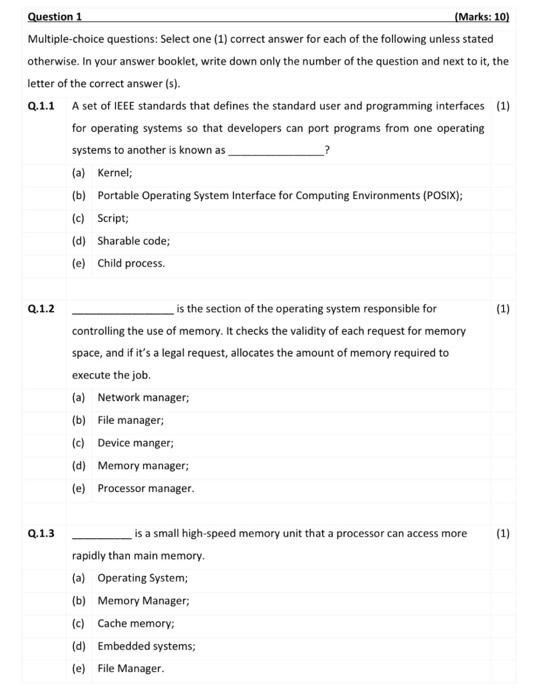
Multiple-choice questions: Select one (1) correct answer for each of the following unless stated otherwise. In your answer booklet, write down only the number of the question and next to it, the letter of the correct answer (s). Q.1.1 A set of IEEE standards that defines the standard user and programming interfaces for operating systems so that developers can port programs from one operating systems to another is known as ? (a) Kernel; (b) Portable Operating System Interface for Computing Environments (POSIX); (c) Script; (d) Sharable code; (e) Child process. Q.1.2 is the section of the operating system responsible for (1) controlling the use of memory. It checks the validity of each request for memory space, and if it's a legal request, allocates the amount of memory required to execute the job. (a) Network manager; (b) File manager; (c) Device manger; (d) Memory manager; (e) Processor manager. Q.1.3 is a small high-speed memory unit that a processor can access more (1) rapidly than main memory. (a) Operating System; (b) Memory Manager; (c) Cache memory; (d) Embedded systems; (e) File Manager. Q.1.4 A condition that specifies that only one process may update (modify) a shared resource at a time to ensure correct operation and result is known as ? (a) Critical region; (b) Complier; (c) Semaphore; (d) WAIT and SIGNAL; (e) Mutex. Q.1.5 are computers that are physically placed inside the products in (1) which they operate to add very specific features and capabilities. (a) Embedded systems; (b) Operating System; (c) Deallocation; (d) Hardware; (e) Dynamic partitions. Q.1.6 A number that designates a particular memory location is called (1) (a) Address; (b) Bound register; (c) Null entry; (d) Best-fit; (e) First-fit. Q.1.7 is a synonym for Process Scheduler. (1) (a) High-level scheduler; (b) Middle-level scheduler; (c) Low-level scheduler; (d) Context switching; (e) CPU-bound. Q.1.8 The sequence of directories and subdirectories the operating system must follow to find a specific file is known as (a) Key field; (b) Path; (c) Extension; (d) Database; (e) Master file directory (MFD). Q.1.9 When there is an excessive amount of page swapping between main memory and secondary storage, the operation becomes inefficient. This phenomenon is called? (a) Thrashing; (b) Compaction of memory; (c) Fixed partitions; (d) Random access memory; (e) Deallocation. Q.1.10 is a situation in which two or more processors operate in one system at the same time and may or may not work on related activities. (a) Replacement policy; (b) Placement policy; (c) Parallel processing; (d) Device processing; (e) Memory processing

Step by Step Solution

There are 3 Steps involved in it

1 Expert Approved Answer
Step: 1 Unlock blur-text-image

Question Has Been Solved by an Expert!

Get step-by-step solutions from verified subject matter experts

Step: 2 Unlock
Step: 3 Unlock

Students Have Also Explored These Related General Management Questions!