







Question: Please do this in the excel! Abbott Lab's market value plunged more than ( $ 5 ) billion or six percent in
Please do this in the excel!
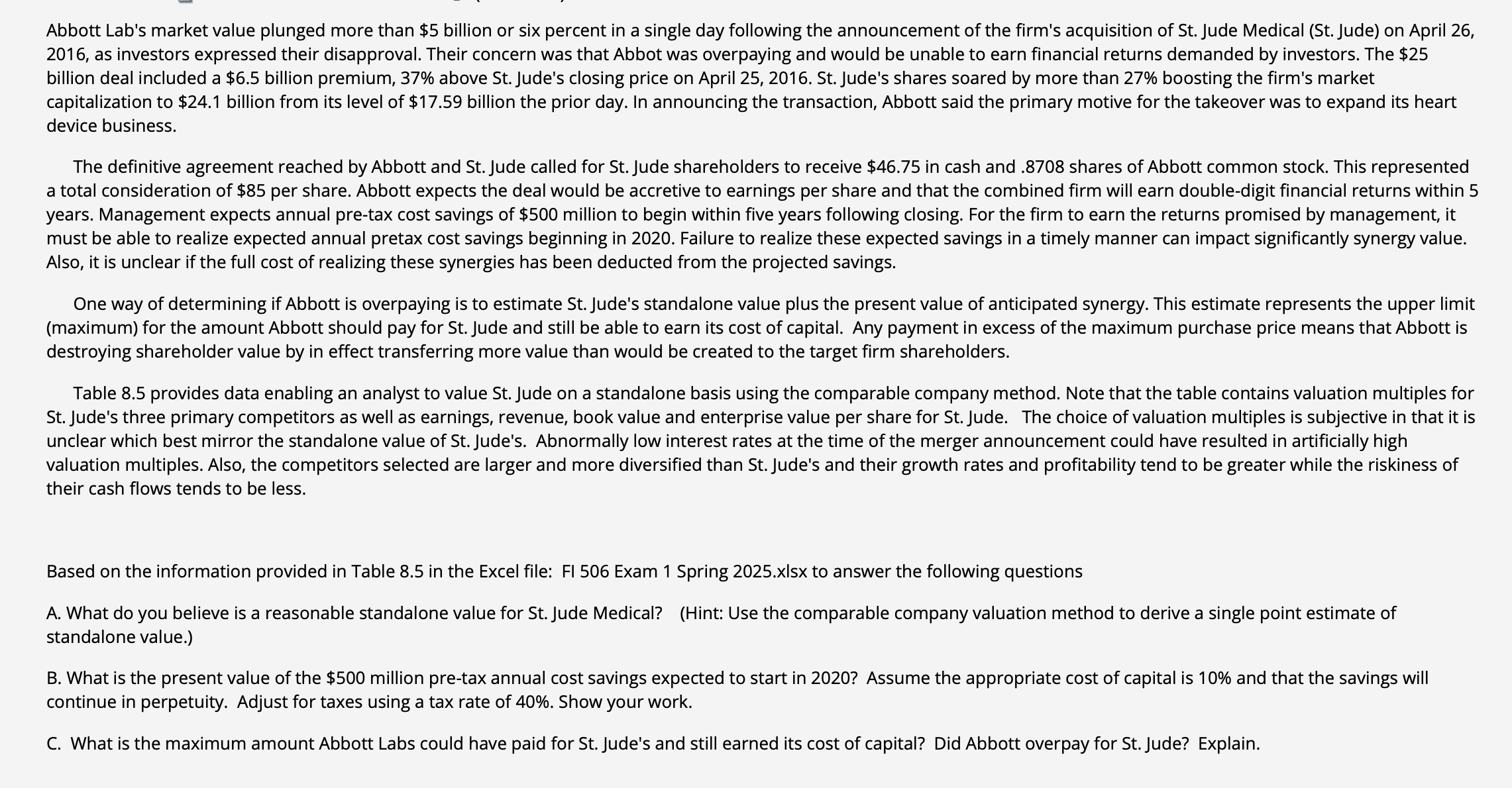
Abbott Lab's market value plunged more than $ billion or six percent in a single day following the announcement of the firm's acquisition of St Jude Medical St Jude on April as investors expressed their disapproval. Their concern was that Abbot was overpaying and would be unable to earn financial returns demanded by investors. The $ billion deal included a $ billion premium, above St Jude's closing price on April St Jude's shares soared by more than boosting the firm's market capitalization to $ billion from its level of $ billion the prior day. In announcing the transaction, Abbott said the primary motive for the takeover was to expand its heart device business. The definitive agreement reached by Abbott and St Jude called for St Jude shareholders to receive $ in cash and shares of Abbott common stock. This represented a total consideration of $ per share. Abbott expects the deal would be accretive to earnings per share and that the combined firm will earn doubledigit financial returns within years. Management expects annual pretax cost savings of $ million to begin within five years following closing. For the firm to earn the returns promised by management, it must be able to realize expected annual pretax cost savings beginning in Failure to realize these expected savings in a timely manner can impact significantly synergy value. Also, it is unclear if the full cost of realizing these synergies has been deducted from the projected savings. One way of determining if Abbott is overpaying is to estimate St Jude's standalone value plus the present value of anticipated synergy. This estimate represents the upper limit maximum for the amount Abbott should pay for St Jude and still be able to earn its cost of capital. Any payment in excess of the maximum purchase price means that Abbott is destroying shareholder value by in effect transferring more value than would be created to the target firm shareholders. Table provides data enabling an analyst to value St Jude on a standalone basis using the comparable company method. Note that the table contains valuation multiples for St Jude's three primary competitors as well as earnings, revenue, book value and enterprise value per share for St Jude. The choice of valuation multiples is subjective in that it is unclear which best mirror the standalone value of St Jude's. Abnormally low interest rates at the time of the merger announcement could have resulted in artificially high valuation multiples. Also, the competitors selected are larger and more diversified than St Jude's and their growth rates and profitability tend to be greater while the riskiness of their cash flows tends to be less. Based on the information provided in Table in the Excel file: FI Exam Spring xlsx to answer the following questions A What do you believe is a reasonable standalone value for St Jude Medical? Hint: Use the comparable company valuation method to derive a single point estimate of standalone value. B What is the present value of the $ million pretax annual cost savings expected to start in Assume the appropriate cost of capital is and that the savings will continue in perpetuity. Adjust for taxes using a tax rate of Show your work. C What is the maximum amount Abbott Labs could have paid for St Jude's and still earned its cost of capital? Did Abbott overpay for St Jude? Explain.
Step by Step Solution
There are 3 Steps involved in it
1 Expert Approved Answer
Step: 1 Unlock

Question Has Been Solved by an Expert!
Get step-by-step solutions from verified subject matter experts
Step: 2 Unlock
Step: 3 Unlock
 Study Help