







Question: Please dont answer after 09/26 Compute 210203 (mod 101). Use any approach that we saw in class. Hint: 101 is a prime number. The approach
Please dont answer after 09/26 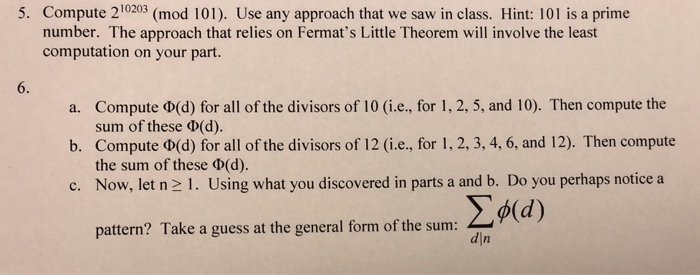
Compute 210203 (mod 101). Use any approach that we saw in class. Hint: 101 is a prime number. The approach that relies on Fermat's Little Theorem will involve the least computation on your part. 5. 6. Compute (d) for all of the divisors of 10 (i.e., for 1, 2, 5, and 10). Then compute the sum of these d(d). Compute (d) for all of the divisors of 12 (i.e., for 1, 2, 3, 4, 6, and 12). Then compute the sum of these 4)(d). Now, let n 2 1. Using what you discovered in parts a and b. Do you perhaps noticea a. b. c. (d) pattern? Take a guess at the general form of the sum
Step by Step Solution
There are 3 Steps involved in it
1 Expert Approved Answer
Step: 1 Unlock

Question Has Been Solved by an Expert!
Get step-by-step solutions from verified subject matter experts
Step: 2 Unlock
Step: 3 Unlock
 Study Help