



Question: please dont copy and paste from any resources. i want u to use your own words. dont take it easy. i paid. dont just throw
please dont copy and paste from any resources. i want u to use your own words. dont take it easy. i paid. dont just throw words and paste it from another recources. lol its my 4th time already. all same answers. so much plagiarism.
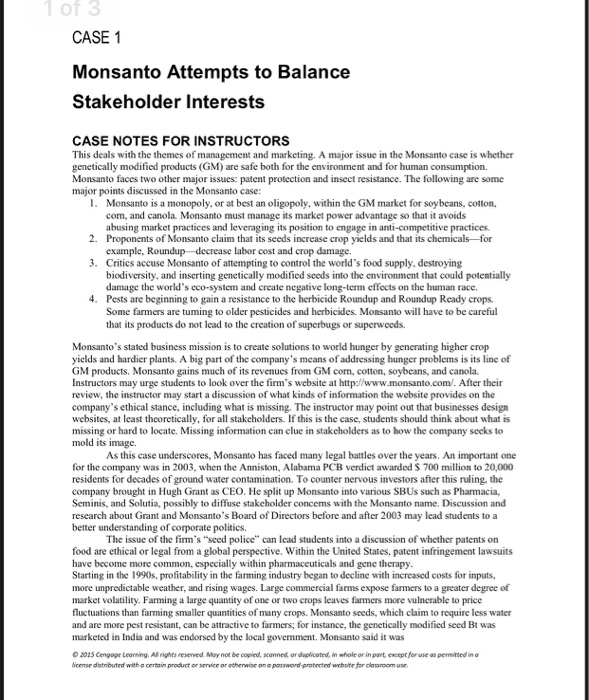
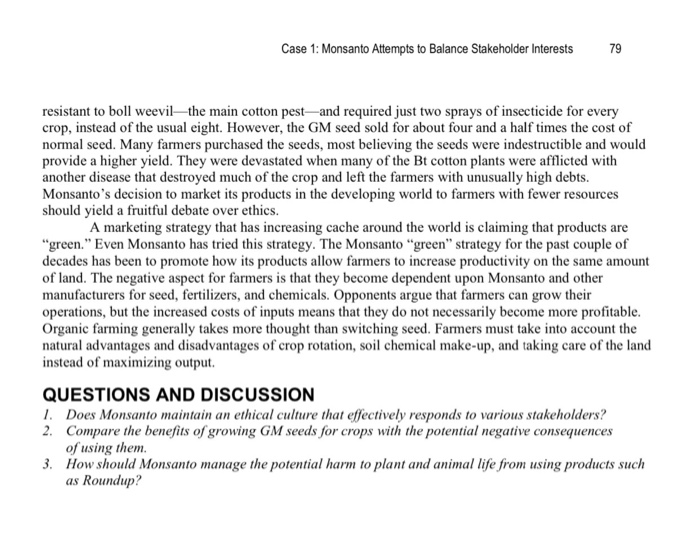
1 of 3 CASE 1 Monsanto Attempts to Balance Stakeholder Interests CASE NOTES FOR INSTRUCTORS This deals with the themes of management and marketing, A major issue in the Monsanto case is whether genetically modified products (GM) are safe both for the environment and for human consumption. Monsanto faces two other major issues: patent protection and insect resistance. The following are some major points discussed in the Monsanto case: 1. Monsanto is a monopoly, or at best an oligopoly, within the GM market for soybeans, cotton, com, and canola. Monsanto must manage its market power advantage so that it avoids abusing market practices and leveraging its position to engage in anti-competitive practices 2. Proponents of Monsanto claim that its seeds increase crop yields and that its chemicalsfor example, Roundup decrease labor cost and crop damage. 3. Critics accuse Monsanto of attempting to control the world's food supply, destroying biodiversity, and inserting genetically modified seeds into the environment that could potentially damage the world's eco-system and create negative long-term effects on the human race. 4. Pests are beginning to gain a resistance to the herbicide Roundup and Roundup Ready crops. Some farmers are tuming to older pesticides and herbicides. Monsanto will have to be careful that its products do not lead to the creation of superbugs or superweeds. Monsanto's stated business mission is to create solutions to world hunger by generating higher crop yields and hardier plants. A big part of the company's means of addressing hunger problems is its line of GM products, Monsanto gains much of its revenues from GM com, cotton, soybeans, and canola. Instructors may urge students to look over the firm's website at http://www.monsanto.com. After their review, the instructor may start a discussion of what kinds of information the website provides on the company's ethical stance, including what is missing. The instructor may point out that businesses design websites, at least theoretically, for all stakeholders. If this is the case, students should think about what is missing or hard to locate. Missing information can clue in stakeholders as to how the company seeks to mold its image As this case underscores, Monsanto has faced many legal battles over the years. An important one for the company was in 2003, when the Anniston, Alabama PCB verdict awarded $ 700 million to 20,000 residents for decades of ground water contamination. To counter nervous investors after this ruling, the company brought in Hugh Grant as CEO. He split up Monsanto into various SBUs such as Pharmacia, Seminis, and Solutia, possibly to diffuse stakeholder concems with the Monsanto name. Discussion and research about Grant and Monsanto's Board of Directors before and after 2003 may lead students to a better understanding of corporate politics The issue of the firm's "seed police" can lead students into a discussion of whether patents on food are ethical or legal from a global perspective. Within the United States, patent infringement lawsuits have become more common, especially within pharmaceuticals and gene therapy. Starting in the 1990s, profitability in the farming industry began to decline with increased costs for inputs, more unpredictable weather, and rising wages. Large commercial farms expose farmers to a greater degree of market volatility. Farming a large quantity of one or two crops leaves farmers more vulnerable to price fluctuations than farming smaller quantities of many crops. Monsanto seeds, which claim to require less water and are more pest resistant, can be attractive to farmers, for instance, the genetically modified seed Bt was marketed in India and was endorsed by the local government, Monsanto said it was 2015 Cengope Learning. All rights reserved. May not be copied, scanned or duplicated, in whole or in part, crcept for use as permitted in a license distributed with a certain product or service or otherwise on possword protected website for classroom use Case 1: Monsanto Attempts to Balance Stakeholder Interests 79 resistant to boll weevilthe main cotton pestand required just two sprays of insecticide for every crop, instead of the usual eight. However, the GM seed sold for about four and a half times the cost of normal seed. Many farmers purchased the seeds, most believing the seeds were indestructible and would provide a higher yield. They were devastated when many of the Bt cotton plants were afflicted with another disease that destroyed much of the crop and left the farmers with unusually high debts. Monsanto's decision to market its products in the developing world to farmers with fewer resources should yield a fruitful debate over ethics. A marketing strategy that has increasing cache around the world is claiming that products are "green." Even Monsanto has tried this strategy. The Monsanto green strategy for the past couple of decades has been to promote how its products allow farmers to increase productivity on the same amount of land. The negative aspect for farmers is that they become dependent upon Monsanto and other manufacturers for seed, fertilizers, and chemicals. Opponents argue that farmers can grow their operations, but the increased costs of inputs means that they do not necessarily become more profitable. Organic farming generally takes more thought than switching seed. Farmers must take into account the natural advantages and disadvantages of crop rotation, soil chemical make-up, and taking care of the land instead of maximizing output. QUESTIONS AND DISCUSSION 1. Does Monsanto maintain an ethical culture that effectively responds to various stakeholders? 2. Compare the benefits of growing GM seeds for crops with the potential negative consequences of using them. 3. How should Monsanto manage the potential harm to plant and animal life from using products such as Roundup
Step by Step Solution
There are 3 Steps involved in it
1 Expert Approved Answer
Step: 1 Unlock

Question Has Been Solved by an Expert!
Get step-by-step solutions from verified subject matter experts
Step: 2 Unlock
Step: 3 Unlock