







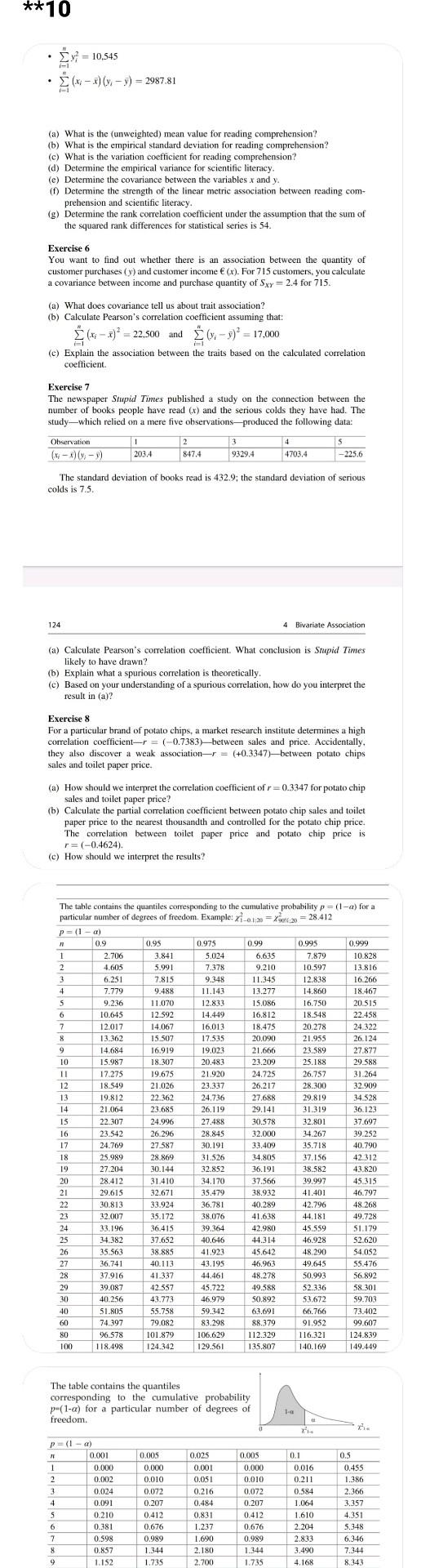
Question: please don't copy past . **10 = 10,545 x = (X; - x)(y- y) = 2987.81 (a) What is the (unweighted) mean value for reading
please don't copy past
.
**10 = 10,545 x = (X; - x)(y- y) = 2987.81 (a) What is the (unweighted) mean value for reading comprehension? (b) What is the empirical standard deviation for reading comprehension? (c) What is the variation coefficient for reading comprehension? (d) Determine the empirical variance for scientific literacy (e) Determine the covariance between the variables x and y (t) Determine the strength of the lincar metric association between reading com- prehension and scientific literacy, (g) Determine the rank correlation coefficient under the assumption that the sum of the squared rank differences for statistical series is 54. Exercise 6 You want to find out whether there is an association between the quantity of customer purchases (y) and customer income (x). For 715 customers, you calculate a covariance between income and purchase quantity of Sxy= 2.4 for 715. (a) What does covariance tell us about trait association? (b) Calculate Pearson's correlation coefficient assuming that: (- x) * = 22,500 and (4-5) = 17,000 (c) Explain the association between the traits based on the calculated correlation coefficient. Exercise 7 The newspaper Stupid Times published a study on the connection between the number of books people have read (x) and the serious colds they have had. The studywhich relied on a mere five observations-produced the following data: Ohservation 1 2 3 4 203.4 847.4 9329.4 4703.4 -225.6 s The standard deviation of books read is 432.9; the standard deviation of serious colds is 7.5. 124 4 Bivariate Association (a) Calculate Pearson's correlation coefficient. What conclusion is Srupid Times likely to have drawn? (b) Explain what a spurious correlation is theoretically (c) Based on your understanding of a spurious correlation, how do you interpret the result in (a)? Exercise 8 For a particular brand of potato chips, a market research institute determines a high correlation coefficient-r = (-0.7383)between sales and price. Accidentally, they also discover a weak associationer = (+0.3347)-between potato chips sales and toilet paper price. (a) How should we interpret the correlation coefficient of r=0.3347 for potato chip sales and toilet paper price? (b) Calculate the partial correlation coefficient between potato chip sales and toilet paper price to the nearest thousandth and controlled for the potato chip price. The correlation between toilet paper price and potato chip price is r=(-0.4624). (c) How should we interpret the results? The table contains the quantiles corresponding to the cumulative probability p= (-a) for a particular number of degrees of freedom. Example: x1-01 = Xx:20 = 28.412 p= (1-2) 1 0.99 6.635 9.210 2 3 4 5 6 7 8 9 10 12 13 14 15 16 17 18 0.9 2.706 4.605 6.251 7.779 9.236 10.645 12.017 13.362 14.684 15.987 17.275 18.549 19.812 21.064 22 307 23 542 24.769 25.989 27.204 28.412 29.615 30.813 32.007 33.196 34.382 35.563 36.741 37,916 39.087 40 256 51.805 74.397 96.578 118.498 0.95 3.841 5.991 7.815 9.488 11.070 12.592 14.067 15.507 16.919 18.307 19.675 21.026 22 362 23.685 24.996 26.296 27.587 28.869 30.144 31.410 32.671 33.924 35.172 36.415 37.652 38.885 40.113 41.337 42 557 43.773 55.758 79,082 101.879 124.342 0.975 5,024 7.378 9.348 11.143 12.833 14.449 16.013 17.535 19.023 20.483 21.920 23.337 24.736 26.119 27.488 28.845 30.191 31.526 32.852 34.170 35.479 36.781 38.076 39.364 40.646 41.923 43.195 44.461 45.722 46.979 59.342 83.298 106.629 129.561 11.345 13.277 15.ORG 16.812 18.475 20.090 21.666 23.209 24.725 26.217 27.688 29.141 30.578 32.000 33,409 34.805 36.191 37.566 38.932 40.289 41.638 42.980 44.314 45.642 46.963 48.278 49.588 50,892 63.691 88.379 112.329 135.807 0.995 7.879 10.597 12.838 14.860 16.750 18.548 20.278 21.955 23.589 25.188 26.757 28,300 29.819 31.319 32.801 34.267 35.718 37.156 38.582 39.997 41.401 42.796 44.181 45.559 46.928 48.290 49.645 50.993 52.336 53.672 66.766 91.952 0.999 10.828 13.816 16.266 18.467 20.SIS 22.458 24.322 26.124 27.877 29.588 31.264 32.909 34.528 36.123 37.697 39.252 40.790 42312 43.820 45.31% 46.79 48.268 49.728 51.179 52.620 54.052 55.476 56.892 58.301 59.703 73.402 99.607 124.839 149.449 19 20 21 22 23 24 25 26 27 28 29 30 40 60 80 116.321 140.169 100 The table contains the quantiles corresponding to the cumulative probability p-(1-a) for a particular number of degrees of freedom x 0.5 0.455 0.005 0.000 0.010 0.072 P =(1-a) PT 0.001 1 0.000) 2 0.002 3 0.024 4 0.091 5 0.210 6 0.381 7 0598 8 0.857 9 1.152 0.207 0.005 0.000 0.010 0,072 0.207 0.412 0.676 0.989 1.344 1.735 0.025 0.001 0.051 0.216 0.484 0.831 1.237 1.690 2.180 2.700 0.1 0.016 0.211 0.584 1.064 1.610 2.204 2.833 3.490 4.168 0.412 1.386 2.366 3.357 4.351 5.348 6.346 72344 8.343 0.676 0.989 1.344 1.735Step by Step Solution
There are 3 Steps involved in it
1 Expert Approved Answer
Step: 1 Unlock

Question Has Been Solved by an Expert!
Get step-by-step solutions from verified subject matter experts
Step: 2 Unlock
Step: 3 Unlock
 Study Help