







Question: PLEASE DON'T GIVE CHAT GPT SOLUTIONS, I NEED FULL CLEAR HAND SOLUTION OF EVERY PART Determine the minimum factor of safety for yielding. Use distortion
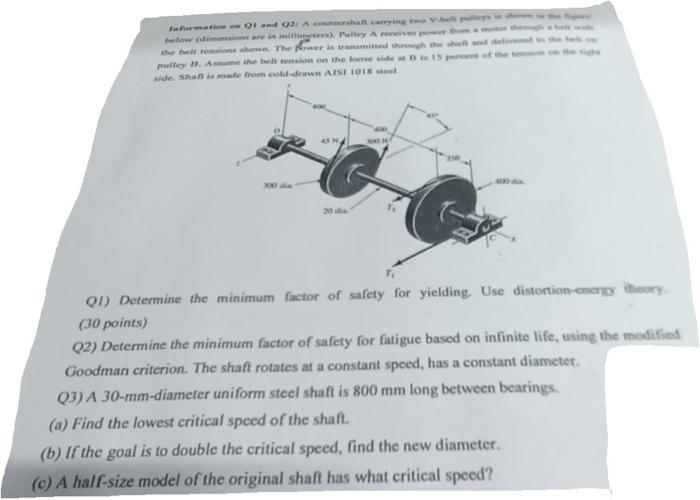
Information Q1 and Q2: A countershaft carrying two V-belt pulleys is s below (dimensions are in millimeters). Pulley A receives power from a motor heigh the bell tensions shown. The flower is transmitted through the shaft and delivered pulley B. Assume the belt tension on the loose side at B is 15 percent of the tension side. Shall is made from cold-drawn AISI 1018 steel 300 a 20 dia 300 Q1) Determine the minimum factor of safety for yielding. Use distortion-energy theory. (30 points) Q2) Determine the minimum factor of safety for fatigue based on infinite life, using the modified Goodman criterion. The shaft rotates at a constant speed, has a constant diameter. Q3) A 30-mm-diameter uniform steel shaft is 800 mm long between bearings. (a) Find the lowest critical speed of the shaft. (b) If the goal is to double the critical speed, find the new diameter. (c) A half-size model of the original shaft has what critical speed?
Step by Step Solution
There are 3 Steps involved in it

Get step-by-step solutions from verified subject matter experts
 Study Help