







Question: PLEASE EXPLAIN! 2. PDP-8 assembly language (7 points) What is the two's complement 12-bit representation of negative 17? a. (13 points) The following PDP-8 machine
PLEASE EXPLAIN!
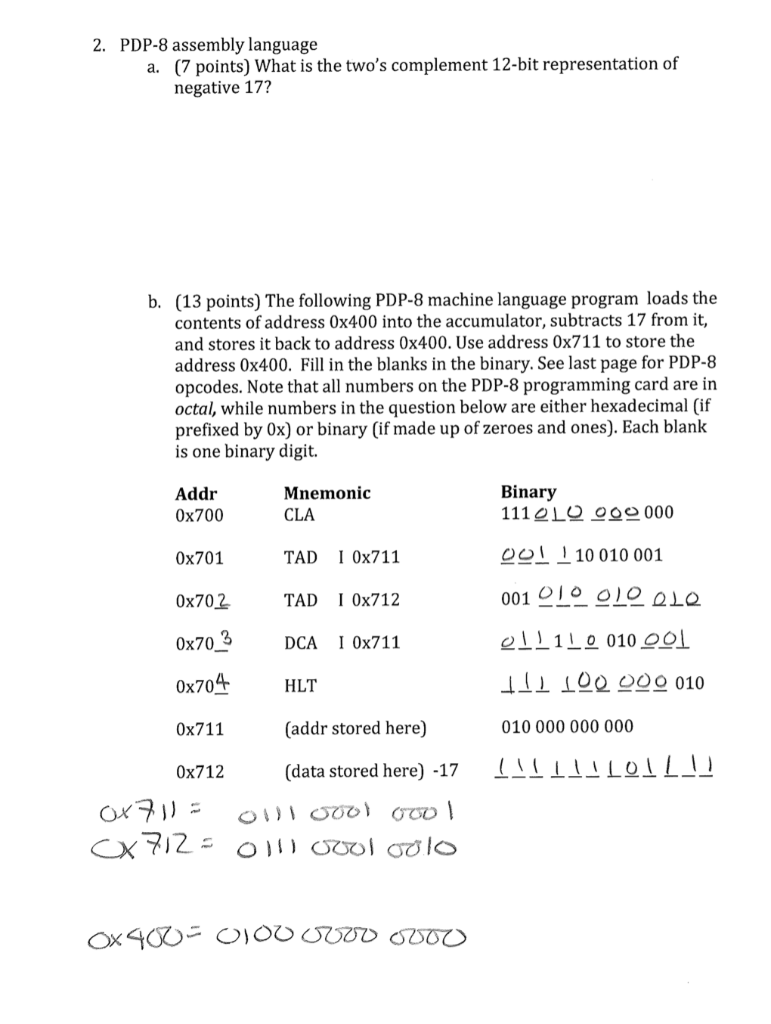
2. PDP-8 assembly language (7 points) What is the two's complement 12-bit representation of negative 17? a. (13 points) The following PDP-8 machine language program loads the contents of address 0x400 into the accumulator, subtracts 17 from it, and stores it back to address 0x400. Use address 0x711 to store the address 0x400. Fill in the blanks in the binary. See last page for PDP-8 opcodes. Note that all numbers on the PDP-8 programming card are in octal, while numbers in the question below are either hexadecimal (if prefixed by 0x) or binary (if made up of zeroes and ones). Each blank is one binary digit. b. Addr 0x700 Binary 111 e L 000 Mnemonic CLA TAD I 0x711 TAD I 0x712 DCA I 0x711 HLT (addr stored here) (data stored here) -17 ? , 10 010 001 0x701 0x702 0x70 0x704 0x711 001 2 41 102 010 010 000 000 000 2. PDP-8 assembly language (7 points) What is the two's complement 12-bit representation of negative 17? a. (13 points) The following PDP-8 machine language program loads the contents of address 0x400 into the accumulator, subtracts 17 from it, and stores it back to address 0x400. Use address 0x711 to store the address 0x400. Fill in the blanks in the binary. See last page for PDP-8 opcodes. Note that all numbers on the PDP-8 programming card are in octal, while numbers in the question below are either hexadecimal (if prefixed by 0x) or binary (if made up of zeroes and ones). Each blank is one binary digit. b. Addr 0x700 Binary 111 e L 000 Mnemonic CLA TAD I 0x711 TAD I 0x712 DCA I 0x711 HLT (addr stored here) (data stored here) -17 ? , 10 010 001 0x701 0x702 0x70 0x704 0x711 001 2 41 102 010 010 000 000 000
Step by Step Solution
There are 3 Steps involved in it

Get step-by-step solutions from verified subject matter experts
 Study Help