







Question: Please explain how you get the answer Problem 4. Imagine that you are the producer of James Bond movies. You are trying to decide whether
Please explain how you get the answer
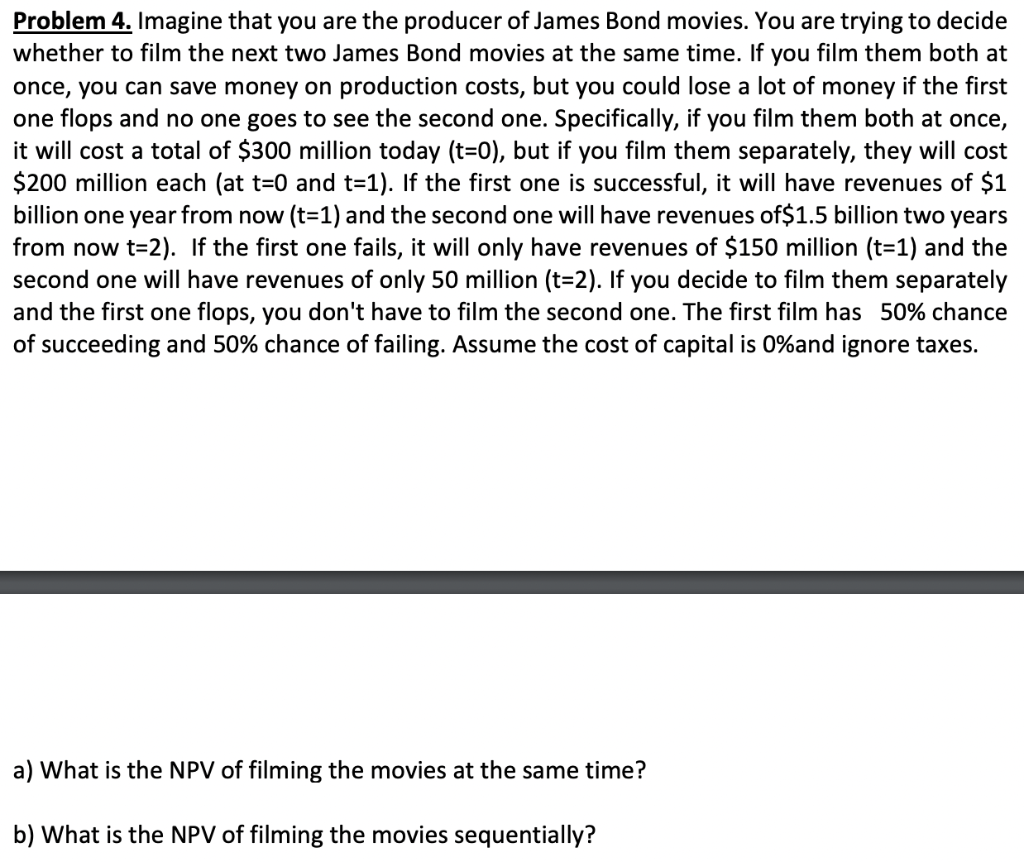
Problem 4. Imagine that you are the producer of James Bond movies. You are trying to decide whether to film the next two James Bond movies at the same time. If you film them both at once, you can save money on production costs, but you could lose a lot of money if the first one flops and no one goes to see the second one. Specifically, if you film them both at once, it will cost a total of $300 million today (t=0), but if you film them separately, they will cost $200 million each (at t=0 and t=1 ). If the first one is successful, it will have revenues of $1 billion one year from now (t=1) and the second one will have revenues of 1.5 billion two years from now t=2 ). If the first one fails, it will only have revenues of $150 million (t=1) and the second one will have revenues of only 50 million (t=2). If you decide to film them separately and the first one flops, you don't have to film the second one. The first film has 50% chance of succeeding and 50% chance of failing. Assume the cost of capital is 0% and ignore taxes. a) What is the NPV of filming the movies at the same time? b) What is the NPV of filming the movies sequentially? Problem 4. Imagine that you are the producer of James Bond movies. You are trying to decide whether to film the next two James Bond movies at the same time. If you film them both at once, you can save money on production costs, but you could lose a lot of money if the first one flops and no one goes to see the second one. Specifically, if you film them both at once, it will cost a total of $300 million today (t=0), but if you film them separately, they will cost $200 million each (at t=0 and t=1 ). If the first one is successful, it will have revenues of $1 billion one year from now (t=1) and the second one will have revenues of 1.5 billion two years from now t=2 ). If the first one fails, it will only have revenues of $150 million (t=1) and the second one will have revenues of only 50 million (t=2). If you decide to film them separately and the first one flops, you don't have to film the second one. The first film has 50% chance of succeeding and 50% chance of failing. Assume the cost of capital is 0% and ignore taxes. a) What is the NPV of filming the movies at the same time? b) What is the NPV of filming the movies sequentially
Step by Step Solution
There are 3 Steps involved in it

Get step-by-step solutions from verified subject matter experts
 Study Help