



Question: Please explain in detail..... Case 2: Searching for the Right Stock A recent study by the securities industry found that roughly half of all U.S.
Please explain in detail.....
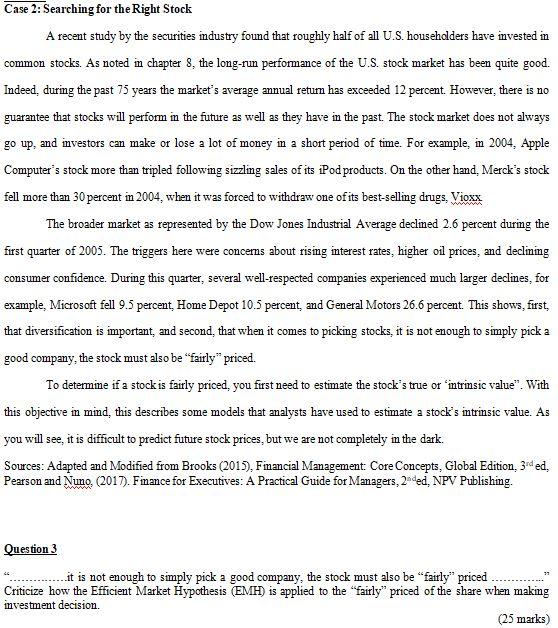
Case 2: Searching for the Right Stock A recent study by the securities industry found that roughly half of all U.S. householders have invested in common stocks. As noted in chapter 8, the long-run performance of the U.S. stock market has been quite good. Indeed, during the past 75 years the market's average annual return has exceeded 12 percent. However, there is no guarantee that stocks will perform in the future as well as they have in the past. The stock market does not always go up, and investors can make or lose a lot of money in a short period of time. For example, in 2004. Apple Computer's stock more than tripled following sizzling sales of its iPod products. On the other hand, Merck's stock fell more than 30 percent in 2004, when it was forced to withdraw one of its best-selling drugs, Vioxx The broader market as represented by the Dow Jones Industrial Average declined 2.6 percent during the first quarter of 2005. The triggers here were concerns about rising interest rates, higher oil prices, and declining consumer confidence. During this quarter, several well-respected companies experienced much larger declines, for example, Microsoft fell 9.5 percent, Home Depot 10.5 percent, and General Motors 26.6 percent. This shows, first, that diversification is important, and second, that when it comes to picking stocks, it is not enough to simply pick a good company, the stock must also be "Fairly" priced. To determine if a stock is fairly priced, you first need to estimate the stock's true or "intrinsic value". With this objective in mind, this describes some models that analysts have used to estimate a stock's intrinsic value. As you will see, it is difficult to predict future stock prices, but we are not completely in the dark Sources: Adapted and Modified from Brooks (2015), Financial Management Core Concepts, Global Edition, 3rd ed. Pearson and Nuno. (2017). Finance for Executives: A Practical Guide for Managers, 2n ded, NPV Publishing. Question 3 it is not enough to simply pick a good company, the stock must also be Fairly" priced Criticize how the Efficient Market Hypothesis (EMH) is applied to the "fairly" priced of the share when making investment decision. (25 marks) Case 2: Searching for the Right Stock A recent study by the securities industry found that roughly half of all U.S. householders have invested in common stocks. As noted in chapter 8, the long-run performance of the U.S. stock market has been quite good. Indeed, during the past 75 years the market's average annual return has exceeded 12 percent. However, there is no guarantee that stocks will perform in the future as well as they have in the past. The stock market does not always go up, and investors can make or lose a lot of money in a short period of time. For example, in 2004. Apple Computer's stock more than tripled following sizzling sales of its iPod products. On the other hand, Merck's stock fell more than 30 percent in 2004, when it was forced to withdraw one of its best-selling drugs, Vioxx The broader market as represented by the Dow Jones Industrial Average declined 2.6 percent during the first quarter of 2005. The triggers here were concerns about rising interest rates, higher oil prices, and declining consumer confidence. During this quarter, several well-respected companies experienced much larger declines, for example, Microsoft fell 9.5 percent, Home Depot 10.5 percent, and General Motors 26.6 percent. This shows, first, that diversification is important, and second, that when it comes to picking stocks, it is not enough to simply pick a good company, the stock must also be "Fairly" priced. To determine if a stock is fairly priced, you first need to estimate the stock's true or "intrinsic value". With this objective in mind, this describes some models that analysts have used to estimate a stock's intrinsic value. As you will see, it is difficult to predict future stock prices, but we are not completely in the dark Sources: Adapted and Modified from Brooks (2015), Financial Management Core Concepts, Global Edition, 3rd ed. Pearson and Nuno. (2017). Finance for Executives: A Practical Guide for Managers, 2n ded, NPV Publishing. Question 3 it is not enough to simply pick a good company, the stock must also be Fairly" priced Criticize how the Efficient Market Hypothesis (EMH) is applied to the "fairly" priced of the share when making investment decision. (25 marks)
Step by Step Solution
There are 3 Steps involved in it

Get step-by-step solutions from verified subject matter experts