







Question: Please explain in detail. The following real Java method defines a predicate whose two arguments are Java int values: public boolean foo (int x, int
Please explain in detail.
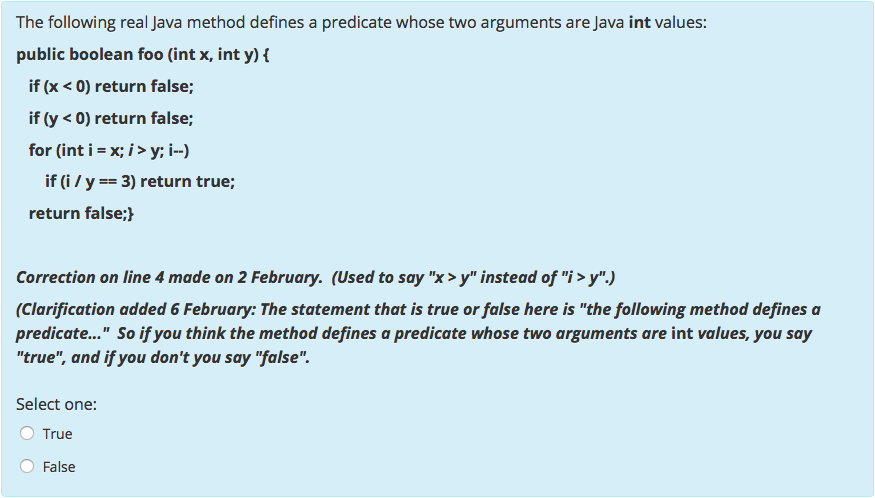
The following real Java method defines a predicate whose two arguments are Java int values: public boolean foo (int x, int y) t if (x y: i-) if (i , y =-3) return true; return false;h Correction on line 4 made on 2 February. (Used to say "x> y" instead of "i> y".) (Clarification added 6 February: The statement that is true or false here is "the following method defines a predicate..." So if you think the method defines a predicate whose two arguments are int values, you say true, and if you don't you say false. Select one: O True O False
Step by Step Solution
There are 3 Steps involved in it
1 Expert Approved Answer
Step: 1 Unlock

Question Has Been Solved by an Expert!
Get step-by-step solutions from verified subject matter experts
Step: 2 Unlock
Step: 3 Unlock
 Study Help