







Question: Please explain in steps and details and please do not copy previous available answers. Thanks Problem #1 : Sipser, exercise 1.6, page 84; subproblems (d),
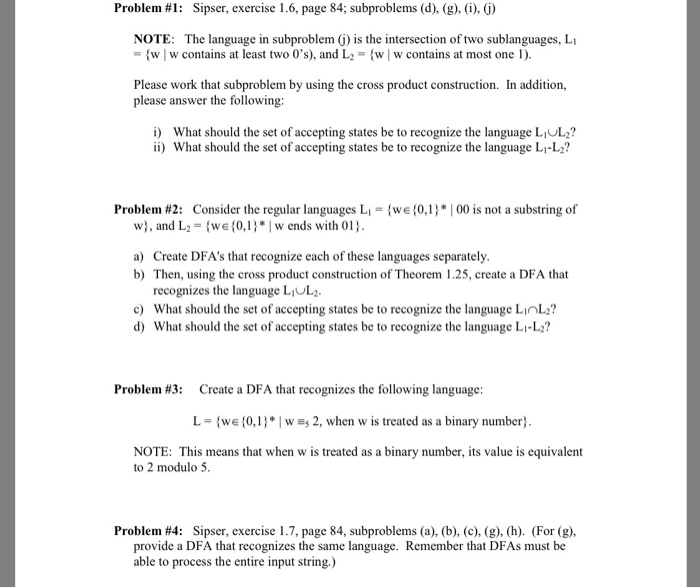
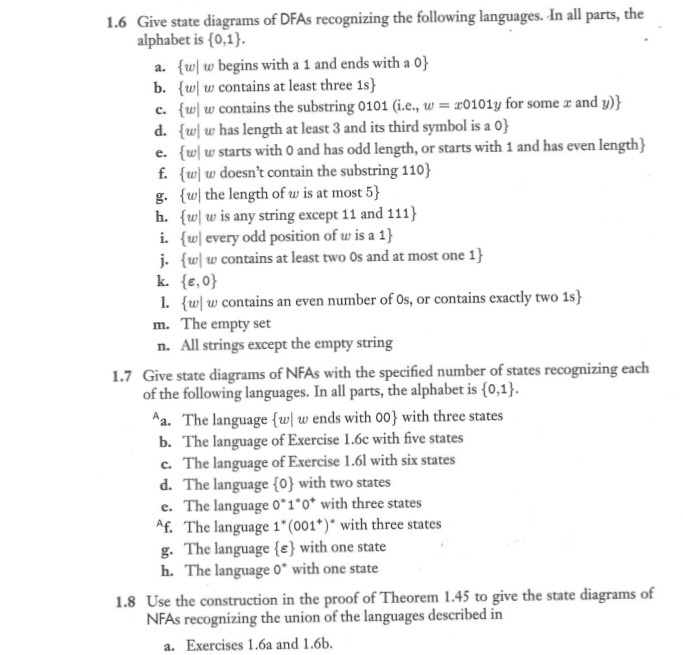
Problem #1 : Sipser, exercise 1.6, page 84; subproblems (d), (g), (i), (j) NOTE: The language in subproblem G) is the intersection of two sublanguages, Li -(w w contains at least two 0's), and L2(w w contains at most one 1). Please work that subproblem by using the cross product construction. In addition, please answer the following: i) What should the set of accepting states be to recognize the language LiUL2? ii) What should the set of accepting states be to recognize the language Li-L2? Problem #2: Consider the regular languages L'-(we(0,1) * 1 00 is not a substring of w), and L2 = {we {0,1 } * I w ends with 01 } . a) Create DFA's that recognize each of these languages separately. b) Then, using the cross product construction of Theorem 1.25, create a DFA that recognizes the language L UL2 c What should the set of accepting states be to recognize the language LiOL? d) What should the set of accepting states be to recognize the language L-L2? Problem #3: Create a DFA that recognizes the following language: L- (we (0,1)* w s2, when w is treated as a binary number NOTE: This means that when w is treated as a binary number, its value is equivalent to 2 modulo 5 Problem #4: Sipser, exercise 1.7, page 84, subproblems (a), (b), (c), (g), (h). (For (g), provide a DFA that recognizes the same language. Remember that DFAs must be able to process the entire input string.) Problem #1 : Sipser, exercise 1.6, page 84; subproblems (d), (g), (i), (j) NOTE: The language in subproblem G) is the intersection of two sublanguages, Li -(w w contains at least two 0's), and L2(w w contains at most one 1). Please work that subproblem by using the cross product construction. In addition, please answer the following: i) What should the set of accepting states be to recognize the language LiUL2? ii) What should the set of accepting states be to recognize the language Li-L2? Problem #2: Consider the regular languages L'-(we(0,1) * 1 00 is not a substring of w), and L2 = {we {0,1 } * I w ends with 01 } . a) Create DFA's that recognize each of these languages separately. b) Then, using the cross product construction of Theorem 1.25, create a DFA that recognizes the language L UL2 c What should the set of accepting states be to recognize the language LiOL? d) What should the set of accepting states be to recognize the language L-L2? Problem #3: Create a DFA that recognizes the following language: L- (we (0,1)* w s2, when w is treated as a binary number NOTE: This means that when w is treated as a binary number, its value is equivalent to 2 modulo 5 Problem #4: Sipser, exercise 1.7, page 84, subproblems (a), (b), (c), (g), (h). (For (g), provide a DFA that recognizes the same language. Remember that DFAs must be able to process the entire input string.)
Step by Step Solution
There are 3 Steps involved in it

Get step-by-step solutions from verified subject matter experts
 Study Help