



Question: Please explain only the circled part in yellow. How did they come to this form of the method of undetermined coefficients. Which equation did they
Please explain only the circled part in yellow. How did they come to this form of the method of undetermined coefficients. Which equation did they use.? According to me the x pi is wrong.
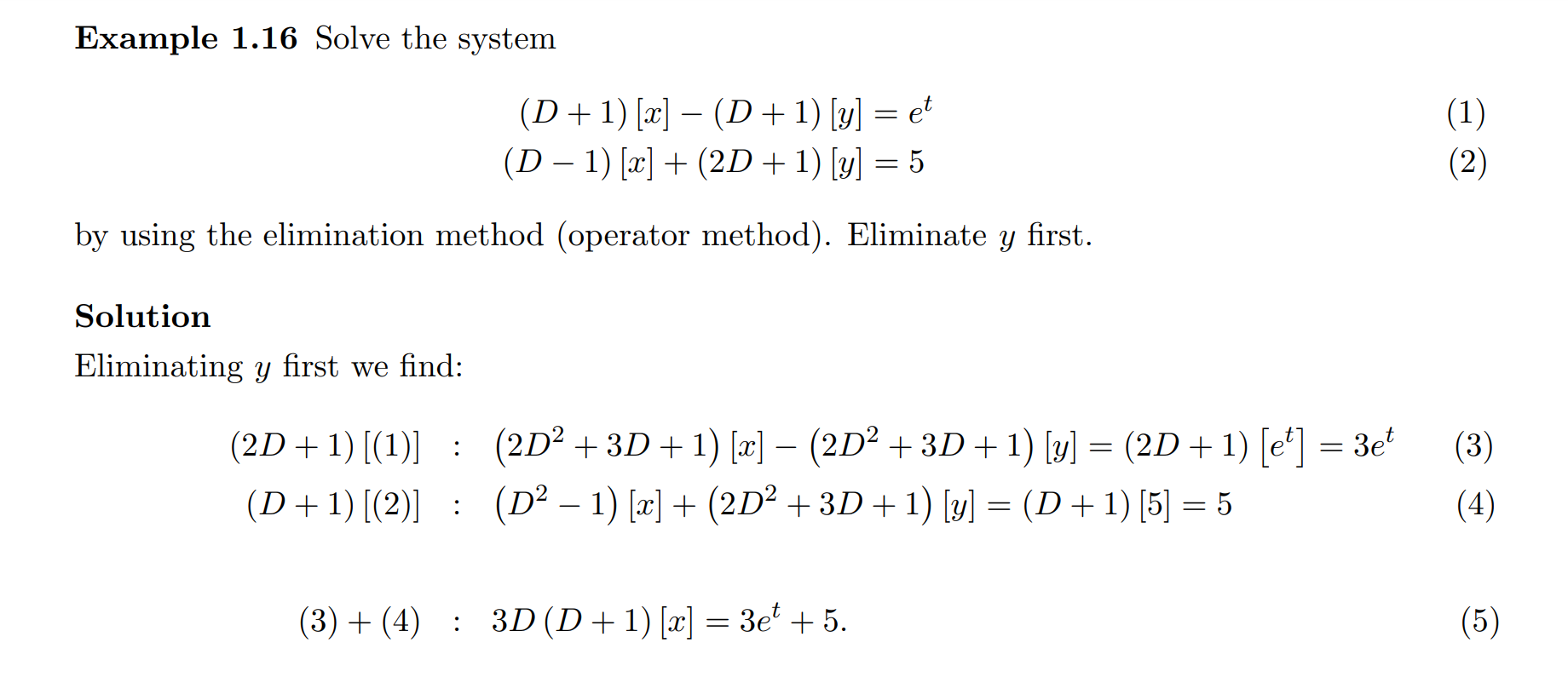
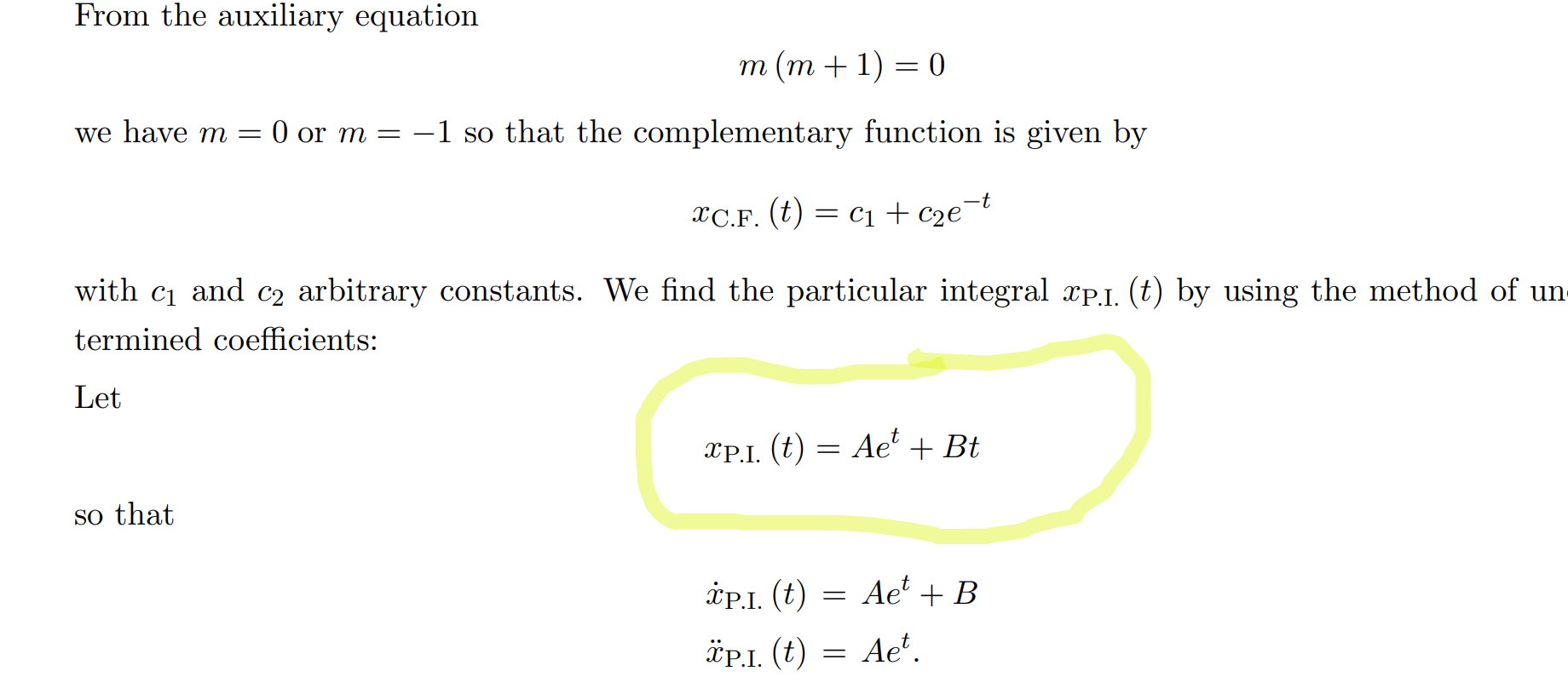
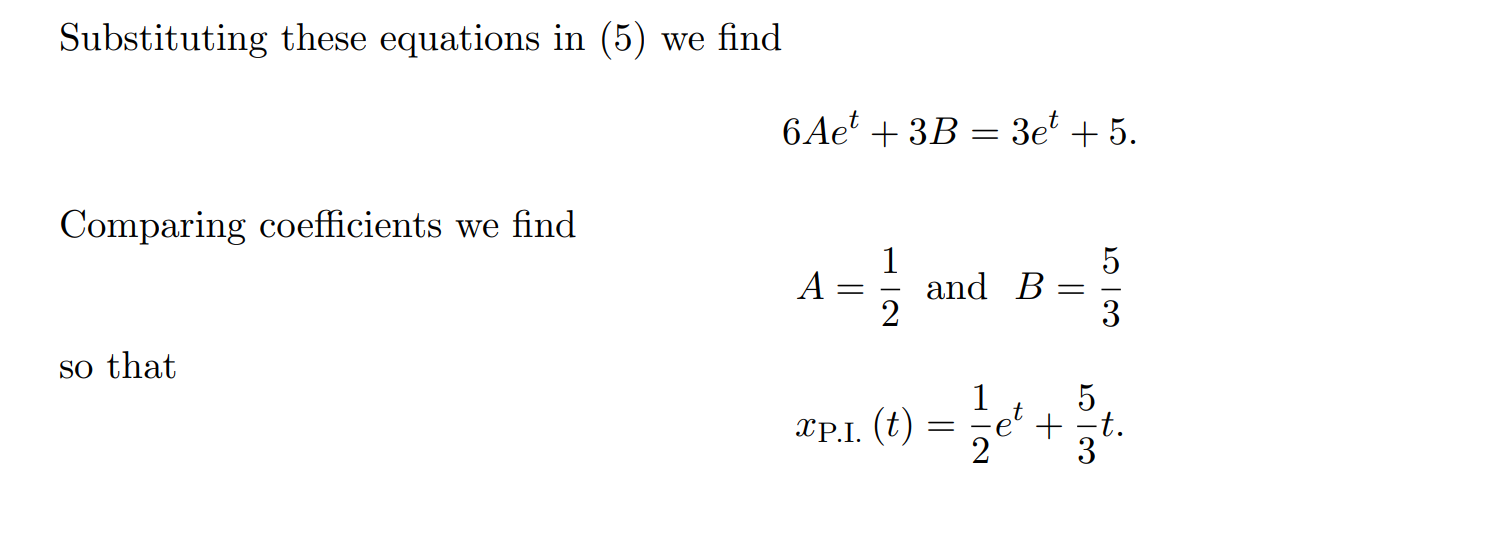
Example 1.16 Solve the system (D + 1) [x] - (D + 1) [y] = et (D - 1) [x] + (2D + 1) [y] = 5 2 by using the elimination method (operator method). Eliminate y first. Solution Eliminating y first we find: (2D + 1) [(1)] : (2D2 + 3D + 1) [x] - (2D2 + 3D + 1) [y] = (2D + 1) [et] = 3et (3) (D + 1) [(2)] : (D2 - 1) [x] + (2D2 + 3D + 1) [y] = (D + 1) [5] =5 (4) (3) + (4) : 3D (D + 1) [a] = 3et + 5. (5)From the auxiliary equation m (m + 1) = 0 we have m = 0 or m = -1 so that the complementary function is given by XC.F. (t) = c1+ cze-t with ci and c2 arbitrary constants. We find the particular integral xp.I. (t) by using the method of un termined coefficients: Let XP.I. (t) = Aet + Bt so that acp.I. (t) = Aet + B 3CP.I. (t) = Aet.Substituting these equations in (5) we find 6Act + 3B = 3et + 5. Comparing coefficients we find A = NIH and B = so that XP.I. (t ) = e t
Step by Step Solution
There are 3 Steps involved in it

Get step-by-step solutions from verified subject matter experts