







Question: Please explain step-by-step how to solve this (a) Suppose you are evaluating the speedup for some program that you have developed By using Amdahl's law,
Please explain step-by-step how to solve this
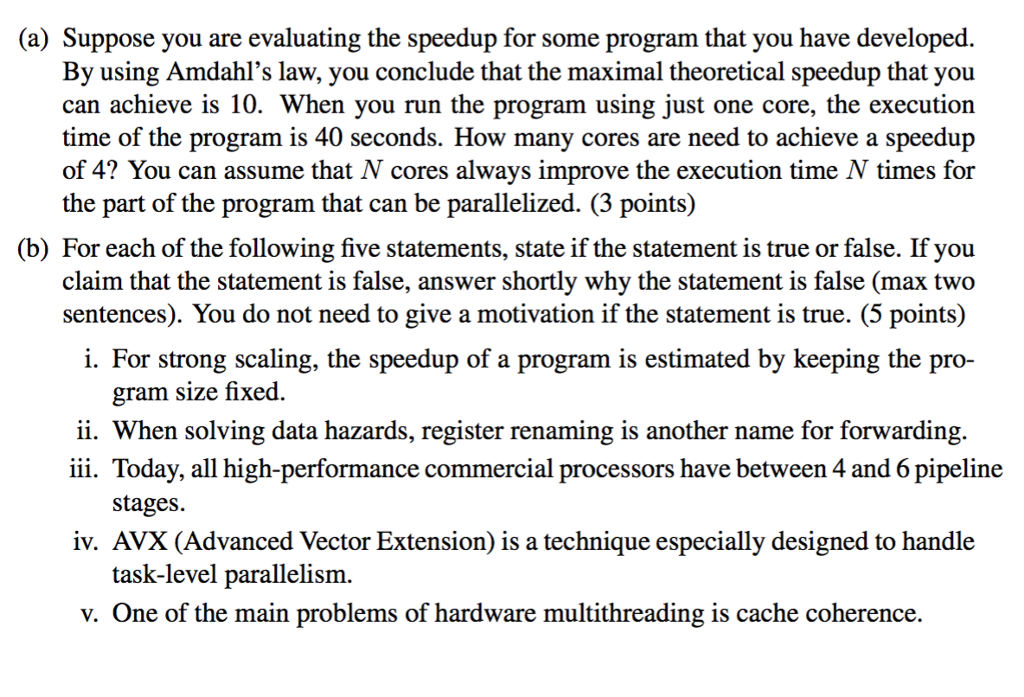
(a) Suppose you are evaluating the speedup for some program that you have developed By using Amdahl's law, you conclude that the maximal theoretical speedup that you can achieve is 10. When you run the program using just one core, the execution time of the program is 40 seconds. How many cores are need to achieve a speedup of 4? You can assume that N cores always improve the execution time N times for the part of the program that can be parallelized. (3 points) (b) For each of the following five statements, state if the statement is true or false. If you claim that the statement is false, answer shortly why the statement is false (max two sentences). You do not need to give a motivation if the statement is true. (5 points) i. For strong scaling, the speedup of a program is estimated by keeping the pro- gram size fixed ii. When solving data hazards, register renaming is another name for forwarding. iii. Today, all high-performance commercial processors have between 4 and 6 pipeline stages. iv. AVX (Advanced Vector Extension) is a technique especially designed to handle task-level parallelism. v. One of the main problems of hardware multithreading is cache coherence
Step by Step Solution
There are 3 Steps involved in it

Get step-by-step solutions from verified subject matter experts
 Study Help