







Question: Please explain why each relation is Reflexive, Symmetric, Antisymmetric, Transitive, Partial Order, or has Equivalence Relation. 6. Consider the following relations. (a) Ri ={(1,1), (1,2),
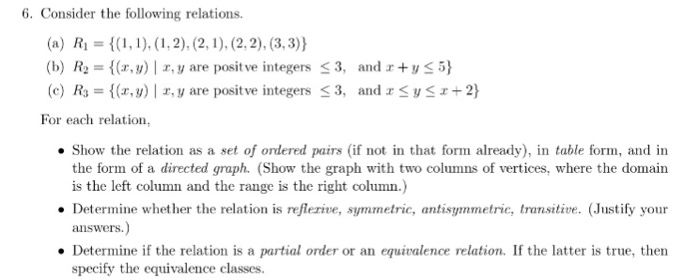
6. Consider the following relations. (a) Ri ={(1,1), (1,2), (2,1), (2,2), (3,3)) (b) R2r,y),y are positve integers 3, and r y5 (c) R3 = {(z, y) I r, y are posit ve integers 3, and z z+2} For each relation, Show the relation as a set of ordered pairs (if not in that form already), in table form, and in the form of a directed graph. (Show the graph with two columns of vertices, where the domain is the left column and the range is the right column.) Determine whether the relation is reflerive, symmetric, antisymmetric, transitive. (Justify your answers . Determine if the relation is a partial order or an equivalence relation. If the latter is true, then specify the equivalence classes
Step by Step Solution
There are 3 Steps involved in it

Get step-by-step solutions from verified subject matter experts
 Study Help