







Question: Please fill in the highlighted blanks using the information below. 1) Life Period of the Equipment = 4 years 8) Sales for first year (1)
Please fill in the highlighted blanks using the information below.
| 1) Life Period of the Equipment = 4 years | 8) Sales for first year (1) | $ 200,000 | |||||
| 2) New equipment cost | $ (200,000) | 9) Sales increase per year | 5% | ||||
| 3) Equipment ship & install cost | $ (35,000) | 10) Operating cost (60% of Sales) | $ (120,000) | ||||
| 4) Related start up cost | $ (5,000) | (as a percent of sales in Year 1) | -60% | ||||
| 5) Inventory increase | $ 25,000 | 11) Depreciation (Straight Line)/YR | $ (60,000) | ||||
| 6) Accounts Payable increase | $ 5,000 | 12) Marginal Corporate Tax Rate (T) | 21% | ||||
| 7) Equip. salvage value before tax | $ 15,000 | 13) Cost of Capital (Discount Rate) | 10% | ||||
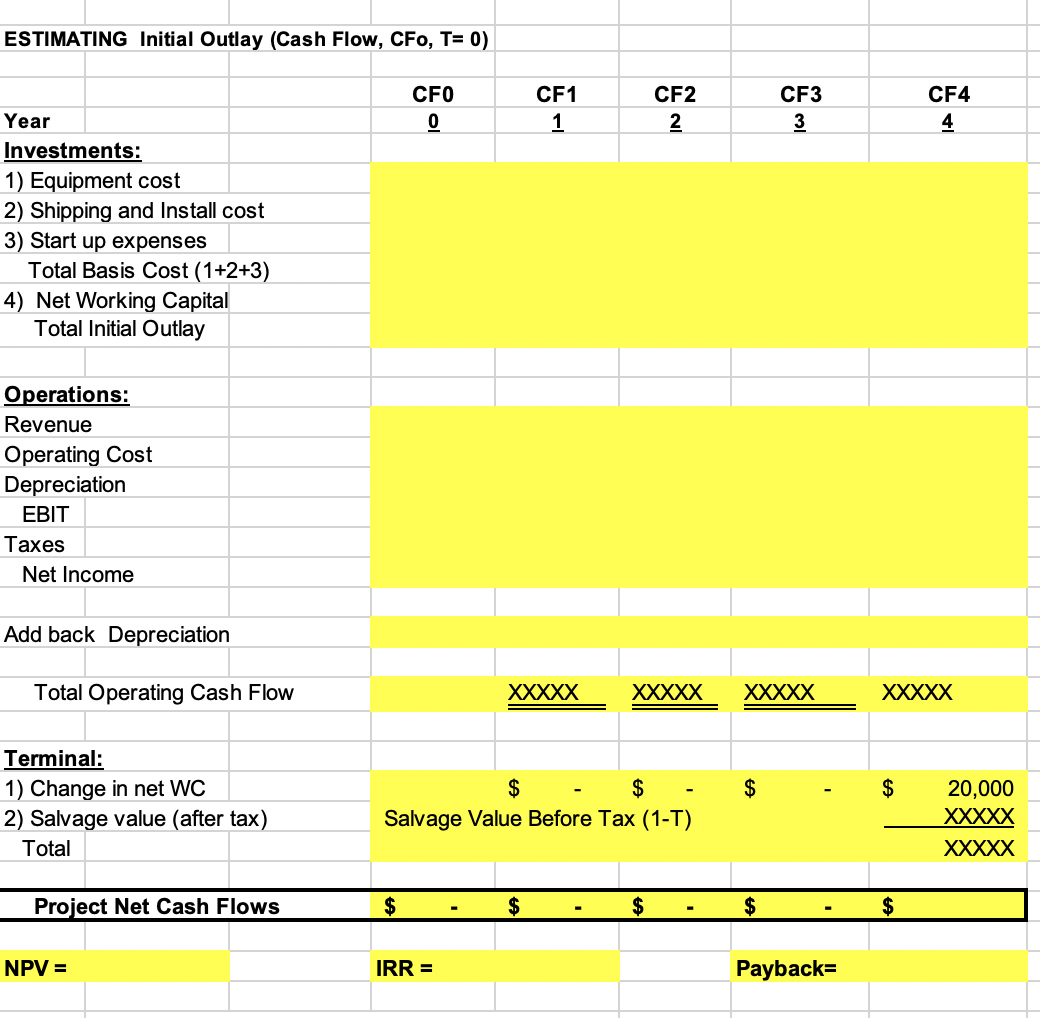
Q1. Would you accept the project based on NPV, IRR?
Would you accept the project based on Payback rule if project cut-off is in 3 years?
Q2. Impact of 2017 Tax Cut Act on Net Income, Cash Flows, and Capital Budgeting (investment) decision.
a. Estimate NPV, IRR and Payback Period of the project if equipment is fully depreciated in first year and tax rate equals to 21%. Would you accept or reject the project?
b. As a CFO of the firm, which of the above two scenario (a) or (b) would you choose? Why?
Q3. How would you explain to your CEO what NPV means?
Q4. What are advantages and disadvantages of using only Payback method?
Q5. What are advantages and disadvantages of using NPV versus IRR?
Q6. Explain the difference between independent projects and mutually exclusive projects.
a. When you are confronted with Mutually Exclusive Projects and have coflicts with NPV and IRR results, which criterion would you use (NPV or IRR) and why?
ESTIMATING Initial Outlay (Cash Flow, CFO, T= 0) CFO 0 CF1 1 CF2 2 CF3 3 C F4 4 Year Investments: 1) Equipment cost 2) Shipping and Install cost 3) Start up expenses Total Basis Cost (1+2+3) 4) Net Working Capital Total Initial Outlay Operations: Revenue Operating Cost Depreciation EBIT Taxes Net Income Add back Depreciation Total Operating Cash Flow XXX _XXXXX XXXXX XXXXX Terminal: 1) Change in net WC 2) Salvage value (after tax) Total $ - $ - Salvage Value Before Tax (1-T) $ - $ 20,000 Project Net Cash Flows - $ NPV = IRR = Payback= ESTIMATING Initial Outlay (Cash Flow, CFO, T= 0) CFO 0 CF1 1 CF2 2 CF3 3 C F4 4 Year Investments: 1) Equipment cost 2) Shipping and Install cost 3) Start up expenses Total Basis Cost (1+2+3) 4) Net Working Capital Total Initial Outlay Operations: Revenue Operating Cost Depreciation EBIT Taxes Net Income Add back Depreciation Total Operating Cash Flow XXX _XXXXX XXXXX XXXXX Terminal: 1) Change in net WC 2) Salvage value (after tax) Total $ - $ - Salvage Value Before Tax (1-T) $ - $ 20,000 Project Net Cash Flows - $ NPV = IRR = Payback=
Step by Step Solution
There are 3 Steps involved in it

Get step-by-step solutions from verified subject matter experts
 Study Help