







Question: please fill out table 6 . 1 through table 6 . 6 , then answer questions 1 - 6 , thank you so much Objective
please fill out table through table then answer questions thank you so much
Objective
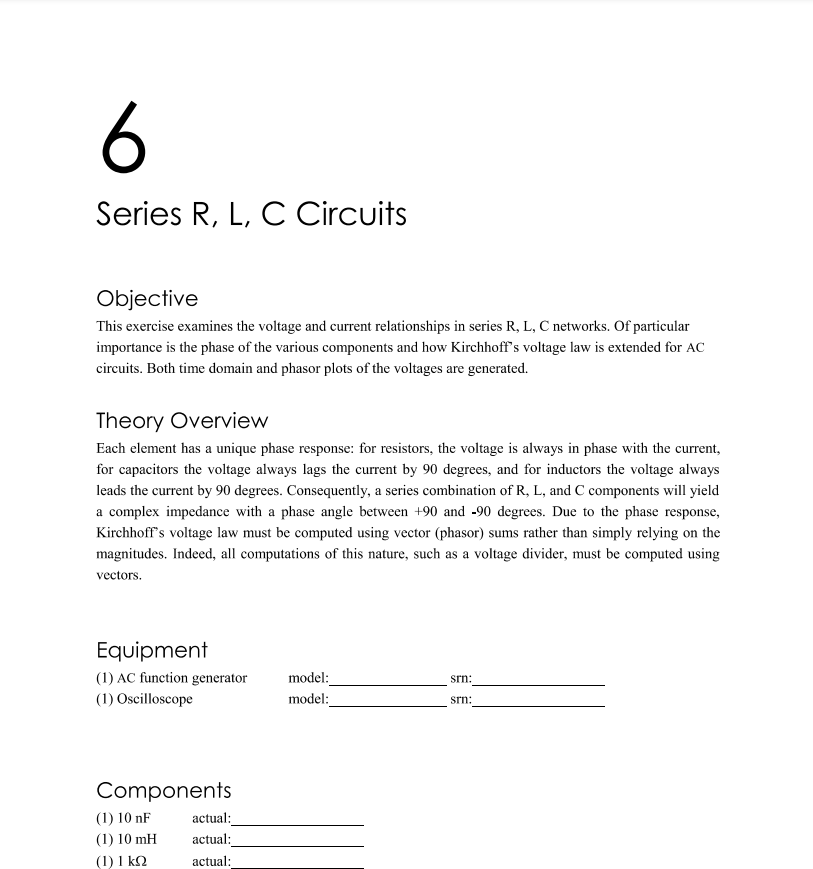
This exercise examines the voltage and current relationships in series R L C networks. Of particular importance is the phase of the various components and how Kirchhoff's voltage law is extended for AC circuits. Both time domain and phasor plots of the voltages are generated.
Theory Overview
Each element has a unique phase response: for resistors, the voltage is always in phase with the current, for capacitors the voltage always lags the current by degrees, and for inductors the voltage always leads the current by degrees. Consequently, a series combination of R L and C components will yield a complex impedance with a phase angle between and degrees. Due to the phase response, Kirchhoff's voltage law must be computed using vector phasor sums rather than simply relying on the magnitudes. Indeed, all computations of this nature, such as a voltage divider, must be computed using vectors.
Equipment
AC function generator
model:
srn:
Oscilloscope
model:
srn:
Components
nF
actual
mH
actual
mathrmkOmega
actual:
Schematics
Figure
Procedure
RC Circuit
Using Figure with Vin Vpp sine at kHzRkOmega, and CnF determine the theoretical
capacitive reactance and circuit impedance, and record the results in Table the experimental
portion of this table will be filled out in step Using the voltage divider rule, compute the resistor
and capacitor voltages and record them in Table
Build the circuit of Figure using RkOmega, and CnF Place one probe across the generator and
another across the capacitor. Set the generator to a kHz sine wave and V pp Make sure that the
Bandwidth Limit of the oscilloscope is engaged for both channels. This will reduce the signal noise
and make for more accurate readings. Also, consider using Averaging for the acquisition mode,
particularly to clean up signals derived using the Math function.
Measure the peaktopeak voltage across the capacitor and record in Table Along with the
magnitude, be sure to record the time deviation between VC and the input signal from which the
phase may be determined Using the Math function, measure and record the voltage and time delay
for the resistor Vin VC Compute the phase angle and record these values in Table
Take a snapshot of the oscilloscope displaying VmVC and VR
Compute the deviations between the theoretical and experimental values of Table and record the
results in the final columns of Table Based on the experimental values, determine the
experimental Z and XC values via Ohm's law :iVRRXCVCiZVini and record back in Table
along with the deviations.
Create a phasor plot showing VinVC and VR Include both the time domain display from step and
the phasor plot with the technical report.
RL Circuit
Replace the capacitor with the mH inductor ie Figure and repeat steps through in like
manner, using Tables and
RLC Circuit
Using Figure with both the nF capacitor and mH inductor, repeat steps through in
similar manner, using Tables and Using a four channel oscilloscope: To obtain proper
readings, place the first probe at the input, the second probe between the resistor and inductor, and the
third probe between the inductor and capacitor. Probe three yields VC Using the Math function, probe
two minus probe three yields VL and finally, probe one minus probe two yields VR Assigning
Reference waveforms can be useful to see all of the signals together. Using a two channel
oscilloscope: Unfortunately, it will be impossible to see the voltage of all three components
simultaneously with the source voltage using a two channel oscilloscope. To obtain proper readings,
place the first probe at the input and the second probe across the capacitor in order to see the phase
and magnitude of VC Then, swap C and L placing the second probe across the inductor to see VL
and finally, swap L and R with the second probe across R in order see VR
Data Tables
RC Circuit
Table
Table
RL Circuit
Table
Table
RLC Circuit
Table
Table
Questions
What is the phase relationship between RL and C components in a series AC circuit?
Based on measurements, does Kirchhoff's voltage law apply to the three tested circuits show work
In general, how would the phasor diagram of Figure change if the frequency was raised?
In general, how would the phasor diagram of Figure change if the frequency was lowered?
Step by Step Solution
There are 3 Steps involved in it
1 Expert Approved Answer
Step: 1 Unlock

Question Has Been Solved by an Expert!
Get step-by-step solutions from verified subject matter experts
Step: 2 Unlock
Step: 3 Unlock
 Study Help