







Question: PLEASE FILL OUT THE CHART ABOVE BY READING BELOW. Develop a SWOT chart to understand how to best integrate JUSS into the JRATS - Identify
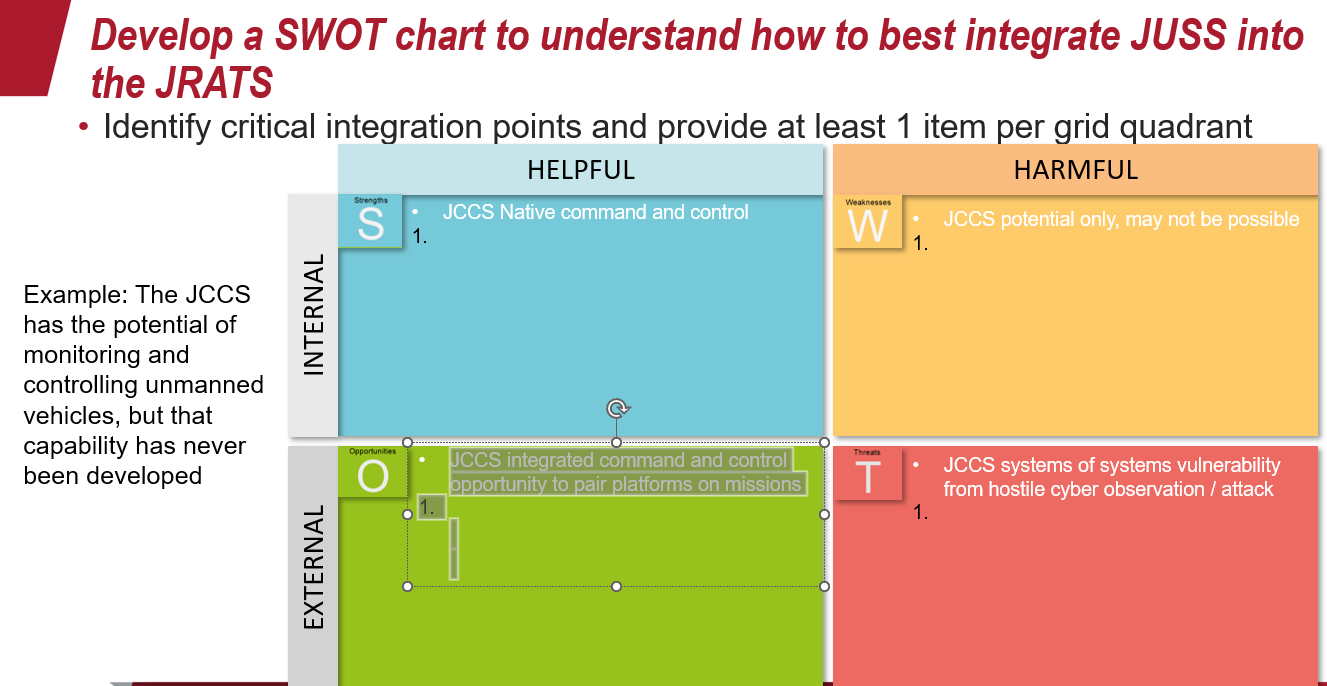
PLEASE FILL OUT THE CHART ABOVE BY READING BELOW.
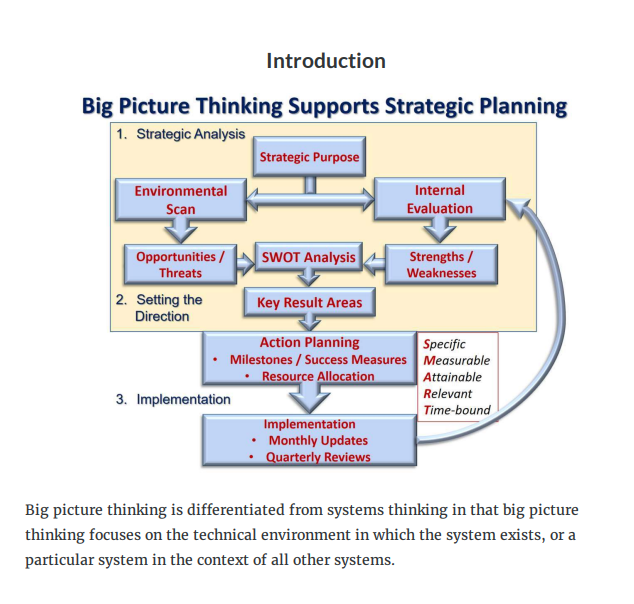
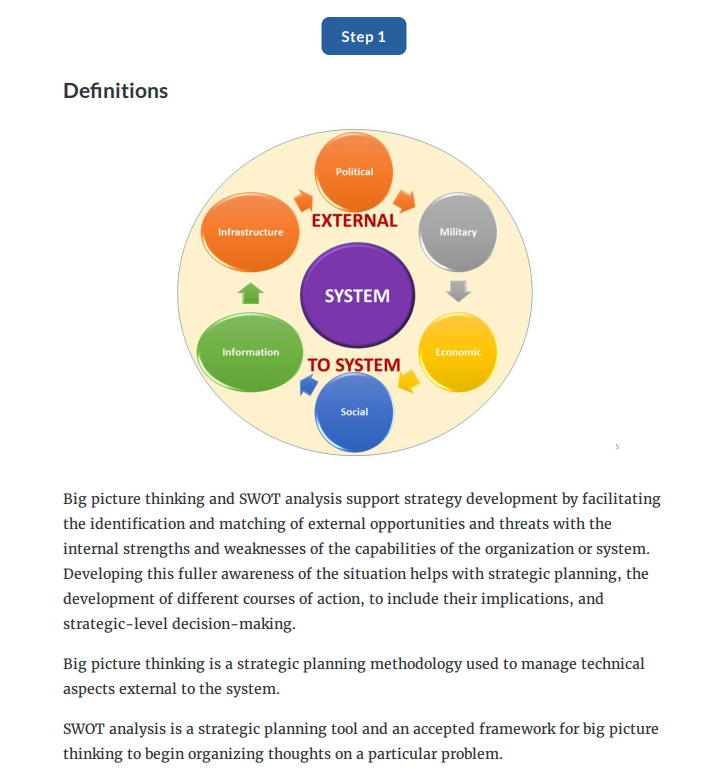
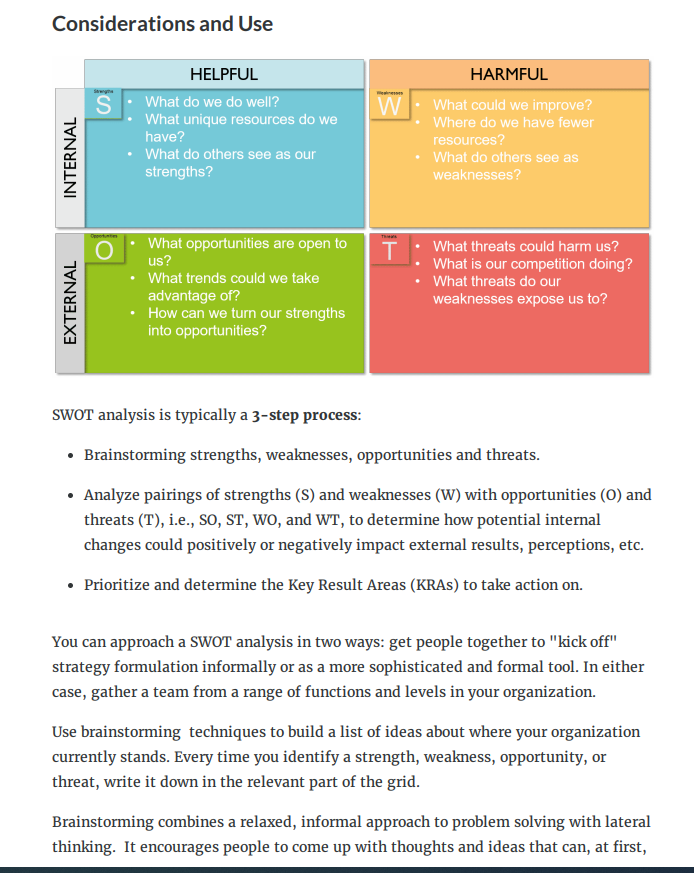
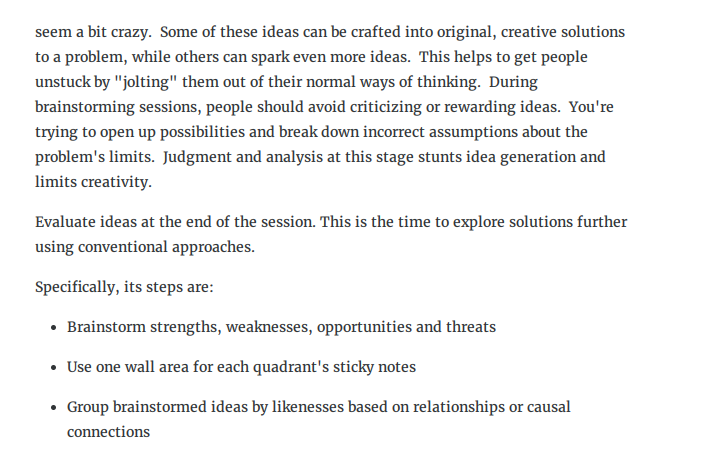
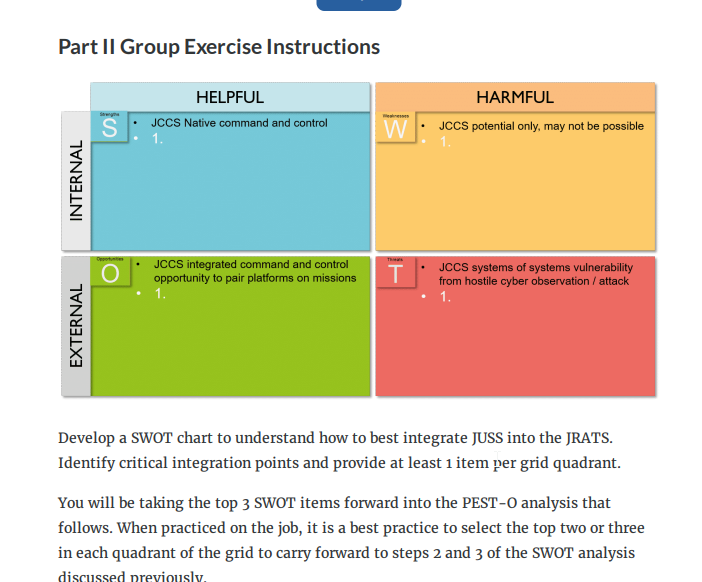
Develop a SWOT chart to understand how to best integrate JUSS into the JRATS - Identify critical intearation points and provide at least 1 item per arid auadrant Example: The JCCS has the potential of monitoring and controlling unmannec vehicles, but that capability has never been developed Bi Big picture thinking is differentiated from systems thinking in that big picture thinking focuses on the technical environment in which the system exists, or a particular system in the context of all other systems. Definitions Big picture thinking and SWOT analysis support strategy development by facilitating the identification and matching of external opportunities and threats with the internal strengths and weaknesses of the capabilities of the organization or system. Developing this fuller awareness of the situation helps with strategic planning, the development of different courses of action, to include their implications, and strategic-level decision-making. Big picture thinking is a strategic planning methodology used to manage technical aspects external to the system. SWOT analysis is a strategic planning tool and an accepted framework for big picture thinking to begin organizing thoughts on a particular problem. Considerations and Use SWOT analysis is typically a 3-step process: - Brainstorming strengths, weaknesses, opportunities and threats. - Analyze pairings of strengths (S) and weaknesses (W) with opportunities (O) and threats (T), i.e., SO, ST, WO, and WT, to determine how potential internal changes could positively or negatively impact external results, perceptions, etc. - Prioritize and determine the Key Result Areas (KRAs) to take action on. You can approach a SWOT analysis in two ways: get people together to "kick off" strategy formulation informally or as a more sophisticated and formal tool. In either case, gather a team from a range of functions and levels in your organization. Use brainstorming techniques to build a list of ideas about where your organization currently stands. Every time you identify a strength, weakness, opportunity, or threat, write it down in the relevant part of the grid. Brainstorming combines a relaxed, informal approach to problem solving with lateral thinking. It encourages people to come up with thoughts and ideas that can, at first, seem a bit crazy. Some of these ideas can be crafted into original, creative solutions to a problem, while others can spark even more ideas. This helps to get people unstuck by "jolting" them out of their normal ways of thinking. During brainstorming sessions, people should avoid criticizing or rewarding ideas. You're trying to open up possibilities and break down incorrect assumptions about the problem's limits. Judgment and analysis at this stage stunts idea generation and limits creativity. Evaluate ideas at the end of the session. This is the time to explore solutions further using conventional approaches. Specifically, its steps are: - Brainstorm strengths, weaknesses, opportunities and threats - Use one wall area for each quadrant's sticky notes - Group brainstormed ideas by likenesses based on relationships or causal connections Part II Group Exercise Instructions Develop a SWOT chart to understand how to best integrate JUSS into the JRATS. Identify critical integration points and provide at least 1 item per grid quadrant. You will be taking the top 3 SWOT items forward into the PEST-O analysis that follows. When practiced on the job, it is a best practice to select the top two or three in each quadrant of the grid to carry forward to steps 2 and 3 of the SWOT analysis
Step by Step Solution
There are 3 Steps involved in it

Get step-by-step solutions from verified subject matter experts
 Study Help