







Question: PLEASE FILL OUT THE CHART ABOVE BY READING BELOW. Apply PEST-O analysis to understand how to best integrate JUSS into the JRATS - Using the
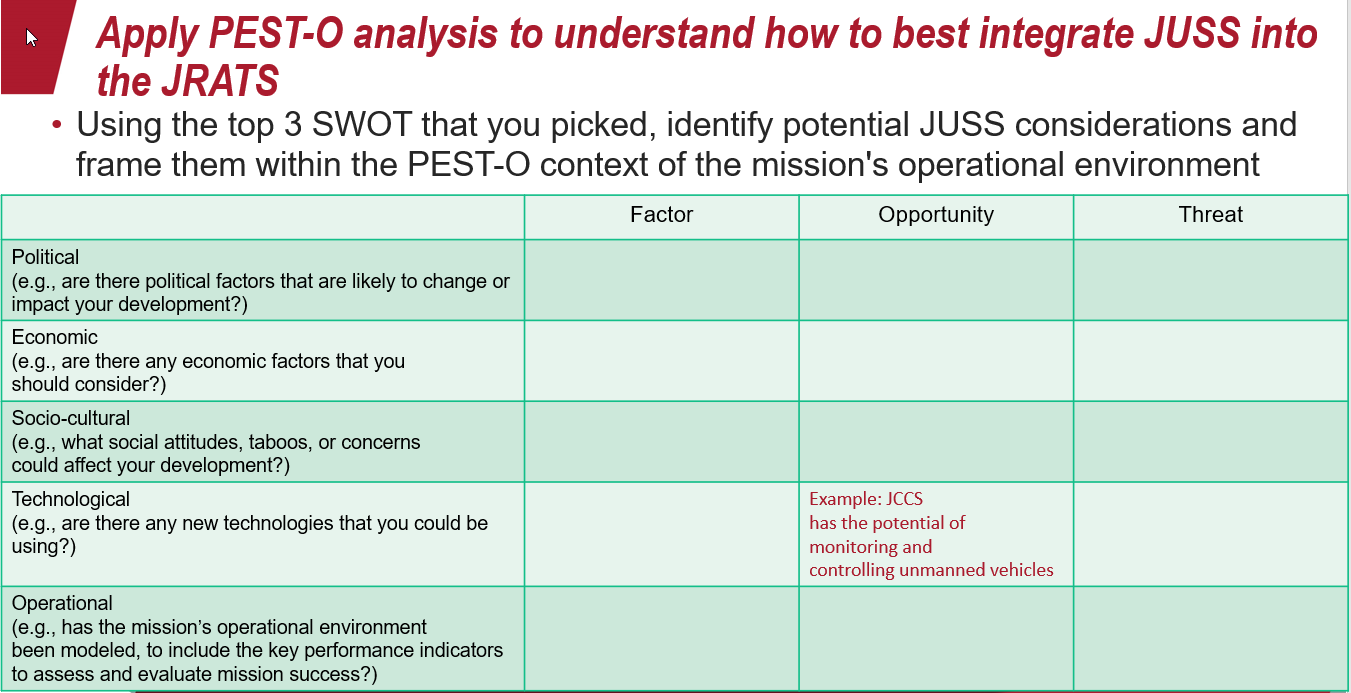 PLEASE FILL OUT THE CHART ABOVE BY READING BELOW.
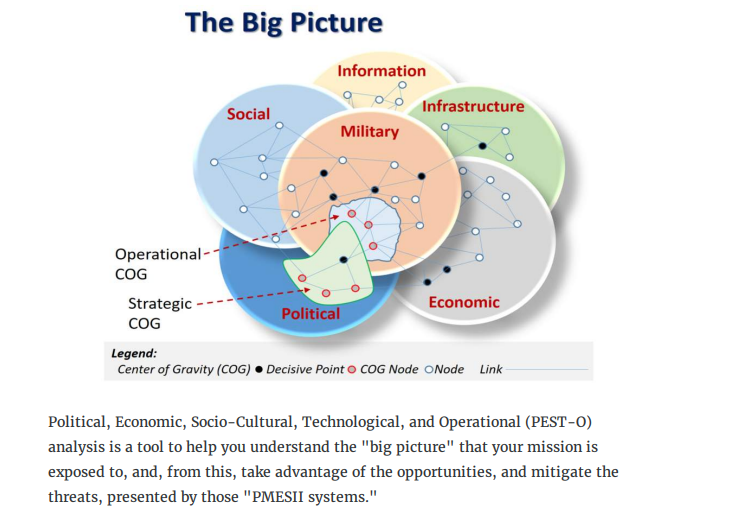
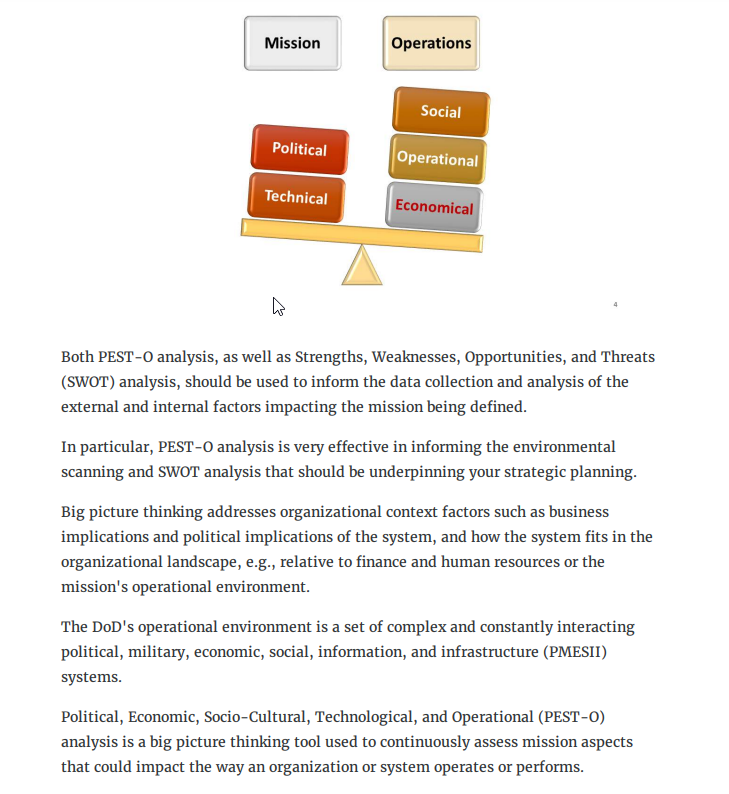
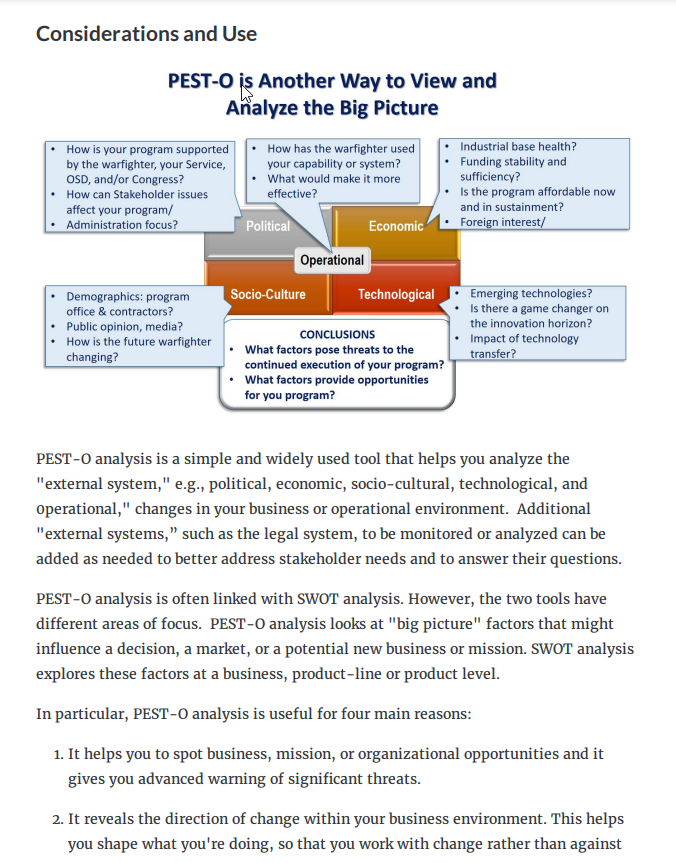
Apply PEST-O analysis to understand how to best integrate JUSS into the JRATS - Using the top 3 SWOT that you picked, identify potential JUSS considerations and frame them within the PEST-O context of the mission's operational environment The Big Picture Political, Economic, Socio-Cultural, Technological, and Operational (PEST-0) analysis is a tool to help you understand the "big picture" that your mission is exposed to, and, from this, take advantage of the opportunities, and mitigate the threats, presented by those "PMESII systems." Both PEST-O analysis, as well as Strengths, Weaknesses, Opportunities, and Threats (SWOT) analysis, should be used to inform the data collection and analysis of the external and internal factors impacting the mission being defined. In particular, PEST-O analysis is very effective in informing the environmental scanning and SWOT analysis that should be underpinning your strategic planning. Big picture thinking addresses organizational context factors such as business implications and political implications of the system, and how the system fits in the organizational landscape, e.g., relative to finance and human resources or the mission's operational environment. The DoD's operational environment is a set of complex and constantly interacting political, military, economic, social, information, and infrastructure (PMESII) systems. Political, Economic, Socio-Cultural, Technological, and Operational (PEST-O) analysis is a big picture thinking tool used to continuously assess mission aspects that could impact the way an organization or system operates or performs. PEST-O analysis is a simple and widely used tool that helps you analyze the "external system," e.g., political, economic, socio-cultural, technological, and operational," changes in your business or operational environment. Additional "external systems," such as the legal system, to be monitored or analyzed can be added as needed to better address stakeholder needs and to answer their questions. PEST-O analysis is often linked with SWOT analysis. However, the two tools have different areas of focus. PEST-O analysis looks at "big picture" factors that might influence a decision, a market, or a potential new business or mission. SWOT analysis explores these factors at a business, product-line or product level. In particular, PEST-O analysis is useful for four main reasons: 1. It helps you to spot business, mission, or organizational opportunities and it gives you advanced warning of significant threats. 2. It reveals the direction of change within your business environment. This helps you shape what you're doing, so that you work with change rather than against 3. It helps you avoid starting, or to initiate termination of, projects that are likely to fail for reasons beyond you control. It also helps you to identify the changes that are necessary for your project to remain successful in its environment. 4. It can help you break free of unconscious assumptions when you enter a new country, region, or market; because it helps you develop an objective view of this new environment. Follow these steps to analyze your environment and the opportunities and threats that it presents. 1. Use PEST-O to brainstorm the changes happening around the initiative. Use these changes to identify critical factors to guide your questioning, and tailor the questions to suit the specific needs of your mission. 2. Brainstorm opportunities arising from each of these changes. 3. Brainstorm threats or issues that could be caused by them. 4. Take appropriate action through communicating analytic results to decisionmakers
Step by Step Solution
There are 3 Steps involved in it

Get step-by-step solutions from verified subject matter experts
 Study Help