







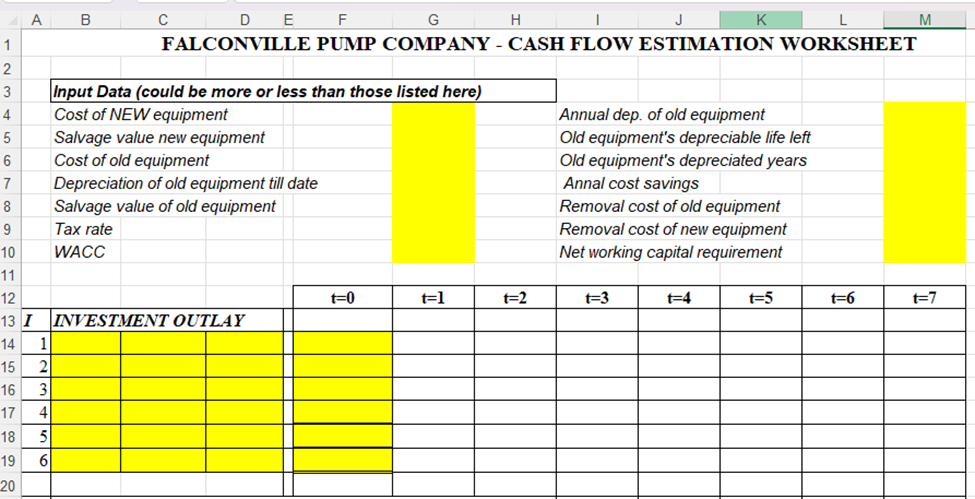
Question: Please fill out the ICAR format Excel Cash Flow Estimation Worksheet below with the data based on the provided information here: Input Data Cost of
Please fill out the ICAR format Excel Cash Flow Estimation Worksheet below with the data based on the provided information here:
Input Data
- Cost of New Equipment:
- Delivery cost: $115,000
- Installation and testing: $3,000
- Total Cost:$118,000
- Depreciation of New Equipment:
- Classified as 7-year property under MACRS.
- Depreciation rates: Year 1 = 14%, Year 2 = 25%, Year 3 = 17%, Year 4 = 13%, Year 5 = 9%, Year 6 = 9%, Year 7 = 9%, Year 8 = 4%.
- Salvage Value and Removal Costs:
- Salvage value: $8,000
- Removal costs: $1,200
- Old Equipment:
- Original cost: $48,000
- Depreciated over 6 years (straight-line).
- Depreciated for 5 years.
- Salvage value: $4,200
- Removal cost: $1,000
- Net Working Capital Requirement:
- Increase by $6,500 at t=0.
- Annual Cost Savings:
- $32,000 per year.
- Financing and Tax Information:
- Debt ratio: 30%
- Interest rate on debt: 6%
- Dividend per share (D0): $2.00
- Dividend growth rate: 5%
- Current stock price (P0): $28.00
- Tax rate: 25%
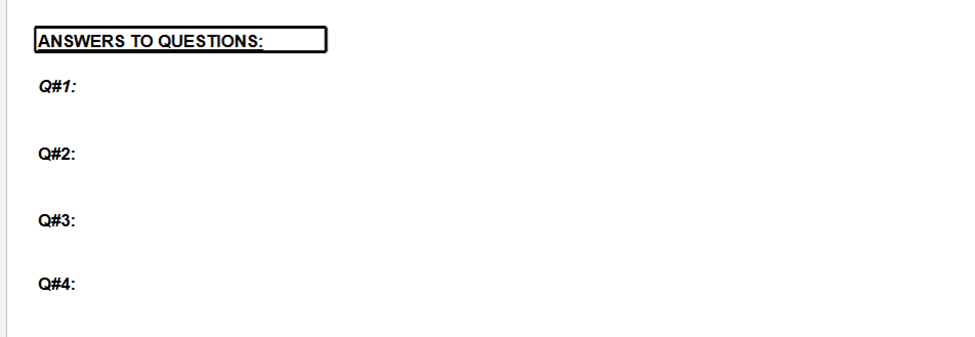
QUESTIONS
(Please provide answers to the following four questions on the attached Cash Flow
Estimation Worksheet. You should show all your work with Excel formulas/equations for
all computed numbers for Questions 1, 2 & 3, and concise and direct answers for Question
#4 on the attached Cash Flow Estimation Worksheet and answers to te tables at the bottom
of your spreadsheet, whenever applicable. NO WORK SHOWN, NO POINTS.)
1. Compute the firm's weighted average cost of capital given the info/data in the case.
What other approaches/methods can be used to measure the firm's cost of common
equity and thus its WACC? To that end, what additional info/data would you need?
(Hint: A firm's weighted average cost of capital is equal to???? =????(????)(1 - t) +????????,
where???? and???? are the weights of debt and equity in the capital structure;????and ???? are the respective costs of debt and equity; and t is the corporate tax rate; Do no round
up your WACC figure.)
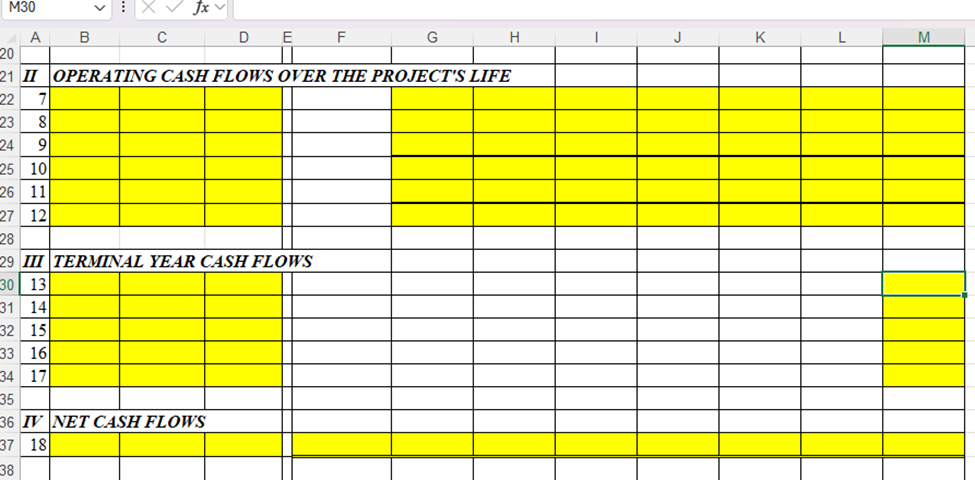
2. Develop a capital budgeting schedule using the attached Cash Flow Estimation
Worksheet (Excel spreadsheet) that should list all relevant cash flow items and
amounts related to the replacement project over the 7-year expected life of the new
pumping system. (Reference Reading: "Cash Flow Analysis Example (RIC Project)",
one of required Readings for the course.)
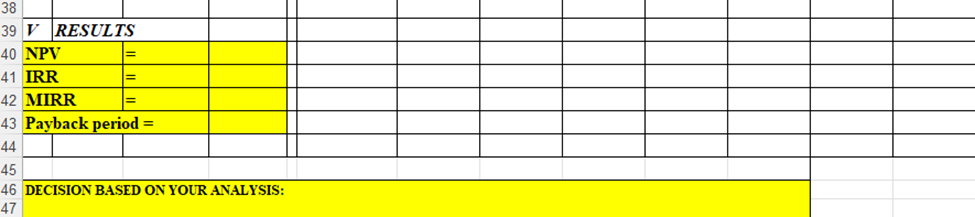
3. Based on the capital budgeting schedule, evaluate the replacement project by
computing NPV, IRR, MIRR, and Payback Period. Would you recommend to accept
or reject the replacement project based solely on your DCF analysis so far?
4. Before you make the final accept/reject decision, what other factors and approaches
would you consider further? Discuss also how to PRACTICALLY take into account
those factors and approaches in the capital budgeting decision process, whenever
applicable.
Step by Step Solution
There are 3 Steps involved in it

Get step-by-step solutions from verified subject matter experts
 Study Help