







Question: please fine the sulotion by mat lap code Closed Loop System With reference to Figure 3. Q7. Derive the transfer function of the system closed
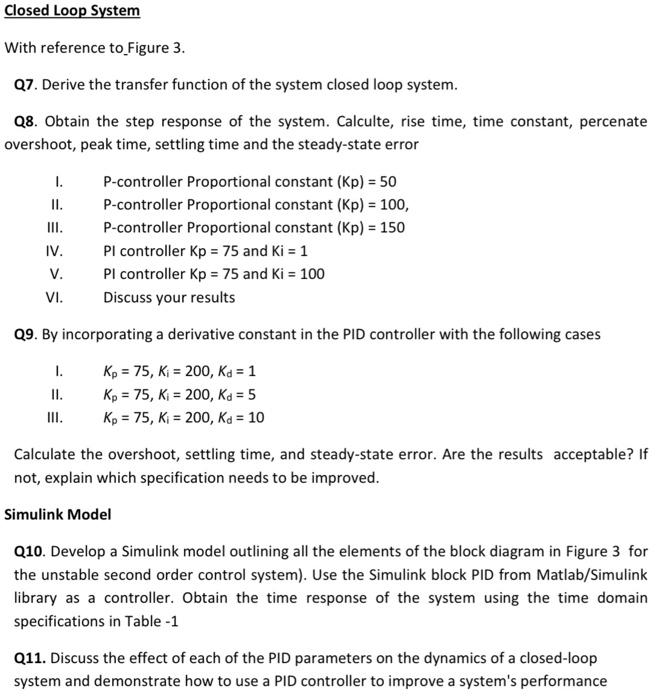

Closed Loop System With reference to Figure 3. Q7. Derive the transfer function of the system closed loop system. Q8. Obtain the step response of the system. Calculte, rise time, time constant, percenate overshoot, peak time, settling time and the steady-state error 1. P-controller Proportional constant (Kp) = 50 II. P-controller Proportional constant (Kp) = 100, III. P-controller Proportional constant (Kp) = 150 IV. Pl controller Kp = 75 and Ki = 1 V. Pl controller Kp = 75 and Ki = 100 VI. Discuss your results 29. By incorporating a derivative constant in the PID controller with the following cases 1. II. Kp = 75, K; = 200, Kd = 1 Kp = 75, K = 200, Ka = 5 Kp = 75, Ki = 200, Ka = 10 Calculate the overshoot, settling time, and steady-state error. Are the results acceptable? If not, explain which specification needs to be improved. Simulink Model Q10. Develop a Simulink model outlining all the elements of the block diagram in Figure 3 for the unstable second order control system). Use the Simulink block PID from Matlab/Simulink library as a controller. Obtain the time response of the system using the time domain specifications in Table -1 Q11. Discuss the effect of each of the PID parameters on the dynamics of a closed-loop system and demonstrate how to use a PID controller to improve a system's performance e(s) V(s) PID controller G(s) e(s) Figure 3 Closed-loop diagram Table -1 Time domain specifications. Step response characteristics Design values Settling time less than 2 seconds Overshoot less than 5% Steady-state error less than 1% The DC Motor specifications are given in Table 2. Table 2: DC Motor parameters Description Value and Unites Parameter symbols J moment of inertia of the rotor 0.01 kg.m2 b motor viscous friction constant 0.1 N.m.s electromotive force constant 0.01 V/rad/sec Kt motor torque constant 0.01 N.m/Amp R electric resistance 122 L electric inductance 0.5 H
Step by Step Solution
There are 3 Steps involved in it

Get step-by-step solutions from verified subject matter experts
 Study Help