







Question: PLEASE FULLY SOLVED AND STEP BY STEP SOLUTION (BASED ON NUMERICAL ANALYSIS LEVEL-1) 3. (a) Consider the problem, Evaluate log10(7). Suppose we use a numerical
PLEASE FULLY SOLVED AND STEP BY STEP SOLUTION (BASED ON NUMERICAL ANALYSIS LEVEL-1)
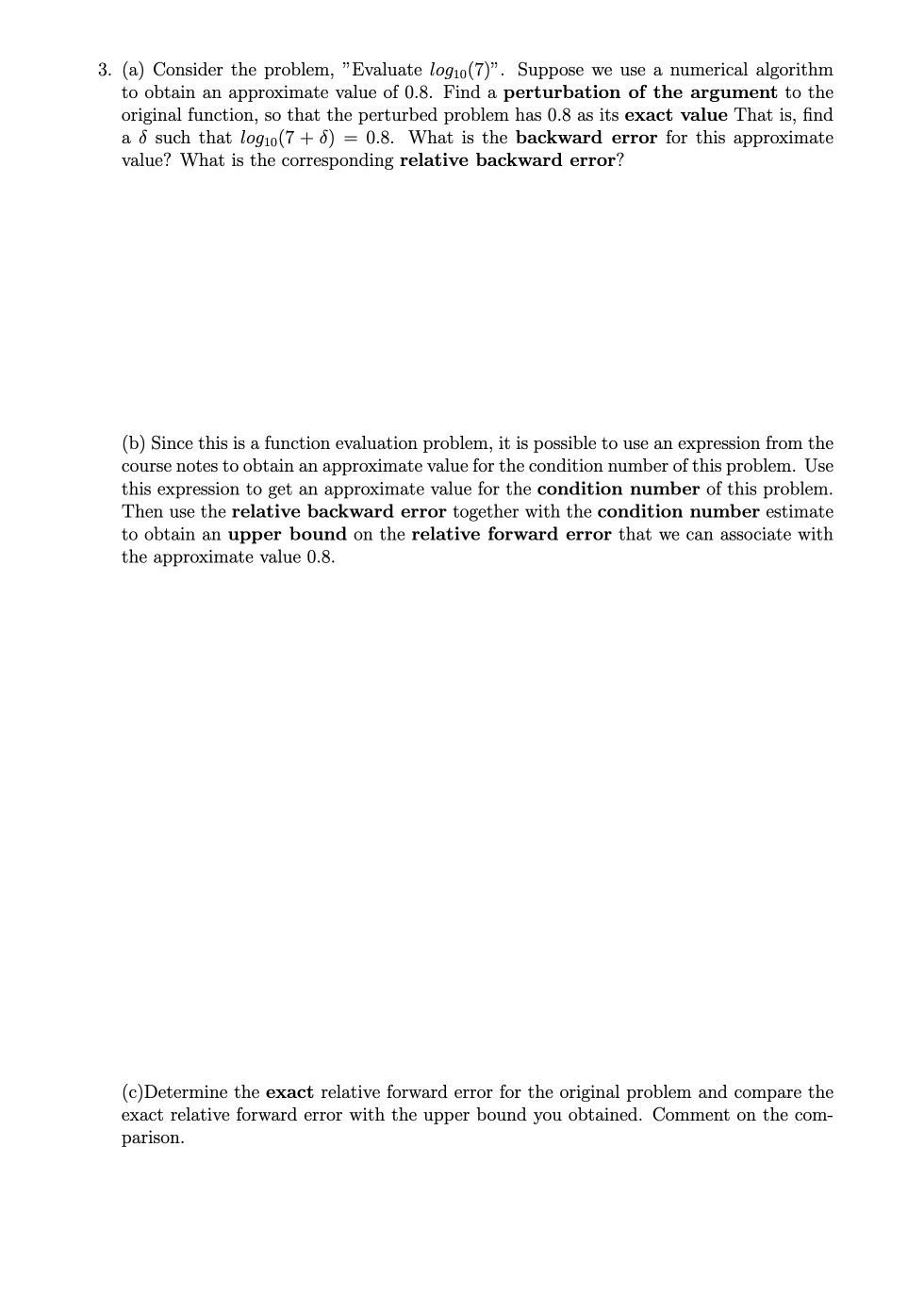
3. (a) Consider the problem, "Evaluate log10(7). Suppose we use a numerical algorithm to obtain an approximate value of 0.8. Find a perturbation of the argument to the original function, so that the perturbed problem has 0.8 as its exact value That is, find a d such that log10(7 + 8) = 0.8. What is the backward error for this approximate value? What is the corresponding relative backward error? (b) Since this is a function evaluation problem, it is possible to use an expression from the course notes to obtain an approximate value for the condition number of this problem. Use this expression to get an approximate value for the condition number of this problem. Then use the relative backward error together with the condition number estimate to obtain an upper bound on the relative forward error that we can associate with the approximate value 0.8. (c)Determine the exact relative forward error for the original problem and compare the exact relative forward error with the upper bound you obtained. Comment on the com- parison. 3. (a) Consider the problem, "Evaluate log10(7). Suppose we use a numerical algorithm to obtain an approximate value of 0.8. Find a perturbation of the argument to the original function, so that the perturbed problem has 0.8 as its exact value That is, find a d such that log10(7 + 8) = 0.8. What is the backward error for this approximate value? What is the corresponding relative backward error? (b) Since this is a function evaluation problem, it is possible to use an expression from the course notes to obtain an approximate value for the condition number of this problem. Use this expression to get an approximate value for the condition number of this problem. Then use the relative backward error together with the condition number estimate to obtain an upper bound on the relative forward error that we can associate with the approximate value 0.8. (c)Determine the exact relative forward error for the original problem and compare the exact relative forward error with the upper bound you obtained. Comment on the com- parison
Step by Step Solution
There are 3 Steps involved in it

Get step-by-step solutions from verified subject matter experts
 Study Help