Question: Please give a brief summary on this Chapter from Managing Human Resources 16edition by Bohlander and Snell. 7 Training and Development After studying this chapter,
Please give a brief summary on this Chapter from Managing Human Resources 16edition by Bohlander and Snell.

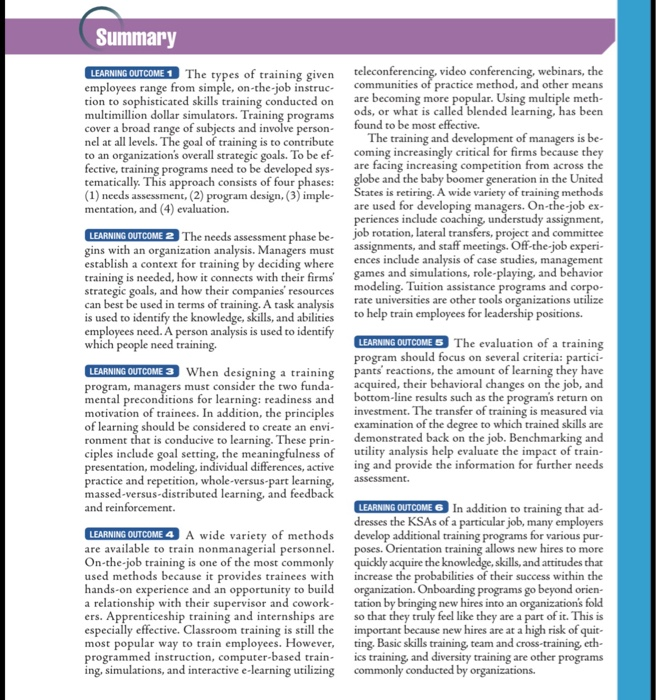
7 Training and Development After studying this chapter, you should be able to types of che conducted Summary LEARNING OUTCOME1 The types of training given teleconferencing, video conferencing, webinars, the employees range from simple, on-the-job instruc- communities of practice method, and other means tion to sophisticated skills training conducted on are becoming more popular. Using multiple meth- multimillion dollar simulators. Training programs ods, or what is called blended learning, has been cover a broad range of subjects and involve person- found to be most effective. nel at all levels. The goal of training is to contribute The training and development of managers is be- to an organization's overall strategic goals. To be ef- coming increasingly critical for firms because they fective, training programs need to be developed sys are facing increasing competition from across the tematically. This approach consists of four phases: globe and the baby boomer generation in the United (1) needs assessment, (2) program design, (3) imple States is retiring. A wide variety of training methods mentation, and (4) evaluation. are used for developing managers. On-the-job ex- periences include coaching, understudy assignment, LEARNING OUTCOME 2 The needs assessment phase be job rotation, lateral transfers, project and committee gins with an organization analysis. Managers must assignments, and staff meetings. Off-the-job experi- establish a context for training by deciding where ences include analysis of case studies, management training is needed, how it connects with their firms games and simulations, role-playing, and behavior strategic goals , and how their companies' resources modeling. Tuition assistance programs and corpo- can best be used in terms of training. A task analysis rate universities are other tools organizations utilize is used to identify the knowledge, skills, and abilities to help train employees for leadership positions. employees need. A person analysis is used to identify which people need training. LEARNING OUTCOME 5 The evaluation of a training program should focus on several criteria: partici- LEARNING OUTCOME 3 When designing a training pants' reactions, the amount of learning they have program, managers must consider the two funda acquired, their behavioral changes on the job, and mental preconditions for learning: readiness and bottom-line results such as the program's return on motivation of trainees. In addition, the principles investment. The transfer of training is measured via of learning should be considered to create an envi examination of the degree to which trained skills are ronment that is conducive to learning. These prin demonstrated back on the job. Benchmarking and ciples include goal setting, the meaningfulness of utility analysis help evaluate the impact of train- presentation, modeling, individual differences, active ing and provide the information for further needs practice and repetition, whole-versus-part learning, assessment. massed-versus-distributed learning, and feedback and reinforcement. LEARNING OUTCOME 6 In addition to training that ad- dresses the KSAs of a particular job, many employers LEARNING OUTCOME A A wide variety of methods develop additional training programs for various pur- are available to train nonmanagerial personnel. poses. Orientation training allows new hires to more On-the-job training is one of the most commonly quickly acquire the knowledge, skills, and attitudes that used methods because it provides trainees with increase the probabilities of their success within the hands-on experience and an opportunity to build organization. Onboarding programs go beyond orien- a relationship with their supervisor and cowork tation by bringing new hires into an organization's fold ers. Apprenticeship training and internships are so that they truly feel like they are a part of it. This is especially effective. Classroom training is still the important because new hires are at a high risk of quit- most popular way to train employees. However, ting. Basic skills training, team and cross-training, eth- programmed instruction, computer-based train ics training, and diversity training are other programs ing, simulations, and interactive e-learning utilizing commonly conducted by organizations









 Study Help